
China has a new product making serious waves in the United States — and it runs on artificial intelligence.
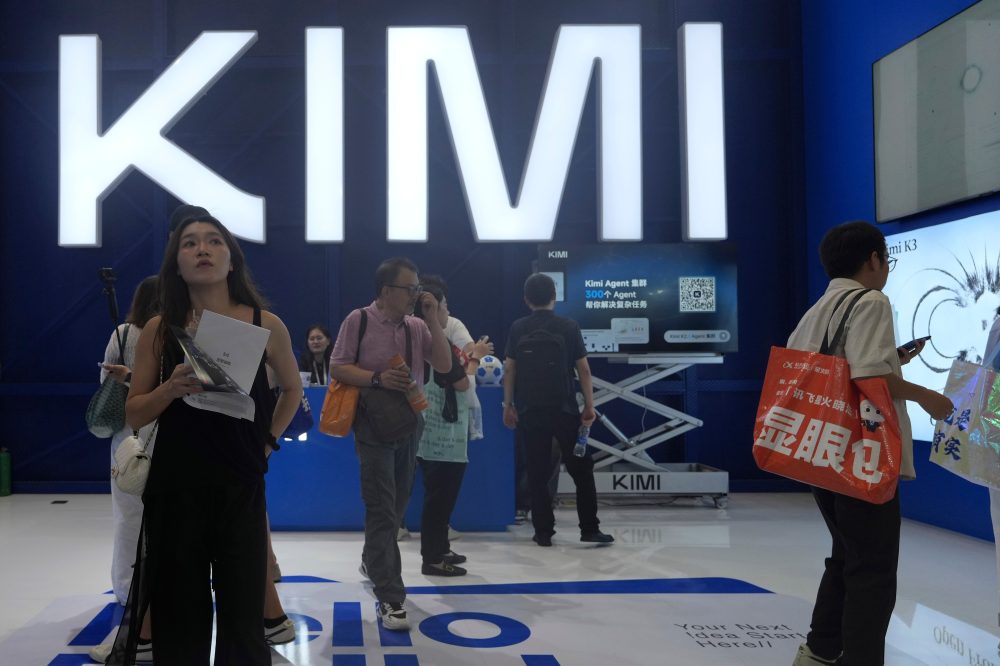
Raffi Krikorian, the chief technology officer at Mozilla, the organization behind the Firefox web browser, made the switch to a Chinese AI startup’s latest model within days of its release. Based in San Francisco, Krikorian began using Moonshot’s Kimi K3 for many of his daily tasks shortly after the model launched more than a week ago.
“It just seems snappier,” Krikorian said, comparing K3 to the well-regarded and pricier Claude Fable chatbot made by San Francisco-based company Anthropic. Before K3, Krikorian had already been relying on another Chinese model — Z.ai’s GLM-5.2 — for routine work like handling his calendar, documents, and email.
Krikorian is part of a growing wave of Americans turning to Chinese AI tools. These systems are making headway worldwide because they offer lower price points and increasingly strong performance. U.S. cryptocurrency exchange Coinbase is among the American companies that have said they are switching to Chinese AI models to cut costs.
The growing popularity of Chinese AI has frustrated some U.S. technology giants. However, absent a full ban, these tools are expected to keep attracting independent software developers in the U.S. and around the globe.
American-led restrictions already prevent China from obtaining some of the world’s most advanced technologies, including top-tier AI chips. U.S. Treasury Secretary Scott Bessent has signaled that additional sanctions could be on the way to protect American intellectual property.
The Trump administration on Wednesday accused Moonshot of using “covert” — though not necessarily illegal — methods to build K3 by drawing on Anthropic’s Fable model. Some U.S. lawmakers and AI companies, including Anthropic, have accused Chinese startups of illegally “distilling” their models to extract proprietary technology. Beijing has dismissed those claims as “groundless.”
The swift rise of advanced Chinese AI models this year marks a new chapter in the technology competition between China and the United States. The story began in earnest earlier last year, when Chinese startup DeepSeek rattled the U.S. tech industry by releasing a model that matched American systems in performance but at a fraction of the cost.
The newest models from startups Z.ai — also known as Zhipu — launched in June, and Moonshot, launched in July, are now considered nearly as capable as the leading models from OpenAI and Anthropic, according to experts. Also in July, China’s Alibaba previewed its Qwen3.8 Max AI model. Back in April, DeepSeek unveiled previews of its latest V4 model, positioning it as a direct challenge to OpenAI’s GPT and Google’s Gemini.
Those advances are translating into real-world results. Curt Meinhold, a technology executive based in Greensboro, North Carolina, said he has increasingly turned to DeepSeek for business tasks such as finding leads and identifying ways to grow sales.
“At the end of the day, most of us, the vast majority of us, 90 plus percent, don’t need (Anthropic’s) Mythos or Fable,” said Meinhold, who founded digital legacy platform LilyList. “Like, we just don’t need it, we need something good enough.”
Chinese AI models are approaching a “critical stage” for broad adoption, according to a July research report from U.S. investment bank Goldman Sachs. The report pointed to a surge in so-called “agentic” AI use — where AI systems independently carry out complex, multi-step tasks — as a key driver pushing users toward more affordable options.
Because AI pricing is calculated per million tokens for both input and output, the use of AI “agents” dramatically magnifies cost differences between models, according to analysts including Alex Colville of the Australian Strategic Policy Institute.
“The Chinese models, you know, I find them to be pretty close on code and research,” Meinhold said. “If I can pay a handful of cents per million output tokens versus 30 bucks or 40 bucks or 50 bucks, then it’s good enough.”
Over the past month, the top five most popular models on OpenRouter — a platform that tracks usage data across AI systems — were all Chinese. Data from market intelligence firm Sensor Tower showed that Kimi received more than 930,000 downloads in the week following K3’s July release, a 200% jump from the week prior. In the U.S. alone, it was downloaded roughly 86,000 times, representing a 387% increase.
K3 proved so popular that Moonshot was forced to temporarily halt new subscriptions after overwhelming demand pushed its systems close to capacity.
That said, Chinese models still trail American AI leaders when it comes to their full range of capabilities, according to Anastasios Angelopoulos, co-founder and CEO of Arena, a platform that evaluates AI systems. U.S. AI firms are also working to lower their own prices by offering cheaper versions of competitive models, noted Yasir Atalan of the Center for Strategic and International Studies.
Most Chinese AI models are open-source, meaning anyone can view and build upon them. This stands in contrast to frontier models from U.S. companies like Anthropic and OpenAI, which are closed-source. Technology research and advisory group Omdia’s Lian Jye Su said Chinese model vendors are expected to use open-source software as a tool to promote global adoption.
As Chinese open-source models grow closer in quality to the closed systems built by leading U.S. companies, Mozilla’s Krikorian observed that “the open frontier is becoming increasingly Chinese-built.” While the U.S. government weighs potential restrictions on Chinese AI models, a group of American tech firms — including Microsoft, Meta, and Nvidia — signed an open letter published Friday expressing support for “open” AI models.
Some experts say other U.S. tech policies have also inadvertently handed China an advantage. Z.ai released its GLM-5.2 model in mid-June, shortly after the Trump administration imposed export controls on Anthropic’s Fable and Mythos models, which kept them unavailable for more than two weeks.
“Restricting an American model can immediately create an opening for a Chinese competitor,” said Arena’s Angelopoulos.
Inside China, people and businesses have rapidly embraced AI, aided by strong government support. Chinese tech companies like Huawei and Tencent are embedding AI into smartphones, AI glasses, and humanoid robots. Now China is setting its sights on leading the global AI landscape as well. At a major technology summit in Shanghai, Chinese President Xi Jinping championed open-source AI and pledged Chinese involvement in expanding AI capabilities, particularly in developing nations.
As with many other Chinese industries, fierce domestic competition is pushing companies to expand internationally. Leading Chinese AI startups are raising significant new funding to support that push, including through public share offerings.
Both China and the U.S. will seek to “encourage widespread adoption of their AI ecosystems, while safeguarding technologies that could materially strengthen strategic rivals,” said Chelsey Tam of investment research firm Morningstar.
“The competition is no longer simply the United States against China; the Chinese labs are also putting a lot of pressure on one another,” Angelopoulos said.
As in the U.S., the massive spending behind Chinese AI has also raised questions about long-term financial sustainability. Z.ai, for example, reported that its revenue surged 132% to 724 million yuan (about $107 million) last year — but its net loss also jumped 60%, reaching 4.7 billion yuan (about $694 million).
For now, Chinese AI models appear poised to keep gaining ground, including in the U.S. “I would highly recommend anyone doing any serious AI load to at least evaluate it,” Krikorian said.