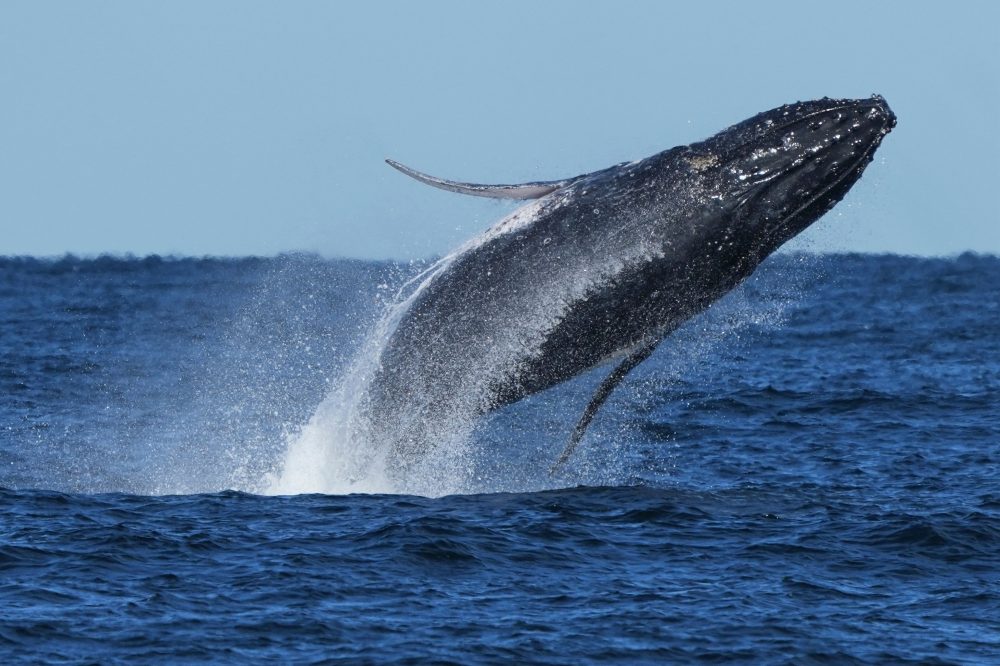

CAPE TOWN, South Africa — A South African couple had a once-in-a-lifetime experience last December when they stumbled upon a massive gathering of humpback whales off the western coast of South Africa — a so-called “supergroup” made up of nearly 300 of the enormous sea creatures.
Scientists say this kind of sighting is a powerful sign that whale populations in the southern hemisphere have made a dramatic comeback in the decades since an international ban on commercial whale hunting took effect in 1986.
Chris and Monique Fallows said they had grown accustomed to spotting increasingly large groups of humpbacks in the area, but nothing could have prepared them for what greeted them that morning. Spouts of mist and spray shot skyward from blowhole after blowhole as the couple found their boat completely surrounded by the massive animals.
“It was extraordinary,” said Chris Fallows, a well-known fine art wildlife photographer with 35 years of experience documenting marine life. “Quite quickly we realized that there must be several hundred whales coming together in one particular area.”
Fallows described the sight as resembling a “Manhattan skyline” made entirely of whale breath.
Together, Chris and Monique counted 299 individual humpbacks. Monique Fallows, an author and naturalist, explained that the couple identified each whale by photographing its tail — known as a fluke — a standard method used by scientists since every whale’s tail pattern is unique.
According to Alex Vogel, the Africa coordinator for Happywhale — an organization that maintains a global whale database using photos submitted largely by everyday people — this appears to be the largest humpback whale gathering ever recorded. Happywhale verified the Fallows’ count independently.
Data from scientists and the International Whaling Commission, which tracks global whale populations, shows that humpback numbers in the southern hemisphere have surged from fewer than 10,000 during the peak of the whaling era to more than 100,000 today.
Only a handful of countries continue to hunt whales commercially.
Humpbacks typically travel alone or in small groups, but they occasionally form these large supergroups in areas where food is plentiful. The whales feed on krill and small fish, and sightings of large gatherings are on the rise across the Southern Hemisphere.
Els Vermeulen, the chief scientist at the University of Pretoria’s Whale Unit in South Africa, said these supergroup sightings began reappearing around 2012 and are almost certainly tied to the species’ recovery from the whaling era.
“In general, the moratorium on whaling can be classified as one of the strongest conservation success stories in the marine environment,” said Vermeulen, who holds a doctorate in zoology.
She added that when humpbacks feed together in supergroups, they produce underwater sounds that draw even more whales to the area.
While humpbacks have experienced the most dramatic recovery, the World Wildlife Fund notes that results have been uneven across other whale species. Ongoing threats include entanglement in commercial fishing gear, ship strikes, and climate change. Seven of the 14 great whale species are currently listed as endangered or vulnerable by the International Union for Conservation of Nature. Among the most at-risk is the North Atlantic right whale, with only around 380 individuals remaining.
Vermeulen also flagged a growing new danger for whales near South Africa: the conflict in the Middle East. A recent preliminary assessment she co-authored found that shipping traffic around the southern tip of Africa had quadrupled since December 2023 — when the Israel-Hamas war began and Yemen’s Houthi rebels started targeting vessels in the Red Sea.
The situation has been further complicated by the Iran war and the security crisis surrounding the Strait of Hormuz, pushing even more ships to reroute around Africa.
Because most whales killed by ships sink before they can be found, there are no comprehensive statistics on vessel-strike deaths. But Gregg Oelofse, the coastal and environmental manager for the city of Cape Town, said the combination of more whales and more ships clearly raises the danger level.
He noted that some whale carcasses do wash ashore showing clear signs of being struck by vessels.
“We’ll see the propellor strike often through the whale’s body,” Oelofse said. “So, it’s like these big cuts in the whale’s body.”
Vermeulen said she and fellow researchers are pushing authorities to establish official speed limits for ships traveling near the South African coastline, which would give crews more time to spot and avoid whales in their path.