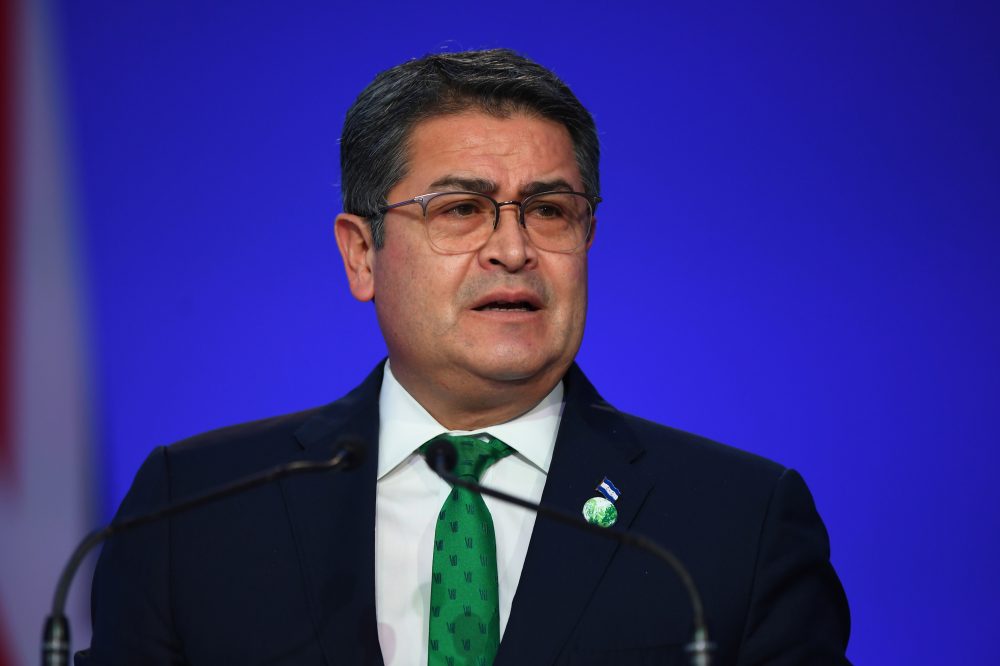

TEGUCIGALPA, Honduras — Four years after being sent to the United States to stand trial on drug trafficking charges, former Honduran President Juan Orlando Hernández is making his return to Honduras this Sunday. He now faces domestic corruption charges, though legal experts are raising serious doubts about whether justice will actually be served.
Hernández, who once enjoyed a reputation as a U.S. ally in the fight against drug trafficking, governed Honduras from 2014 to 2022. During that time, U.S. prosecutors say he boasted that he would “shove the drugs right up the noses of the gringos.”
His extradition shortly after leaving office gave many Hondurans hope — they had long feared his grip on the country’s legal system would shield him from ever being convicted on Honduran soil.
That hope was shaken when Hernández, who had been sentenced to 45 years behind bars in the United States, was freed in December after receiving a presidential pardon from U.S. President Donald Trump. Trump argued that Hernández had not received a fair trial and claimed the prosecution had been orchestrated by the Biden administration.
Now 57, Hernández is returning to face charges tied to a case known as Pandora I. According to an investigation by Honduras’s Specialized Prosecutor’s Unit Against Corruption Networks, known as UFERCO, a network of former senior officials between 2010 and 2013 allegedly participated in approving and distributing more than 288 million lempiras — roughly $10.8 million — to various foundations. UFERCO alleges Hernández personally benefited, receiving at least 62 million lempiras (about $2.3 million) for his political campaign through shell companies, straw men, and fictitious contracts.
Hernández has maintained his innocence, stating that the case “lacks any legal basis.”
In June, a judge suspended his arrest warrant and the international notice sent to Interpol, following a request from his legal team. The case remains pending, and Hernández has agreed to appear before the judge on August 3 for his arraignment.
“The moment has arrived. After four years, I can finally tell you that we will see each other again,” Hernández said in a video he shared on social media.
Since his release, Hernández has spoken about wanting to reunite with his wife, Ana García, and their children. The family’s U.S. visas are currently suspended.
Human rights lawyer and researcher Joaquín Mejía, of the organization Reflection, Research and Communication Team, expressed deep concern about what the return means for justice in Honduras.
“There is a social majority that is outraged, but doesn’t speak out because of fear,” Mejía said. “We’re talking about the boss of all drug bosses.”
Mejía also warned that the outcome of the case is likely already predictable, pointing to other high-ranking officials implicated in Pandora I whose cases have been thrown out.
“Everything points to the suspension being the first step,” he said. “He’ll come, they’ll likely issue him alternative measures to imprisonment to keep up appearances, and then he’ll end up without any problem, without any sanction.”
Luis Javier Santos, the former head of UFERCO who led the investigation into Hernández, views the former president’s return not as an opportunity for justice, but as a sign that accountability has failed. Santos was removed from his position at UFERCO in February — a move he believes reflects the new government’s efforts to undermine anti-corruption work. The current administration is led by Nasry Asfura, of Hernández’s National Party, which took office in January after receiving backing from Trump during the elections.
“We have gone backward to an even worse point than when all the work to fight corruption began,” Santos said.