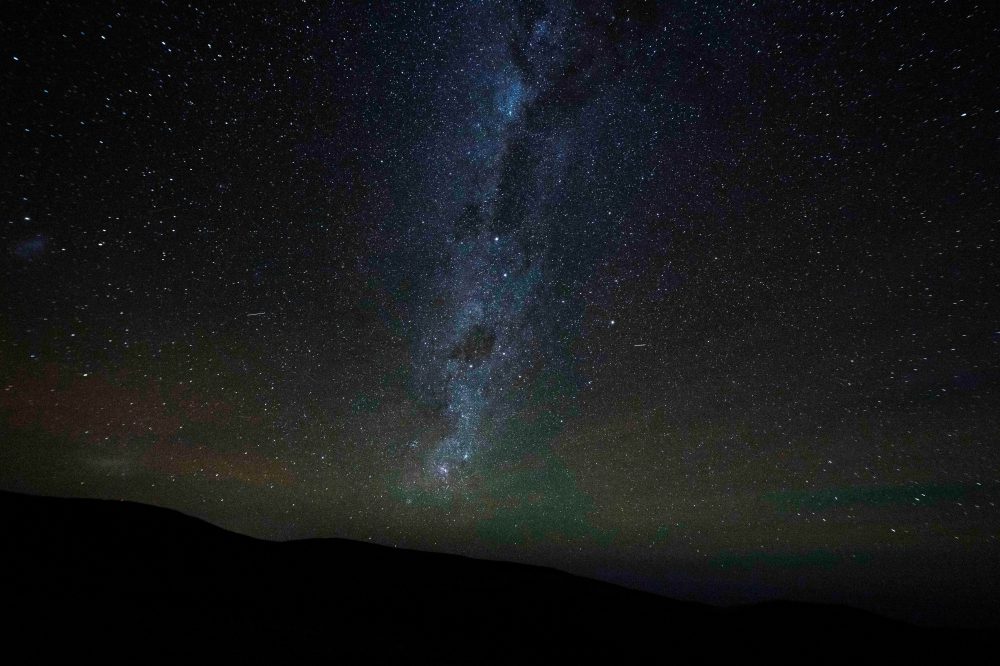

Your eyes need time to adapt to the complete darkness. Gradually, tiny points of light begin to emerge, followed by brighter celestial objects. Within moments, entire star formations become visible, and eventually, you can observe an entire galaxy with nothing but your natural vision.
Chile’s Atacama Desert offers visitors an seemingly endless view of the night sky. Known as Earth’s most arid region, this location also provides one of the clearest views into space available anywhere on the planet.
The desert’s exceptional combination of minimal rainfall, elevated terrain, and most importantly, distance from city lights has established it as an unmatched center for cutting-edge astronomy and the location of the planet’s largest ground-based telescope installations.
“The conditions in the Atacama Desert are unique in the world,” said Chiara Mazzucchelli, president of the Chilean Astronomical Society. “There are more than 300 clear nights per year, meaning no clouds and no rain.”
However, these pristine dark skies now face potential danger.
In the previous year, the desert became the center of a conflict between researchers and an energy company planning a renewable power facility mere kilometers from the Paranal Observatory. The European Southern Observatory manages this location, which will also house what’s planned to be the most advanced optical telescope ever constructed.
While the energy development was scrapped in January after widespread opposition from astronomers, physicists and Nobel Prize winners, the incident highlighted serious worries that current sky protection legislation is insufficient, obsolete and ambiguous. Multiple environmental rules have since undergone examination, including regulations from Chile’s science ministry covering designated astronomical protection areas.
“We are working to ensure the new criteria are strict enough to guarantee that there will be no impact on astronomical areas,” said Daniela González, director of the Cielos de Chile Foundation, a nonprofit founded in 2019 to protect the quality of Chile’s night skies.
The Associated Press conducted a three-day visit to the Paranal installations located within the region known as Photon Valley. Within this elevated corridor, multiple observatories function together utilizing some of the most advanced scientific equipment ever developed.
“Many of these large facilities are located in Chile, and ESO’s telescopes in particular are the most powerful astronomical facilities on the planet,” said Itziar de Gregorio-Monsalvo, the intergovernmental organization’s representative in Chile.
Paranal represents just one of almost 30 astronomical locations throughout northern Chile, with most operated by international organizations. Each year, the Atacama Desert attracts thousands of astronomers and researchers from across the globe who come to study how the universe began.
“We are lucky to be here,” said Julia Bodensteiner, an assistant professor at University of Amsterdam, noting that the chances of being selected as a visiting astronomer at Paranal are just 20% to 30%.
Navigating the Atacama’s rough, irregular landscape presents significant challenges. At elevations above 3,000 meters (10,000 feet), breathing becomes difficult, while extreme daytime heat transitions to bitter nighttime cold. However, for astronomical observation and research, these more than 105,000 square kilometers (40,500 square miles) of desert provide ideal conditions.
The remarkable environment of the Atacama has made possible some of the most ambitious space research projects ever planned, including the Extremely Large Telescope, ELT — a $1.5 billion project by ESO set for completion in 2030.
Featuring 798 mirrors and a light-collecting surface of nearly 1,000 square meters (a quarter of an acre), the ELT will deliver 20 times more power than current leading telescopes and provide 15 times greater clarity than NASA’s Hubble Space Telescope.
The information gathered at these observatories serves a crucial purpose not just for understanding life on Earth, but also for exploring possibilities of life beyond our world. Protecting these research locations remains vital.
Using the ELT, said ESO astronomer Lucas Bordone, “we should be able to see Earth-like planets in what we call the habitable zone, so basically the planets which are candidates towards life.”
Two decades ago, the Atacama Desert represented “an ocean of darkness,” recalled Eduardo Unda-Sanzana, director of the Astronomy Center at the University of Antofagasta. “It was just you and the universe.”
Through the years, the environment has undergone dramatic transformation.
Fueled by expanding cities, industrial growth, and the establishment of mining operations and wind energy installations, the desert has become highly sought-after land where finding balance proves challenging.
At Paranal, researchers live underground in specially designed quarters built to minimize their environmental footprint. Windows must stay blocked, corridors remain unlit, and any outdoor activity relies solely on flashlights. Even minimal artificial light can disrupt telescope operations.
Last year’s announcement of a planned green energy development created alarm throughout the global scientific community. Researchers urged officials to safeguard Chile’s dark skies from the proposed location, planned for construction just 10 kilometers (6 miles) from Paranal.
The situation raised concerns about various negative effects, including additional light pollution, small vibrations and dust particles, plus increased air turbulence. Such conditions would render astronomical research impossible.
“If you place the ELT next to a city, it doesn’t matter that its diameter is 40 meters long. It’s just the same as having a tiny telescope,” Gregorio-Monsalvo said.
Even though the company withdrew the project in late January, researchers caution that without updated, stronger regulations, similar developments could emerge at any time.
“Despite all the media hype in 2025, we find ourselves exactly where we were last year,” said Unda-Sanzana, who is also part of a ministerial advisory commission that recently delivered recommendations to Chile’s government following the incident.
Historical examples abound. Chile’s first international solar observatory — a major solar research station run by the U.S. Smithsonian Institution in the early 1900s — was compelled to cease operations in 1955 because of environmental contamination from expanding mining operations nearby.
“We’ve had 70 years to learn from history and avoid repeating those same mistakes,” Unda-Sanzana said.