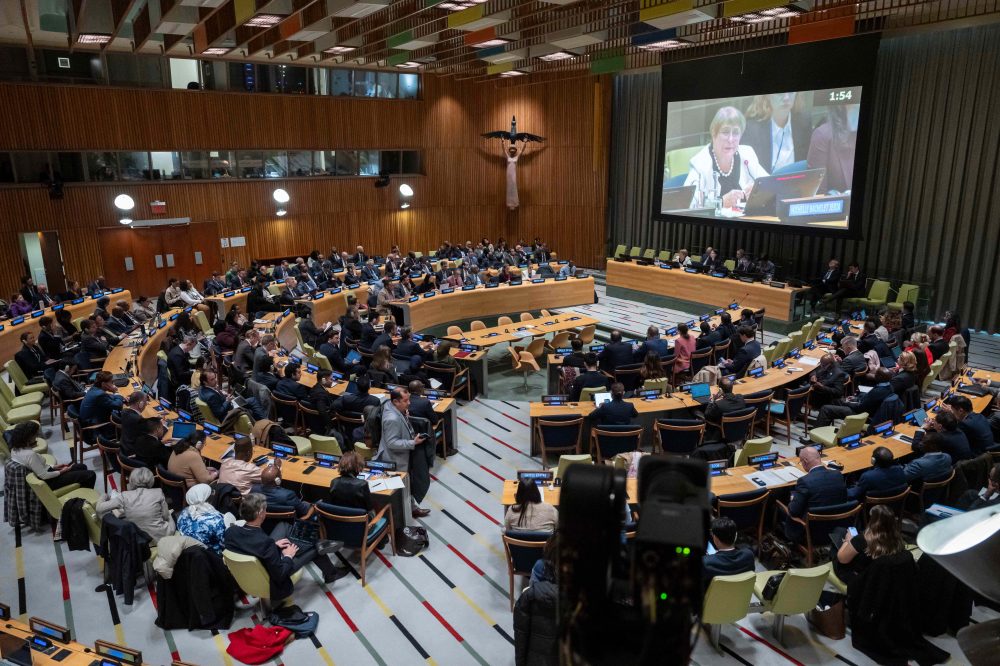

NEW YORK — Four international leaders endured intensive questioning sessions at United Nations headquarters this week as they compete for what officials described as one of the world’s most challenging job interviews.
The candidates seeking to replace Secretary-General António Guterres when his term ends January 1 include former Chilean President Michelle Bachelet, Argentina’s Rafael Grossi, Costa Rica’s Rebeca Grynspan, and former Senegalese President Macky Sall. None emerged as a clear frontrunner following their appearances before UN ambassadors.
Additional contenders may still enter the competition after these initial presentations conclude.
General Assembly President Annalena Baerbock, who oversaw the questioning sessions, emphasized the position’s significance. “The secretary-general is not only the head of the U.N. and the world’s top diplomat — she or he also represents all 8 billion of us, defending the U.N. Charter and leading on peace, development, human rights,” Baerbock stated.
Each candidate committed to strengthening the UN’s core mission areas, particularly its post-World War II mandate to maintain international peace and security — a goal that has proven elusive amid ongoing conflicts in Iran, Gaza, Ukraine, Sudan and elsewhere due to deep international divisions. All four also promised institutional reforms for the organization.
Bachelet, 74, who previously served twice as Chile’s president and led the UN human rights office, emphasized crisis prevention and leadership skills during her presentation. “I stand before you to reclaim the urgent need for dialogue,” she declared, arguing the UN must anticipate, prevent and unite. She also stressed that the next leader should maintain “physical presence in the field” when addressing global challenges.
Grossi, 65, currently heads the International Atomic Energy Agency after a career in Argentine diplomacy. He acknowledged widespread skepticism about the UN’s effectiveness in today’s polarized world. “There are enormous, huge doubts about our institution” in solving global problems, he noted. Without strong leadership and universal support, the organization cannot “regain a key place at the table,” he argued, also advocating for direct engagement in crisis zones.
Grynspan, 65, leads the UN trade and development agency and previously served as Costa Rica’s vice president. She highlighted her ability to maintain principles under pressure and promised to “continue to be the moral voice and the impartial voice that the secretary-general has to be.” She criticized the UN as having become “a risk-conservative organization,” declaring: “We need to take more risks — and I am ready to fail and try again.”
Sall, 64, completed 12 years as Senegal’s president and called for the UN to “regain its place at the global table.” He positioned himself as “a bridge-builder” whose primary goal would be “to contribute to restoring trust, to calm tensions, reduce fragmentation and breathe renewed hope into our collective action.”
Bachelet, a physician by training, addressed criticism from 28 Republican US lawmakers who labeled her a “pro-abortion zealot” and urged Secretary of State Marco Rubio to oppose her candidacy. She acknowledged the controversy while defending women’s reproductive rights and pledged to advance existing UN member agreements, including gender equality initiatives.
Regional rotation traditionally influences secretary-general selection, with Latin America expected to provide the next leader. Sall, the sole non-Latin American candidate, argued the UN Charter permits any candidacy and noted that following a leader from the global north — Guterres is Portuguese — the position should shift to the global south. His candidacy sparked both supportive and opposing demonstrations outside UN headquarters, and he has faced corruption allegations, which he denies.
Daniel Forti from the International Crisis Group observed that the candidates “tried to walk a political tightrope.” He noted: “It is not immediately obvious whether any candidate did enough to propel themselves ahead of the others, or to ward off potential challengers who might emerge later.”
The 15-member UN Security Council will make the selection, with particular influence from the five permanent members holding veto power — the United States, Russia, China, United Kingdom and France — who have remained silent about their preferences. The 193-member General Assembly must provide final approval.
Minh-Thu Pham, who advised former UN chief Kofi Annan and now leads the Starling Institute, identified widespread desire for a secretary-general willing to take risks and actively promote peace. The UN lacks influence in major crises “because it hasn’t had the courage to take risks,” she explained.
Susana Malcorra, Argentina’s former foreign minister and a 2016 secretary-general candidate, emphasized that the United Nations “more than ever” requires fresh leadership and energy. Her organization, GWL Voices, advocates for selecting a woman as the next UN chief.