A Dense Fog Advisory is in effect across the Delmarva Peninsula and surrounding areas until 10 PM tonight, with visibility dropping to just one quarter mile or less in some locations.
The National Weather Service issued the advisory at 4:04 PM, warning residents that hazardous driving conditions are expected throughout the evening hours. Locally, the advisory covers all of Delaware including New Castle, Kent, and Sussex counties, as well as the Delaware beaches. In Maryland, the Eastern Shore counties of Kent, Queen Anne’s, Talbot, Caroline, and Somerset are also under the advisory.
The thick fog is creating dangerous travel conditions across the region, particularly on highways and rural roads where visibility can change rapidly.
Drivers are urged to exercise extreme caution if they must travel tonight. The National Weather Service recommends slowing down significantly, using headlights, and maintaining extra distance between vehicles. Consider delaying non-essential travel until conditions improve.
The fog is expected to gradually lift and dissipate by late evening, with the advisory set to expire at 10 PM. Motorists should continue monitoring local conditions and drive according to visibility, as fog can be patchy and unpredictable.
Stay with TV Delmarva for continued weather updates throughout the evening.
A Dense Fog Advisory is in effect across the Delmarva Peninsula and surrounding regions until 10 PM tonight, creating hazardous driving conditions with visibility reduced to just a quarter mile or less.
The National Weather Service issued the advisory at 4:04 PM, warning residents across Delaware, the Eastern Shore of Maryland, and parts of New Jersey and Pennsylvania to exercise extreme caution on the roads. All three Delaware counties – New Castle, Kent, and Sussex – are under the advisory, along with Maryland’s Kent, Queen Anne’s, Talbot, Caroline, and other Eastern Shore counties.
“Low visibility could make driving conditions hazardous,” warns the Weather Service. Motorists are strongly advised to slow down, use headlights, and maintain extra distance between vehicles during the evening commute.
The thick fog has settled across much of the Mid-Atlantic region, affecting major highways and local roads throughout the Peninsula. Delaware beaches and coastal areas are experiencing some of the densest conditions.
Drivers should consider delaying non-essential travel if possible. If you must drive, remember to use low-beam headlights – high beams can actually reduce visibility in fog by reflecting light back toward you.
The advisory is expected to expire at 10 PM as atmospheric conditions improve overnight.
A Dense Fog Advisory remains in effect across the Delmarva Peninsula and surrounding regions until 10 PM tonight, with visibility dropping to a quarter mile or less in some areas.
The National Weather Service issued the advisory at 4:04 PM, warning drivers of hazardous conditions across Delaware, Maryland’s Eastern Shore, and portions of New Jersey and Pennsylvania. All three Delaware counties – New Castle, Kent, and Sussex – are experiencing the dense fog conditions, along with Maryland’s Kent, Queen Anne’s, Talbot, Caroline, and Sussex counties.
The thick fog is creating dangerous driving conditions throughout the region, prompting safety officials to urge extra caution on roadways. Motorists should reduce speed significantly, turn on headlights, and maintain increased following distances.
“Low visibility could make driving conditions hazardous,” warns the Weather Service advisory.
The fog is expected to gradually lift this evening, with conditions improving after 10 PM. However, patchy fog may persist in some low-lying areas overnight.
Drivers are encouraged to avoid unnecessary travel during peak fog hours and consider delaying trips until visibility improves. Those who must travel should use low-beam headlights and avoid using high beams, which can reflect off the fog and further reduce visibility.
A Dense Fog Advisory is in effect across the Delmarva Peninsula until 10 PM tonight, creating hazardous driving conditions with visibility dropping to just one quarter mile or less.
The National Weather Service issued the advisory at 4:04 PM, warning residents across Delaware, Maryland’s Eastern Shore, and portions of southern New Jersey and eastern Pennsylvania to exercise extreme caution on the roads.
Locally, the advisory covers all of Delaware including New Castle, Kent, and Sussex counties, as well as Delaware’s beaches. On Maryland’s Eastern Shore, Kent, Queen Anne’s, Talbot, Caroline, and Dorchester counties are all under the advisory.
“Low visibility could make driving conditions hazardous,” according to the National Weather Service.
If you must travel this evening, officials strongly recommend slowing down, using your headlights, and leaving plenty of distance between you and other vehicles. Even familiar routes can become dangerous in these conditions.
The dense fog is expected to gradually lift as we move through the evening hours, with conditions improving after 10 PM. Motorists should continue monitoring visibility conditions and avoid unnecessary travel until the advisory expires.
Stay with TV Delmarva for continued weather updates throughout the evening.
In a heart-stopping finish at the Jones Center in Wilmington, Goldey-Beacom College men’s basketball team defeated Georgian Court 88-87 in the Central Atlantic Collegiate Conference Tournament quarterfinals.
The Lightning were led by sophomore guard Tre Powell from Mount Laurel, New Jersey, who equaled his personal best performance with 33 points. However, it was junior Julian Williams from Fayetteville, North Carolina, who played the role of hero, sinking the decisive basket with only 26 seconds remaining on the clock.
The intense matchup showcased the competitive nature of CACC tournament play, with both teams battling until the final moments. The narrow one-point margin of victory highlighted just how evenly matched the two squads were throughout the contest.
Goldey-Beacom’s triumph advances them further in the conference tournament, keeping their postseason hopes alive with this dramatic quarterfinal win on their home court in Wilmington.
Thick fog is blanketing much of the Delmarva Peninsula this evening, prompting the National Weather Service to issue a Dense Fog Advisory until 10 PM tonight.
Visibility has dropped to just a quarter mile or less across the region, creating hazardous driving conditions. The advisory affects all of Delaware, including New Castle, Kent, and Sussex counties, as well as the Delaware beaches. On Maryland’s Eastern Shore, Queen Anne’s, Talbot, Caroline, and Sussex counties are also experiencing the dense fog conditions.
The National Weather Service warns that the severely reduced visibility could make travel dangerous, particularly on highways and rural roads where drivers may not see vehicles, pedestrians, or obstacles until it’s too late to react safely.
Motorists are urged to take extra precautions if they must travel this evening. Officials recommend slowing down significantly, using headlights even during daylight hours, and maintaining extra distance between vehicles. Consider delaying non-essential travel until conditions improve.
The fog advisory is expected to expire at 10 PM tonight as atmospheric conditions change. However, patchy fog may linger in some low-lying areas into the overnight hours. Stay tuned to TV Delmarva for the latest weather updates.
The University of Maryland Eastern Shore Hawks baseball squad posted their most productive offensive showing of the season on Wednesday, crossing home plate 11 times in a midweek contest against Siena, though it wasn’t enough to secure victory.
Despite the disappointing result, the Hawks found a bright spot in freshman Diego Alicea’s performance at the plate. The rookie achieved a personal milestone by collecting multiple hits in a single game for the first time in his college career.
The 11-run output marked the team’s highest-scoring effort through the early portion of the season, demonstrating the Hawks’ offensive potential even in defeat. The strong showing at the plate could provide momentum as the team continues its campaign.
Alicea’s breakthrough performance highlights the development of young talent on the Hawks roster as they work to establish consistency throughout the lineup in the weeks ahead.
Drivers across the Delmarva Peninsula and surrounding areas are being urged to exercise extreme caution this evening as dense fog continues to create hazardous travel conditions with visibility dropping to just one quarter mile or less.
The National Weather Service has issued a Dense Fog Advisory affecting all of Delaware, including New Castle, Kent, and Sussex counties, as well as the Delaware beaches. The advisory also covers portions of Maryland’s Eastern Shore, including Queen Anne’s, Talbot, Caroline, and Somerset counties.
The thick fog blanket extends beyond our immediate viewing area into parts of New Jersey and Pennsylvania, creating widespread visibility issues across the mid-Atlantic region.
Motorists are strongly advised to reduce speed, turn on headlights, and maintain extra following distance while driving in these conditions. The fog is expected to create particularly dangerous situations on highways and rural roads where visibility can change rapidly.
The Dense Fog Advisory remains in effect until 10 PM tonight. Weather officials expect conditions to gradually improve as we head into the overnight hours.
Stay with TV Delmarva for continued weather updates and drive safely if you must travel this evening.
A Dense Fog Advisory is in effect across the entire Delmarva Peninsula this evening, with visibility dropping to just a quarter mile or less in some areas.
The National Weather Service issued the advisory at 4:04 PM and it remains in effect until 10:00 PM tonight. The thick fog is impacting all of Delaware, including New Castle, Kent, and Sussex counties, as well as the Delaware beaches. On Maryland’s Eastern Shore, Queen Anne’s, Talbot, Caroline, and Sussex counties are all experiencing hazardous driving conditions.
The dense fog extends well beyond our immediate viewing area, affecting portions of New Jersey, Pennsylvania, and northern Delaware as driving becomes treacherous on major roadways including Routes 1, 13, and 50.
Motorists are urged to exercise extreme caution if travel is necessary. The National Weather Service recommends slowing down significantly, using headlights, and leaving extra distance between vehicles. Consider delaying non-essential travel until conditions improve.
Visibility is expected to gradually improve as we head into the late evening hours. Stay tuned to TV Delmarva for continued weather updates and check our website for the latest road conditions before heading out tonight.
The National Weather Service has issued a Dense Fog Advisory for the entire Delmarva Peninsula and surrounding areas, warning of dangerous driving conditions through 10 PM tonight.
Visibility has dropped to one quarter mile or less across portions of Delaware, the Eastern Shore of Maryland, southern New Jersey, and southeastern Pennsylvania. The thick fog is creating hazardous travel conditions on local roads and highways.
Locally, the advisory affects all of Delaware including New Castle, Kent, and Sussex counties, along with the Delaware beaches. On Maryland’s Eastern Shore, Kent, Queen Anne’s, Talbot, Caroline, and Sussex counties are under the advisory. The fog is also impacting portions of southern New Jersey and southeastern Pennsylvania.
Drivers are urged to exercise extreme caution if they must travel. The National Weather Service recommends slowing down, using headlights, and maintaining extra distance between vehicles. Consider delaying non-essential travel until visibility improves.
The Dense Fog Advisory remains in effect until 10 PM this evening. Conditions should gradually improve as we move through the evening hours.
Stay with TV Delmarva for the latest weather updates and travel conditions across the peninsula.
The University of Maryland Eastern Shore women’s golf team secured a fifth-place finish at the Howard Invitational tournament, with standout player Bushra Fatima delivering an impressive individual performance that landed her in the top ten.
The Hawks competed against multiple teams in the invitational event hosted by Howard University, where Fatima’s strong showing helped anchor the team’s overall result.
The fifth-place team finish represents a solid outing for the UMES women’s golf program as they continue their competitive season. Fatima’s top-ten individual placement highlights her consistent play and contribution to the Hawks’ golf efforts.
Three University of Maryland Eastern Shore men’s volleyball standouts have earned Northeast Conference weekly recognition after leading their team to a perfect start in conference competition.
Mills, Valentine, and Rowley claimed all three NEC weekly honors following the Hawks’ unblemished 2-0 record to begin their conference schedule. The trio’s exceptional performances helped propel UMES to victory in both of their opening NEC matchups.
The sweep of weekly awards marks a significant achievement for the Hawks volleyball program as they establish momentum early in conference play. The recognition highlights the depth of talent on the UMES roster and their strong preparation for the conference season.
With this promising start to NEC competition, the Hawks appear well-positioned for continued success as the conference schedule progresses.
Drivers across the Delmarva Peninsula are facing hazardous conditions this evening as dense fog blankets the region, reducing visibility to just a quarter mile or less in many areas.
The National Weather Service issued a Dense Fog Advisory at 4:04 PM today, affecting all three Delaware counties—New Castle, Kent, and Sussex—including the Delaware beaches. The advisory also covers portions of Maryland’s Eastern Shore, including Queen Anne’s, Talbot, Caroline, and Sussex counties.
“Low visibility could make driving conditions hazardous,” warns the National Weather Service. The thick fog is expected to persist until 10 PM tonight.
Motorists are urged to exercise extreme caution if they must travel. Officials recommend slowing down significantly, using headlights even during daylight hours, and maintaining extra distance between vehicles. Consider delaying non-essential travel if possible.
The fog advisory extends beyond Delmarva into parts of New Jersey and Pennsylvania, creating a widespread weather event across the mid-Atlantic region.
Conditions should gradually improve after 10 PM as the advisory expires. Drivers should continue monitoring local conditions and weather updates throughout the evening commute.
A Dense Fog Advisory is in effect across the Delmarva Peninsula until 10 PM tonight, with visibility dropping to just one-quarter mile or less in some areas.
The National Weather Service issued the advisory at 4:04 PM, warning drivers of potentially dangerous conditions on roadways throughout the region. All three Delaware counties – New Castle, Kent, and Sussex – are under the advisory, along with portions of Maryland’s Eastern Shore including Kent, Queen Anne’s, Talbot, Caroline, and Sussex counties.
The thick fog is creating hazardous driving conditions as the evening commute gets underway. Weather officials are urging motorists to exercise extreme caution if they must travel during these conditions.
Drivers should slow down significantly, use their headlights, and maintain extra distance between vehicles. The reduced visibility makes it difficult to judge distances and spot other vehicles, pedestrians, or road hazards.
The fog advisory extends beyond Delmarva into portions of New Jersey and southeastern Pennsylvania, affecting a large swath of the Mid-Atlantic region.
Conditions are expected to gradually improve this evening, with the advisory set to expire at 10 PM. Motorists are advised to delay non-essential travel until visibility improves.
The National Weather Service has issued a Dense Fog Advisory for the entire Delmarva Peninsula and surrounding areas until 10 PM tonight, warning drivers of potentially dangerous conditions with visibility dropping to just a quarter mile or less.
The advisory affects all of Delaware, including New Castle, Kent, and Sussex counties, as well as the Delaware beaches. Eastern Shore counties in Maryland including Kent, Queen Anne’s, Talbot, Caroline, and Sussex are also under the advisory. Parts of southern New Jersey and southeastern Pennsylvania are experiencing similar conditions.
The thick fog has already begun reducing visibility significantly across the region, creating hazardous driving conditions during the evening commute. Motorists are being urged to exercise extreme caution if travel is necessary.
The National Weather Service strongly advises drivers to slow down, use headlights, and maintain plenty of distance between vehicles. If visibility becomes too poor, pull off the road safely and wait for conditions to improve.
The Dense Fog Advisory remains in effect until 10 PM EST tonight, when conditions are expected to gradually improve. Commuters should allow extra travel time and consider delaying non-essential trips until the fog lifts.
A Dense Fog Advisory is in effect across the Delmarva Peninsula this evening, with visibility dropping to just one quarter mile or less in some areas.
The National Weather Service issued the advisory at 4:04 PM, warning residents that hazardous driving conditions are expected to continue until 10 PM tonight. The thick fog is impacting portions of Delaware, the Eastern Shore of Maryland, and parts of New Jersey and Pennsylvania.
Locally, the advisory covers all of Delaware including New Castle, Kent, and Sussex counties, as well as Delaware’s beaches. On Maryland’s Eastern Shore, Kent, Queen Anne’s, Talbot, Caroline, and Sussex counties are all affected by the dense fog conditions.
“Low visibility could make driving conditions hazardous,” meteorologists warn. Drivers are urged to take extra precautions if they must travel this evening.
Safety officials recommend slowing down, using headlights, and maintaining plenty of distance between vehicles. Even familiar routes can become dangerous when visibility is severely reduced.
The fog advisory is expected to expire at 10 PM EST tonight. Residents should monitor local weather conditions and consider delaying non-essential travel until visibility improves. Stay with TV Delmarva for continued weather updates throughout the evening.
A Dense Fog Advisory is in effect across the Delmarva Peninsula and surrounding areas until 10 PM tonight, creating dangerous driving conditions with visibility dropping to just a quarter mile or less.
The National Weather Service issued the advisory at 4:04 PM, warning residents across Delaware, the Eastern Shore of Maryland, and portions of New Jersey and Pennsylvania to exercise extreme caution on roadways.
Locally, the fog is impacting all three Delaware counties – New Castle, Kent, and Sussex – including the Delaware beaches. On Maryland’s Eastern Shore, Kent, Queen Anne’s, Talbot, Caroline, and Sussex counties are experiencing the hazardous conditions.
“Low visibility could make driving conditions hazardous,” warns the National Weather Service.
Drivers are urged to slow down immediately, use headlights, and maintain extra distance between vehicles. Even familiar routes can become treacherous when visibility is this severely limited.
The dense fog is expected to gradually lift as we head into the evening hours, with conditions improving after 10 PM tonight.
TV Delmarva will continue monitoring conditions and will provide updates as the situation changes. For the latest weather information, stay tuned to your local forecast.
The National Weather Service has issued a Dense Fog Advisory for the entire Delmarva Peninsula and surrounding areas, warning of visibility dropping to just one quarter mile or less through 10 PM tonight.
The thick fog is creating hazardous driving conditions across Delaware, Maryland’s Eastern Shore, and southern New Jersey. All three Delaware counties—New Castle, Kent, and Sussex—are under the advisory, along with Eastern Shore counties including Queen Anne’s, Talbot, Caroline, and Somerset in Maryland.
Motorists are experiencing significantly reduced visibility on major roadways, including Interstate 95, Route 50, and coastal highways. The fog is particularly dense near waterways and low-lying areas throughout the region.
Authorities are urging drivers to exercise extreme caution if travel is necessary. Weather officials recommend slowing down, using headlights, and maintaining extra distance between vehicles. If visibility becomes too poor, drivers should consider pulling over safely until conditions improve.
The Dense Fog Advisory, issued at 4:04 PM, is expected to lift by 10 PM tonight as atmospheric conditions change. However, patchy fog may persist in some areas through the overnight hours.
Stay with TV Delmarva for continuing coverage of weather conditions affecting your commute and evening plans.
CHARLESTON, S.C. – The University of Delaware women’s golf squad delivered an impressive rally during their closing holes to capture a tie for 10th position at the Daniel Island Invitational tournament in Charleston, South Carolina.
The Blue Hens completed the three-day competition with a combined score of 896, finishing 32 strokes over par in the 15-team tournament field. The College of Charleston served as the host institution for the event.
Competition took place at the Ralston Creek Course located at Daniel Island Club, a challenging par-72 layout measuring 6,166 yards. Delaware’s strong performance in the tournament’s final stretch helped propel the team into the top 10 standings.
New Castle County police have closed a section of Ramsey Road while investigating reports of gunfire Monday evening.
Law enforcement officials are actively working the scene in the unit block of Ramsey Road following the shots fired report. The investigation has prompted authorities to shut down the roadway between Beaver Valley Road and Woodlawn Road.
Police are advising drivers to find alternate routes and stay away from the area during the ongoing investigation. Residents in the neighborhood should anticipate seeing additional law enforcement personnel as officers continue their work at the scene.
A Dense Fog Advisory remains in effect across the Delmarva Peninsula and surrounding areas until 10 PM tonight, with visibility dropping to just one quarter mile or less in some locations.
The National Weather Service issued the advisory at 4:04 PM, warning that hazardous driving conditions are expected to continue through the evening hours. The dense fog is impacting all three Delaware counties – New Castle, Kent, and Sussex – including the Delaware beaches.
In Maryland, the advisory covers the Eastern Shore counties of Kent, Queen Anne’s, Talbot, Caroline, and Sussex. Parts of New Jersey and Pennsylvania are also experiencing similar conditions.
“Low visibility could make driving conditions hazardous,” according to the weather service alert. Officials are urging drivers to take extra precautions if they must travel during the advisory period.
Motorists should slow down, use headlights, and maintain plenty of distance between vehicles. The fog is expected to gradually lift this evening, with conditions improving after 10 PM.
TV Delmarva will continue monitoring conditions and provide updates as the advisory expires. Drivers are encouraged to avoid unnecessary travel until visibility improves across the region.
A Dense Fog Advisory is in effect across the entire Delmarva Peninsula until 10 PM tonight, creating hazardous driving conditions with visibility dropping to just a quarter mile or less in some areas.
The National Weather Service issued the advisory at 4:04 PM, affecting all of Delaware including New Castle, Kent, and Sussex counties, as well as the Delaware beaches. On Maryland’s Eastern Shore, Kent, Queen Anne’s, Talbot, Caroline, and parts of Somerset counties are under the advisory.
The thick fog has also spread into portions of New Jersey and southeastern Pennsylvania, creating a widespread weather event across the mid-Atlantic region.
Drivers are urged to exercise extreme caution during the evening commute. Weather officials recommend slowing down, using headlights, and maintaining extra distance between vehicles. Even familiar routes can become dangerous when visibility is severely limited.
The fog is expected to gradually lift this evening, with conditions improving after 10 PM. However, patchy fog could linger in some low-lying areas overnight.
Stay with TV Delmarva for continuing coverage of local weather conditions and any updates to this advisory.
Delaware’s Department of Agriculture is urging farm insurance agents across the state to participate in an online discussion with federal officials regarding crop insurance subsidy matters scheduled for Monday, March 9 at 2 p.m.
The virtual question-and-answer session will feature representatives from the USDA Risk Management Agency addressing concerns about crop insurance subsidy topics. State agriculture officials emphasize that crop insurance serves as an essential element of agricultural safety nets, providing protection for farmers against unpredictable weather patterns, environmental challenges, and fluctuating economic circumstances that can impact farming operations.
Weather officials from the National Weather Service Mount Holly office have issued a dense fog advisory for the Delmarva Peninsula, warning residents of significantly reduced visibility conditions Sunday evening.
The advisory went into effect at 4:04 PM on March 3rd and will remain active until 10:00 PM the same day, according to meteorologists.
Drivers are urged to exercise extreme caution while traveling during these conditions, as the thick fog can drastically limit visibility on roadways. Motorists should reduce speeds, use low-beam headlights, and maintain greater following distances between vehicles.
The weather service recommends avoiding unnecessary travel if possible until conditions improve later this evening.
The University of Delaware baseball team is gearing up to host the Maryland Terrapins in a midweek matchup on their home diamond.
The Blue Hens will welcome their in-state rivals for what promises to be an exciting contest between the two programs. The game will provide Delaware fans with another chance to cheer on their team during the ongoing season.
This midweek showdown represents an important opportunity for both teams as they continue their respective campaigns. Home field advantage could play a key role as the Blue Hens look to capitalize on familiar surroundings and local fan support.
A 48-year-old Dagsboro resident is behind bars on serious drug and weapons charges after Delaware State Police executed a search warrant at his home yesterday.
Dominick Drummond was taken into custody following the March 2, 2026 operation at a residence in the 27000 block of Dagsboro Road. Multiple law enforcement agencies participated in the raid, including the Sussex County Drug Unit, Sussex County Governor’s Task Force, and Delaware State Police Special Operations Response Team.
Authorities had been investigating Drummond for allegedly selling illegal drugs from his home when they obtained the search warrant. During the operation, police observed Drummond attempting to destroy evidence by throwing narcotics into a fire pit on his property. Law enforcement detained Drummond along with three other individuals without any resistance.
The search of the residence yielded significant evidence, including:
About 122.02 grams of cocaine
Roughly 38.6 grams of crack cocaine
A stolen 9mm pistol
Several 12-gauge ammunition rounds
Equipment used for drug activities
$16,030 in cash believed to be from drug sales
Following his arrest, Drummond was transported to Troop 4 headquarters where he faced arraignment before Justice of the Peace Court 2. He was subsequently transferred to Sussex Correctional Institution and is being held on $131,000 cash bond.
The charges against Drummond include multiple felony counts:
Manufacture, Deliver, Possession with Intent to Deliver a Controlled Substance, Tier 3 (Felony) – 2 counts
Possession of a Controlled Substance, Tier 3 (Felony) – 2 counts
Possession of a Firearm During the Commission of a Felony (Felony)
Possession of a Firearm/Destructive Weapon If Previously Convicted of Two Violent Felonies on Separate Occasions (Felony)
Possession of a Firearm or Ammunition by a Person Prohibited – Prior Violent Crime or Felony (Felony)
Receiving a Stolen Firearm (Felony)
Unlawful to Knowingly Operate or Attempt to Operate a Clandestine Laboratory (Felony)
Tampering with Physical Evidence (Felony)
Possession of Drug Paraphernalia
Of the three other people detained during the search, two received misdemeanor charges and were released on their own recognizance.
The University of Delaware women’s lacrosse squad is set to conclude their current stretch of home games this Wednesday when they face off against the University of Maryland, Baltimore County (UMBC) Retrievers.
The Blue Hens will be looking to finish their homestand strong as they take on UMBC in what promises to be an exciting matchup. The game represents the final opportunity for Delaware fans to see their team play on home turf during this particular series of home contests.
Wednesday’s contest against the Retrievers will cap off what has been an important homestand for the Delaware program as they continue their season campaign.
The University of Delaware women’s tennis squad has maintained its standing in the national spotlight, securing the 63rd position in the most recent Intercollegiate Tennis Association team rankings.
The ITA made the announcement on Tuesday from Tempe, Arizona, revealing that the Blue Hens have held their ground in the competitive national landscape. This ranking reflects the team’s consistent performance as they continue their season.
The latest poll results demonstrate the program’s ability to compete at a high level among collegiate tennis programs across the country. The Blue Hens’ steady position in the rankings showcases the team’s ongoing efforts and dedication throughout their current campaign.
Lewes city officials are inviting residents to weigh in on proposed changes to local housing regulations that would affect accessory dwelling units within city limits.
The municipality is accepting public input on a draft ordinance that would modify existing zoning rules found in Chapter 197 of the city’s Municipal Code. Specifically, the proposed changes target Section 197-46.1, which governs accessory dwelling units, commonly known as ADUs.
Community members interested in sharing their thoughts on the zoning modification have until noon on March 6, 2026, to submit their comments to city officials. The proposed ordinance carries the designation Ord 2-26 and was previously identified as Ord 3-24.
Accessory dwelling units typically refer to secondary housing structures on residential properties, such as garage apartments, basement units, or small detached homes that provide additional living space.
The City of Lewes is inviting residents to weigh in on proposed changes to how parking lots must be designed within city limits.
Officials are seeking public input on Ordinance 01-26, which would modify existing zoning regulations specifically related to vehicular parking area design standards. The proposed amendments target Section 197-61(C) of Chapter 197 in the city’s zoning code, which governs off-street parking requirements.
Community members interested in sharing their thoughts on these parking design revisions have until noon on March 6, 2026 to submit their comments to the city.
Delaware Attorney General Kathy Jennings has teamed up with her counterparts from New York and New Jersey in a federal court battle aimed at protecting existing restrictions on mailing firearms across state lines.
The three state attorneys general stepped into the lawsuit today after the Trump Administration decided not to defend the federal regulations, which could potentially open the door for unrestricted gun shipments through the U.S. Postal Service.
At the center of the legal dispute is a federal statute enacted by Congress in 1927 that places limitations on shipping firearms through the mail. The Delaware AG’s office says defending this law is crucial to preventing an influx of prohibited weapons from crossing state boundaries via postal delivery.
The intervention represents a coordinated effort by the tri-state attorneys general to maintain current federal firearms shipping restrictions that they argue protect public safety in their respective states.
Queen Anne’s County officials have given residents additional time to share their thoughts on local parks and recreational facilities.
The county has pushed back the deadline for its parks and recreation survey to March 15, giving community members more opportunity to participate in planning discussions.
County officials are encouraging all residents, regular park visitors, and community members to take part in the online questionnaire to help guide future decisions about parks, recreational programs, and open space development.
The survey can be accessed through the county’s website at surveymonkey.com/r/QAsLPPRPSocialMedia.
Motorists in Sussex County are encountering foggy conditions of different intensities across the region, according to Delaware Department of Transportation reports.
The weather phenomenon is affecting visibility throughout the county, creating potentially dangerous driving conditions for residents and travelers.
Drivers are advised to exercise caution, reduce speeds, and use low-beam headlights when navigating through areas experiencing reduced visibility due to the fog.
Delaware State Police have taken a 42-year-old Dover resident into custody on multiple felony drug charges following the discovery of methamphetamine at his campsite.
Christopher Naylor was apprehended on March 2, 2026, around 2:20 p.m. when members of the Kent County Governor’s Task Force went to the 800 block of Artis Drive in Dover. Officers were initially seeking Naylor due to an outstanding capias warrant for his failure to appear in New Castle County Court of Common Pleas.
When law enforcement arrived at the location, they observed Naylor coming out of a tent situated in the backyard of the property. Authorities took him into custody peacefully. During the arrest process, officers noticed illegal drugs and related equipment visible inside the tent.
A subsequent search of the tent revealed several incriminating items:
• About 10.13 grams of methamphetamine • A digital scale • Various drug paraphernalia
Following his arrest, Naylor was transported to Troop 3 headquarters where he faced formal charges. He appeared before Justice of the Peace Court 11 for arraignment and was subsequently sent to Sussex Correctional Institution. His bond was set at $15,001 secured.
The charges filed against Naylor include:
• Possession with Intent to Distribute a Controlled Substance, Tier 2 (Felony) • Possession of a Controlled Substance, Tier 2 (Felony) • Possession of Drug Paraphernalia
A standout athlete from Salisbury University’s women’s lacrosse team has earned prestigious national recognition this week.
Julianna Ott, who plays for the third-ranked Sea Gulls, received the National Offensive Player of the Week award from the Intercollegiate Women’s Lacrosse Coaches Association. The organization made the announcement Tuesday afternoon in Northborough, Massachusetts.
The recognition follows what officials described as an exceptional weekend performance by Ott for the highly-ranked Salisbury University lacrosse program. The Sea Gulls currently hold the third position in national rankings.
This national honor highlights the continued excellence of Salisbury University’s women’s lacrosse program, which has established itself as one of the premier teams in collegiate lacrosse.
Wicomico County residents will have the opportunity to weigh in on their local government’s financial plans during an upcoming public budget hearing.
County Executive Julie M. Giordano has scheduled the session to review the proposed fiscal year 2027 spending plan, which encompasses the county’s operating expenses, capital improvement projects, and both governmental and enterprise fund allocations.
The public hearing will address the appropriation of all county expenditures for the upcoming fiscal year, giving residents a chance to voice their opinions on how their tax dollars will be spent.
All Wicomico County citizens are encouraged to attend and participate in the budget discussion process.
Motorists traveling through Prices Corner should expect continued overnight lane restrictions as the Delaware Department of Transportation works to repair the Route 41 bridge spanning Red Clay Creek near Greenbank Road.
DelDOT officials report that crews are patching the bridge deck during nighttime hours, with lane restrictions in effect from 8:00 PM until 6:00 AM each night. The construction project began on Monday, February 23rd but has encountered weather-related setbacks.
The transportation department now expects the bridge repair work to conclude on Friday, March 20th, representing an extension from the original timeline due to adverse weather conditions that have impacted the construction schedule.
Drivers are advised to plan for potential delays and consider alternate routes during the overnight restriction hours while crews complete the necessary bridge maintenance work.
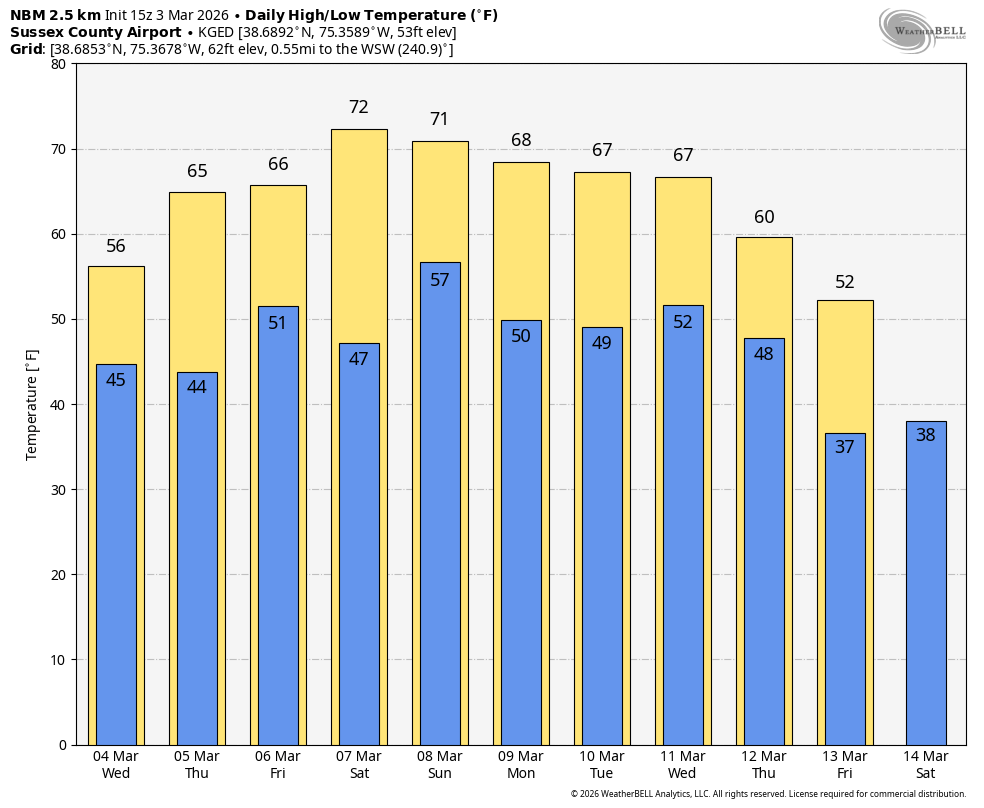
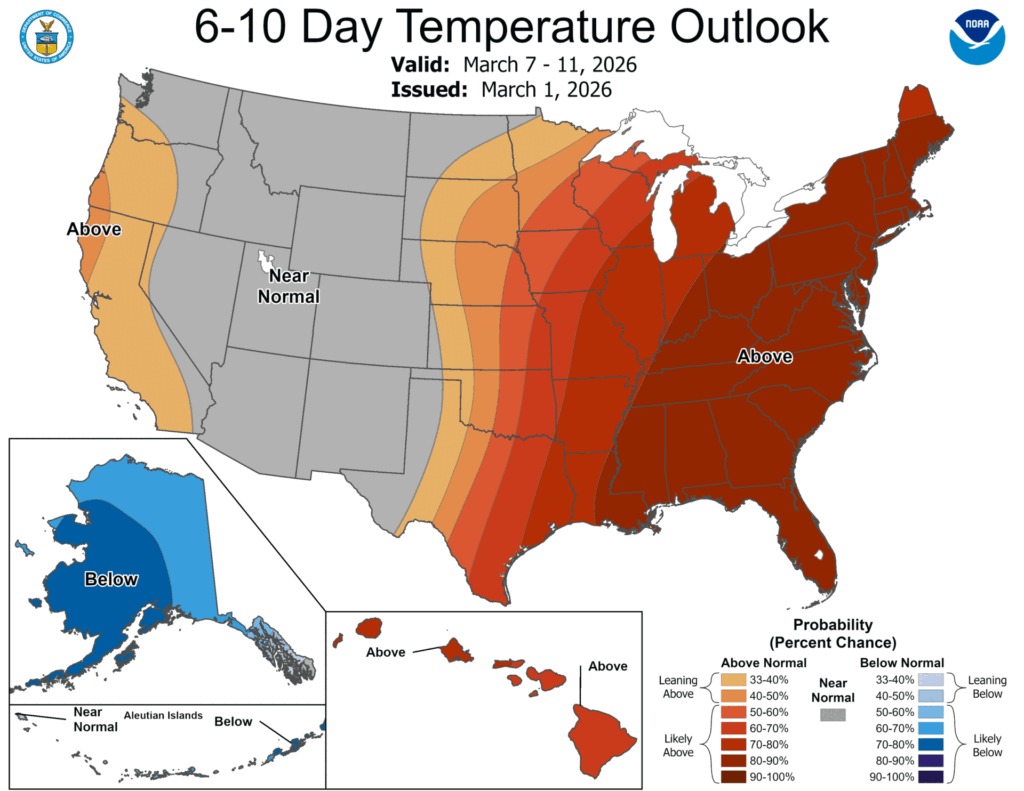
A significant shift in the overall weather pattern is setting the stage for a prolonged warm up across the Delmarva Peninsula beginning mid week and continuing into early next week. An upper level trough developing over the western United States will allow strong ridging to build over the eastern half of the country. As that western trough digs farther south into western Mexico by Friday, the ridge over the East will amplify. At the surface, a large Bermuda high will take control, promoting a milder southwest flow into the Mid Atlantic and pushing temperatures well above average for early March.
By Wednesday, highs across Delmarva will climb into the 50s to near 60 degrees. The forecast becomes more complicated from Thursday through Saturday as a frontal boundary wavers north and south across the region. The front is expected to lift north on Thursday before stalling and then dropping back south as a backdoor front Friday into Saturday. Its exact placement will create sharp temperature differences across relatively short distances. South of the boundary, temperatures will warm into the mid 60s to around 70 degrees, while areas near the front hover around 60. North of the boundary, highs may struggle in the 40s and 50s. There is increasing potential that some parts of Delmarva could trend cooler than currently forecast, particularly if a persistent east to northeast wind develops and pulls in cooler marine air from the Atlantic.
By Sunday and into early next week, the front is expected to lift back north, placing the region firmly in the warm sector once again. Highs should reach the 60s and lower 70s inland. Coastal communities, including areas along the Delaware Beaches and the Maryland and Virginia Eastern Shore, are likely to remain cooler in the 40s and 50s due to the influence of the cold ocean waters.
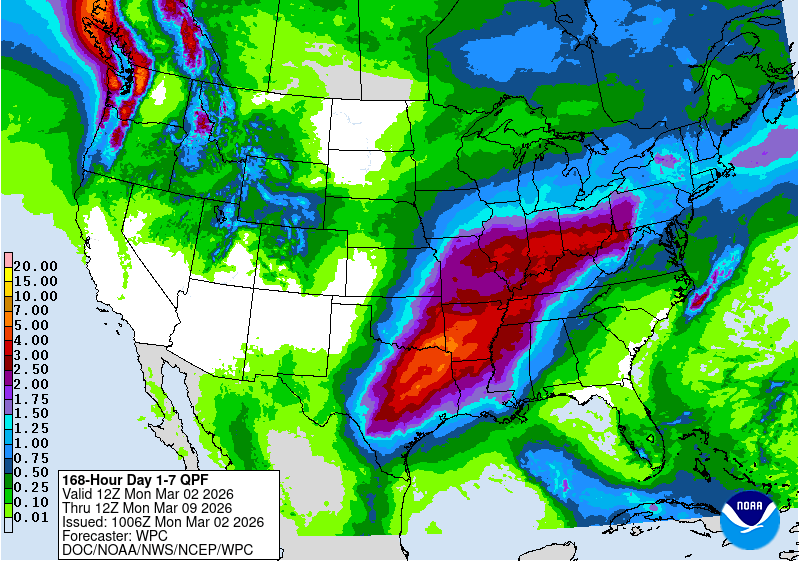
Although this pattern does not favor any significant storms, it will not be completely dry. The wavering boundary will serve as a focus for several weak disturbances moving through from Wednesday into Saturday, bringing multiple opportunities for showers. A slightly stronger wave Thursday night could even produce a few rumbles of thunder. Shower chances may linger into the weekend and early next week as the jet stream remains displaced well to the north.
Any rainfall that develops will be welcomed across Delmarva, where ongoing drought conditions have left soils dry. While this does not appear to be a soaking event, periodic showers could provide some short term relief as the region transitions toward spring.
Delaware Transit Corporation will hold a recruitment event this Saturday, March 21st, seeking to fill positions for transit specialists and maintenance workers.
The hiring fair runs from 9 AM until 1 PM at DART’s facility located at 119 Lower Beech Street in Wilmington. Job seekers can participate in testing, sit for interviews, and potentially receive employment offers on the same day.
The agency is specifically looking to hire Paratransit Specialists and Maintenance Personnel during this community recruitment drive.
Attendees will have the chance to interact with current DART staff members and take part in pre-employment assessments scheduled for 9:30 AM and 11:30 AM. Those who pass the initial testing phase will move forward to the interview process.
Law enforcement officials in New Castle County have completed a months-long investigation that resulted in arrests connected to illegal sexual activities at area massage establishments.
The probe was launched in 2025 by investigators with the New Castle County Division of Police Drug and Human Trafficking Investigations Team after receiving reports of inappropriate conduct at multiple massage therapy locations across the county.
According to police, the investigation revealed that customers visiting these businesses for massage services were being solicited for sexual acts. One of the establishments under scrutiny was identified as Wellness Tui-Na.
The investigation has led to multiple arrests, though specific details about the charges and individuals involved have not yet been released by authorities.
Motorists traveling through downtown Rehoboth Beach should plan alternate routes on Tuesday, March 4, 2026, as city officials announce a six-hour street shutdown to accommodate construction work.
South First Street will be blocked to traffic between Rehoboth Avenue and Wilmington Avenue starting at 7 a.m. and continuing until 1 p.m. The street closure is necessary to allow crane equipment to safely access the Avenue Inn for heating and air conditioning system repairs on the building’s rooftop.
Rehoboth Beach police officers will be stationed throughout the affected area to direct traffic and maintain safety protocols while the construction crew completes their work. The temporary closure is expected to conclude by early afternoon, allowing normal traffic flow to resume.
Delaware’s top education official has rolled out an ambitious new blueprint designed to improve student outcomes throughout the First State over the next four years.
Education Secretary Cindy Marten unveiled the Delaware Department of Education’s Strategic Plan for 2025-2028 today, establishing concrete goals aimed at preparing every student for success after graduation, whether they pursue higher education or enter the workforce directly.
The comprehensive initiative focuses on four key areas: improving reading proficiency, boosting high school completion rates, expanding access to quality early childhood education programs, and addressing the ongoing challenge of keeping experienced teachers in Delaware classrooms.
This marks the first strategic plan of its kind for the state education department, representing a systematic approach to addressing educational challenges facing Delaware schools and students.
Motorists traveling along Ellis Mills Road should expect delays due to ongoing lane restrictions affecting the stretch between Bowman Road and Matt Road.
According to DelDOT traffic officials, drivers will encounter periodic lane closures in the area throughout the day. The restrictions are set to continue until 2 p.m. this afternoon.
Commuters are advised to allow extra travel time or consider alternate routes to avoid potential delays in the affected area.
ANNAPOLIS, MD – The Maryland Department of Agriculture is joining the national observance of Weights and Measures Week, which runs through March 7, 2026.
The weeklong recognition, which began March 1st, focuses on this year’s theme ‘We Measure What Matters,’ highlighting the critical role that accurate measurements play in the daily routines of Maryland residents and the state’s economic well-being.
The annual observance draws attention to the importance of measurement precision across various aspects of life that affect families throughout the state.
ANNAPOLIS, MD (March 3, 2026) – Maryland’s Department of Agriculture is alerting agricultural producers about available financial assistance programs designed to help with spring manure management expenses.
The state agency announced that farmers may request cost-share assistance to help pay for hauling specific manure types to agricultural fields that have suitable soil phosphorus concentrations. The program also provides financial support to help cover expenses related to liquid manure injection procedures.
These grant opportunities are part of Maryland’s ongoing efforts to support sustainable farming practices while helping producers manage operational costs during the critical spring planting season.
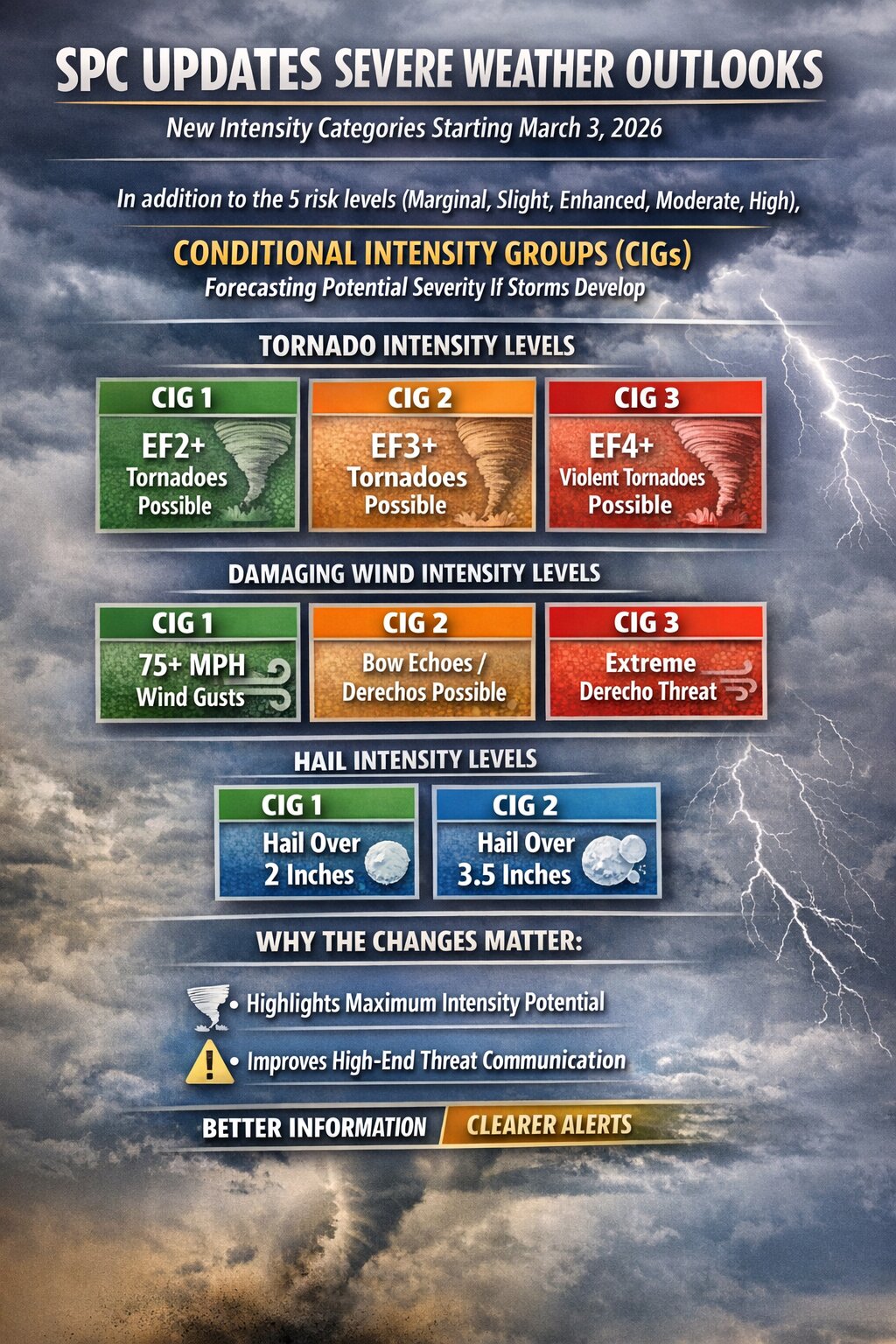
Beginning today, March 3, 2026, the Storm Prediction Center is implementing significant changes to how severe weather risks are communicated in its daily convective outlooks.
The update does not change the familiar five tier categorical system used to describe overall severe weather risk. Instead, it enhances the outlooks by adding clearer information about the potential intensity of tornadoes, damaging winds, and hail, even in situations where storms may be limited in coverage.
The change is designed to improve how forecasters communicate high impact threats and help emergency managers, broadcasters, and the public better understand the severity of possible outcomes.
What Remains the Same
The SPC will continue to issue its well known categorical risk levels: Marginal Level 1, Slight Level 2, Enhanced Level 3, Moderate Level 4, and High Level 5.
These categories still represent the overall probability and expected coverage of severe thunderstorms within 25 miles of a point.
What Is New: Conditional Intensity Groups
The major addition is the introduction of Conditional Intensity Groups, also known as CIGs. These new markers appear within the probabilistic tornado, wind, and hail outlooks and are intended to show the maximum expected intensity of severe hazards if storms develop.
In previous outlooks, hatched areas indicated potential for significant severe weather but did not clearly differentiate between moderate and extreme scenarios. Now, distinct intensity tiers provide clearer hazard messaging.
Tornado Outlook Changes
Tornado forecasts now include three Conditional Intensity Groups.
CIG 1 indicates an environment supportive of tornadoes up to at least EF2 strength.
CIG 2 signals potential for strong tornadoes of at least EF3 intensity.
CIG 3 highlights an environment capable of producing violent tornadoes rated EF4 or stronger.
This is particularly important in conditional setups where storm coverage may be limited but atmospheric parameters strongly favor intense tornadoes. Under the old system, that nuance was more difficult to convey visually. Now, even on days with lower overall probabilities, SPC can communicate when the ceiling for tornado strength is especially high.
Damaging Wind Outlook Changes
Wind outlooks are also receiving expanded intensity detail.
Three wind intensity tiers are now included.
CIG 1 represents potential for gusts of at least 74 miles per hour.
CIG 2 indicates an environment supportive of organized bow echoes or derechos.
CIG 3 highlights an ongoing or highly likely derecho level event.
In addition, SPC is adding higher probability thresholds of 75 percent and 90 percent to Day 1 and Day 2 wind outlooks. These elevated percentages signal very high confidence in widespread damaging wind. This refinement allows forecasters to distinguish between scattered severe gusts and large scale, high impact wind events.
Hail Outlook Changes
Hail forecasts now include two distinct intensity tiers.
CIG 1 indicates potential for hail greater than 2 inches in diameter.
CIG 2 indicates potential for hail exceeding 3.5 inches in diameter.
The addition helps differentiate between typical severe hail events and environments supportive of extremely large, destructive hail often associated with long lived supercells.
Unlike tornado and wind outlooks, hail currently includes two tiers rather than three, reflecting the rarity and forecasting challenges associated with the most extreme hail sizes.
Why the Change Matters
The update enhances SPC’s ability to communicate risk in two critical ways. It separates coverage probability from maximum intensity potential. It also better highlights high end threats in conditional environments.
For emergency planners and broadcast meteorologists, this provides clearer decision support information. For the public, it offers a more precise understanding of how dangerous storms could become, not just how likely they are to occur.
The revised outlook format takes effect with today’s convective outlook issuance and will apply to Day 1, Day 2, and Day 3 severe weather forecasts.
Motorists using Woodpecker Road should plan for potential delays this morning as construction crews work along a stretch of the roadway.
According to DelDOT, drivers can expect intermittent lane restrictions on Woodpecker Road in the area between Line Road and Woodland Ferry Road. The construction activity is causing periodic lane closures that are expected to continue until noon today.
Drivers are advised to allow extra travel time and exercise caution when passing through the work zone.
Worcester County officials have announced a scheduled maintenance training event featuring Derrick Babcock at the county’s Fire Training Center.
The training session is set to begin on Wednesday, March 25th, 2026 at 8:00 AM and will continue through Thursday, March 26th, concluding at 4:00 PM.
The event will take place at Worcester County’s Fire Training Center, according to information posted on the county’s official website on March 3rd, 2026.
Further details about the specific nature of the maintenance training or additional participants have not been released by county officials at this time.
Delaware Department of Transportation officials have temporarily shut down the westbound lane on Gravel Hill Road, also known as Route 30, at its intersection with Bennum Switch Road due to ongoing construction activities.
The lane restriction is expected to remain in place until 5 PM today, according to DelDOT’s traffic incident reporting system.
Motorists traveling westbound on Route 30 should expect delays and plan alternate routes if possible during the construction period.
Weather officials have concluded a brief winter weather advisory that affected the Delmarva Peninsula early Sunday morning.
The National Weather Service office in Mount Holly, New Jersey, had put the advisory into effect at 7:51 a.m. on March 3rd, lifting it approximately one hour and nine minutes later at 9:00 a.m. the same day.
The short-duration advisory covered areas under the Mount Holly forecast office’s jurisdiction, which includes portions of Delaware and the surrounding region.
Residents who may have been impacted by the brief weather event can continue monitoring local conditions and official weather service updates for any additional information.
Good morning, Delmarva! We’re starting this Tuesday with a soggy, gray day across the peninsula. Light rain and patchy fog will be our main weather story today, with temperatures reaching a cool 48 degrees under cloudy skies.
The rain should taper off by mid-afternoon around 3 PM, though we’ll keep some patchy fog lingering and just a slight chance for a few more light showers between 3 and 5 PM. Gentle southeast winds at 5 mph will keep things calm. We’re looking at about an 80% chance of rain today, so keep that umbrella handy! Rainfall amounts will be light – between a tenth and quarter inch.
Tonight, expect patchy fog to return before more light rain moves in, with lows dipping to 44 degrees. Wednesday brings a bit of improvement with partly cloudy skies and a chance of light rain, but temperatures will rebound nicely to 56 degrees.
Wednesday night, rain becomes likely again with lows around 43.
Stay dry out there, Delmarva, and I’ll see you tonight for your evening forecast update!
Delaware Department of Transportation officials are reporting a traffic incident that has shut down the left lane of eastbound US Route 40 at Pleasant Valley Road.
The lane closure is the result of a vehicle crash in the area. DelDOT has not provided details about the severity of the accident or whether there are any injuries involved.
Drivers traveling eastbound on US 40 through this area should anticipate delays and consider using alternative routes. The right lane remains open to traffic.
This is a developing situation and DelDOT has not yet announced when the lane is expected to reopen to normal traffic flow.
Delaware Department of Transportation officials are alerting drivers about active construction causing lane restrictions on a busy stretch of Interstate 95 northbound.
The right shoulder closure affects traffic traveling north on I-95 from the point where Interstate 495 splits off through the Pennsylvania state line. The restriction is scheduled to remain in place until 4 p.m. today.
Motorists using this corridor should plan for potential delays and consider alternate routes if possible during the construction period.
Delaware Department of Transportation officials have implemented a temporary speed limit reduction on Interstate 495, bringing the maximum allowable speed down to 55 miles per hour due to current weather conditions affecting the roadway.
The speed restriction has been put in place as a safety precaution to help motorists navigate the interstate more safely during adverse weather that could impact driving conditions.
Drivers traveling on I-495 are advised to observe the reduced speed limit and exercise additional caution while the weather-related restrictions remain in effect.
Motorists traveling on Foulk Road near Annwood Drive are dealing with traffic delays today due to ongoing construction work that has forced the closure of the right lane.
The Delaware Department of Transportation reports that construction crews are working on Route 261 (Foulk Road) at its intersection with Annwood Drive, requiring the temporary shutdown of the right travel lane.
Officials expect the lane restriction to remain in place until 3 PM today. Drivers are advised to allow extra travel time and use caution when passing through the construction zone.
The work zone may cause slower traffic conditions during peak travel periods as vehicles merge into the remaining open lane.
State officials marked Delaware’s annual 302 Day celebration by bringing civics education directly to elementary students across the First State on Monday.
Lieutenant Governor Kyle Evans Gay joined Education Secretary Cindy Marten for classroom visits in four different school districts, where they worked with fourth-grade students on interactive civics activities. The educational outreach comes as the United States prepares to commemorate its 250th anniversary.
The classroom visits were coordinated with support from the Delaware Public Archives and other state partners to provide students with hands-on learning experiences about government and civic engagement.
A vehicle accident has forced the closure of southbound US Route 13 at POW MIA Parkway, creating traffic disruptions for Delaware drivers.
According to DelDOT traffic reports, the southbound lanes remain blocked as emergency crews respond to the crash scene. The incident is causing significant delays for commuters traveling through the area.
Drivers are advised to find alternative routes and allow extra travel time while authorities work to clear the roadway and investigate the collision.
No additional details about the crash, including potential injuries or the number of vehicles involved, have been released at this time.
WILMINGTON, Delaware — A federal appeals court has directed tariff-related lawsuits back to Wilmington’s U.S. Court of International Trade on Monday, setting the stage for decisions on how to return over $130 billion in collected duties to importing companies.
The Federal Circuit Court of Appeals issued a brief, single-page ruling approving importers’ request to transfer the litigation back to the trade court where proceedings began earlier this year. The Trump administration had fought against this move, seeking a delay of up to four months to evaluate their legal strategy.
Last month on February 20, the Supreme Court invalidated tariffs that Trump had implemented using emergency economic powers. While more than 300,000 importing businesses paid these duties, the high court offered no direction on the government’s obligation to return the funds, with Trump warning the refund process might trigger five years of court battles.
Approximately 2,000 importing companies have filed legal claims seeking their money back, including major corporations such as FedEx. Meanwhile, smaller importing businesses are pushing for customs authorities to establish a streamlined, affordable system for processing refunds.
The importing companies have already petitioned the trade court to mandate government action on creating a refund mechanism once the case returns to the court’s authority.
Delaware’s Consumer Protection Unit is marking National Consumer Protection Week this week with educational outreach aimed at helping residents avoid fraud and scams.
Running from March 2nd through 8th, the observance has prompted the Delaware Department of Justice to organize face-to-face community events while also distributing online educational materials focused on fraud prevention and consumer awareness.
As part of their awareness campaign, state officials have compiled and published Delaware’s most prevalent scams for 2025, creating a top 10 list to help residents recognize common fraud schemes. The department plans to distribute additional online educational resources throughout the week.
Delaware State University’s men’s basketball squad dropped a heartbreaking 61-59 decision to South Carolina State, with Jalen St. Clair leading the Hornets’ offensive effort by putting up 13 points in the losing effort.
The Dover-based Hornets battled throughout the contest but were unable to secure the victory in what proved to be a tightly contested matchup. St. Clair’s double-digit scoring performance highlighted Delaware State’s efforts on the offensive end.
Despite the setback, the narrow margin of defeat demonstrates the competitive nature of the game, with just two points separating the teams when the final buzzer sounded.
Visitors to several popular Lewes destinations can once again access public restroom facilities after the city announced the reopening of five locations on March 2nd.
The restroom facilities that have returned to service include those at Canalfront Park, Mary Vessels Park, Savannah Beach, the Trail Head at the Lewes Public Library, and Zwaanendael Park.
However, beachgoers planning to visit Johnnie Walker Beach should note that those restroom facilities continue to be unavailable, as the city operates them on a seasonal schedule.
Delaware Governor Matt Meyer has officially proclaimed the first week of March as Weights and Measures Week throughout the state.
The governor’s proclamation covers March 1-7 and highlights the critical work performed by the Delaware Department of Agriculture’s Weights and Measures division.
“I urge all Delawareans to recognize the importance of equity in the marketplace and the role that the Delaware Department of Agriculture’s Weights and Measures staff play in ensuring your protection in commercial transactions,” Governor Meyer stated in his official proclamation.
The designation aims to raise public awareness about the importance of accurate measurements and fair trading practices that protect consumers during everyday purchases.
Motorists can once again travel North Chapel Street in Newark after police cleared a vehicle incident that had blocked traffic under a railroad bridge.
The Newark Police Department announced that the roadway between Cleveland Avenue and East Main Street has been reopened following the removal of the vehicle from beneath the bridge structure.
The incident had temporarily closed this section of North Chapel Street to through traffic while emergency responders worked to clear the scene.
The City of Cambridge has directed that all flags be displayed at half-staff on municipal properties and government facilities.
The order affects flags flying at city buildings, public facilities, and other government locations throughout Cambridge.
City officials have not provided additional details regarding the duration of the half-staff display or the specific reason for the directive at this time.
Weather officials have issued a winter weather advisory for the Delmarva Peninsula, warning residents of potentially hazardous conditions during the early morning hours.
The National Weather Service office in Mount Holly, New Jersey, activated the advisory at 1:26 AM EST on March 3rd, with the warning set to remain active until 8:00 AM EST the same day.
Local residents are advised to exercise caution during morning travel and stay updated on changing weather conditions throughout the advisory period.
Delaware motorists are facing significant traffic delays this morning after a vehicle accident forced authorities to shut down two right lanes on Interstate 95 southbound near the Delaware Route 1 junction.
The crash has created a bottleneck in one of the state’s busiest highway corridors, with traffic backing up as drivers merge into the remaining open lanes. DelDOT officials are working to clear the scene as quickly as possible.
Drivers traveling through the area should anticipate extended travel times and may want to consider using alternative routes until the roadway fully reopens. The incident serves as a reminder for motorists to maintain safe following distances and remain alert while navigating through construction and accident zones.
Each year, meteorologists and emergency management officials mark their calendars for the official Atlantic hurricane season, which begins on June 1st and extends through November 30th.
This six-month window represents the period when conditions in the Atlantic Ocean basin are most favorable for tropical storm and hurricane development. During these months, residents along the Eastern Seaboard, including Delaware and the Delmarva Peninsula, monitor weather forecasts closely as storm systems can potentially impact the region.
The established timeframe helps coastal communities prepare for potential severe weather events and serves as a reminder for families to review their emergency preparedness plans.
Vietnam War veterans will be honored during a special recognition ceremony this Saturday in Queen Anne’s County, Maryland.
The commemoration event is planned for March 28, 2026, running from 2:00 PM until 4:00 PM at the Queen Anne’s County High School Auditorium in Centreville.
The ceremony will serve as the area’s observance of National Vietnam Veterans Day, providing an opportunity for the community to pay tribute to those who served during the Vietnam conflict.
Delaware residents can experience a patriotic musical celebration as the nation approaches its 250th birthday milestone. Historic Christ Church will host a special concert titled “Music of a New Nation” on Saturday, March 7, 2026, running from 3:00 PM to 5:00 PM.
The afternoon performance serves as a tribute to the upcoming semicentennial anniversary of the Declaration of Independence, featuring musical selections that capture the spirit of America’s founding era.
The two-hour event promises to blend historical significance with musical artistry, offering attendees an opportunity to reflect on the nation’s revolutionary heritage through song.
Those interested in attending the commemorative concert can visit Historic Christ Church during the scheduled time frame to participate in this patriotic celebration.
A small Queen Anne’s County community is celebrating after receiving more than $1 million in federal funding for a major municipal project.
Senators Chris Van Hollen and Angela Alsobrooks made the trip to Barclay to personally deliver the substantial funding award to town officials. The federal directed spending allocation totals $1.044 million and is designated specifically for the construction of a combined community center and town hall facility.
The funding represents a significant investment in the infrastructure of Barclay, providing the town with resources to build a multipurpose facility that will serve both governmental and community functions for residents.
The University of Maryland Eastern Shore men’s basketball squad faced significant challenges protecting the basketball during their recent matchup against North Carolina Central University, ultimately falling to the Eagles in a game where ball security proved decisive.
The Hawks found themselves unable to establish offensive consistency as repeated giveaways disrupted their scoring opportunities throughout the contest. These possession losses allowed NCCU to capitalize on extra scoring chances and maintain control of the game’s tempo.
UMES coaching staff will likely focus on ball handling fundamentals and decision-making in upcoming practice sessions as the team works to address these recurring issues that have impacted their performance.
The defeat adds another loss to the Hawks’ season record as they continue working to find their rhythm in conference play. The team will need to shore up their ball security moving forward to compete effectively in their remaining games.
The University of Maryland Eastern Shore Hawks softball team concluded their North Carolina road trip in impressive fashion, completing a doubleheader sweep against the Golden Bulls.
The Hawks displayed commanding performances in both contests, demonstrating the kind of consistency that coaches hope to see during away games. The sweep marked a successful end to UMES’s time on the road in the Tar Heel State.
With this doubleheader victory, the Hawks return to the Eastern Shore having maximized their opportunities during the North Carolina swing. The team’s ability to win both games of the doubleheader showcases their depth and preparation as they continue their season.
The successful road trip provides momentum for UMES as they prepare for upcoming contests back in familiar territory.
Delaware State University women’s basketball team has reason to celebrate as two of their players have been selected for Mid-Eastern Athletic Conference weekly recognition.
The MEAC has announced that Huggins and Scott from the Delaware State Hornets have earned weekly honors for their exceptional performances on the court.
The conference regularly recognizes standout student-athletes who demonstrate excellence in their weekly basketball performances across member institutions.
This recognition highlights the continued success of Delaware State’s women’s basketball program within the competitive MEAC conference.
The Delaware State University Hornets softball program has made adjustments to their competitive schedule, according to a recent announcement from the athletics department.
The team’s planned twin bill against Holy Cross has been called off, requiring the Hornets to modify their upcoming slate of games.
No additional details were provided regarding the reasoning behind the scheduling modification or potential makeup dates for the cancelled contests.
Job seekers across the Eastern Shore will have access to numerous employment opportunities at an upcoming career fair scheduled for April 1st in Snow Hill, Worcester County officials announced.
The comprehensive employment and resource event will bring together employers from various industries looking to fill positions, offering attendees a chance to explore different career paths in one convenient location.
Worcester County is organizing the fair to help connect local residents with available jobs and provide access to career resources that can assist in professional development and job placement.
The timing of the fair comes as many businesses continue seeking qualified workers across different sectors, making it an opportune moment for those looking to advance their careers or find new employment.
Additional details about participating employers, specific job openings, and event logistics are expected to be released as the April 1st date approaches.
Motorists traveling on Route 7 should prepare for traffic disruptions as the Delaware Department of Transportation begins construction work that will require periodic lane restrictions.
The project will affect both northbound and southbound lanes along the stretch of roadway between Christiana Meadows and East Songsmith Drive. DelDOT officials indicate the lane closures will occur intermittently as construction crews complete their work.
Drivers are advised to allow extra travel time and consider alternate routes when possible during the construction period. The department has not provided specific dates or times for when the lane restrictions will be in effect.
Ocean Pines utility customers in several neighborhoods should prepare for water service interruptions scheduled for Tuesday, March 4th.
The planned outage will impact residents living in the Windjammer, Sandyhook, Capetown, and Essex Court communities within Ocean Pines.
The utility disruption notice was posted on Monday evening, March 2nd, giving residents advance warning to make necessary preparations for the temporary loss of water service.
Residents in these specific areas should plan accordingly by storing water for drinking, cooking, and other essential needs during the scheduled maintenance period.
Worcester County’s Fire Training Center will be the site of an emergency services training event next month.
The training session is set for Wednesday, March 18, 2026, running from 12:00 p.m. through 6:00 p.m. at the county’s fire training facility.
The event was announced by Worcester County officials on Monday, March 2nd. No additional details about the specific nature of the emergency services training or participating agencies have been released at this time.
Worcester County officials have scheduled a human resources training session for Monday, March 9, 2026, at the Fire Training Center.
The HR Classroom event is planned to run from 12:00 p.m. to 4:00 p.m., providing a four-hour educational opportunity for participants.
The training session was announced on Monday, March 2, 2026, and will be held at Worcester County’s Fire Training Center facility.
Additional details about the specific curriculum, registration requirements, or target audience for the HR training have not been released at this time.
Drivers using Interstate 495 southbound in New Castle County are facing lane restrictions due to active construction operations.
The Delaware Department of Transportation reports that the right travel lane is currently blocked between Exit 4 and Exit 3 on the southbound side of I-495. The lane closure is scheduled to remain in effect until 5 a.m.
Motorists are advised to allow extra travel time and use caution when navigating through the construction zone. Traffic may experience delays during the closure period.
Delaware Department of Transportation officials announced that construction activities will force the temporary shutdown of a key turning lane in New Castle County.
The right turn lane connecting westbound US Route 40 to northbound Delaware Route 7 will be unavailable to drivers during the construction period. DelDOT has not specified the duration of the closure or provided details about the nature of the construction work taking place.
Motorists who regularly use this route should prepare for potential traffic delays and consider using alternative paths to reach their destinations. The closure affects one of the busier intersections in the area, where US-40 meets Route 7.
DelDOT continues to monitor traffic conditions and will provide updates as the construction project progresses.
Weather officials have issued a Winter Weather Advisory for the Delmarva Peninsula, alerting residents to prepare for challenging conditions through Monday morning.
The National Weather Service office in Mount Holly, New Jersey announced the advisory Saturday evening at 8:49 PM, with the warning set to remain in effect until 8:00 AM on Monday, March 3rd.
Local residents should monitor weather conditions closely and take appropriate precautions during the advisory period. The warning suggests that winter weather conditions may create hazardous situations for travel and outdoor activities across Delaware and the surrounding Delmarva region.
Residents are encouraged to stay updated on changing weather conditions and plan accordingly for potential impacts to their Monday morning commute and weekend activities.
Two University of Delaware track and field athletes have been recognized with prestigious conference honors announced this week.
Conference USA revealed on Monday that Blue Hens competitors Olamide Ayeni and Marie-Theres Gruber have both earned spots on the league’s third team all-conference squad.
Ayeni competes in throwing events for Delaware, while Gruber specializes in distance running competitions. Both athletes’ performances throughout the season were strong enough to merit recognition among the top performers across the conference.
The all-conference selections highlight the continued success of Delaware’s track and field program within Conference USA competition.
Good evening, Delmarva! We’re tracking a messy weather pattern moving through our area tonight that’ll keep things interesting through midweek.
Tonight’s the story of transition – we’re starting with a chance of light snow before 1am, then expect a mix of rain and snow between 1am and 3am before settling into steady rain and snow. Temperatures will hover right around the freezing mark at 31°F with light easterly winds. There’s an 80% chance of precipitation, and while we could see less than an inch of snow accumulation, most of it will likely melt as we transition to rain.
Tuesday brings much milder conditions with temperatures climbing to 46°F and light rain continuing. The warming trend continues Tuesday night with temps holding around 44°F and more light rain expected.
Looking ahead to Wednesday, we’ll see temperatures reach a pleasant 56°F, though light rain remains likely.
Bottom line: grab your umbrella and maybe keep a light jacket handy for the next few days. Drive safely tonight during that snow-to-rain transition!
Stay warm and dry, Delmarva!
Delaware Attorney General Kathy Jennings is praising a federal court ruling that has once again prevented the collection of private information from food stamp recipients across the country.
The U.S. District Court for the Northern District of California issued a decision blocking federal demands that states hand over confidential details about millions of people who apply for or receive benefits through the Supplemental Nutrition Assistance Program.
This marks another legal victory for Jennings, who earlier joined with other attorneys general in challenging the data collection requirements through federal court action.
The ruling protects sensitive personal information of SNAP participants from being turned over to federal authorities, continuing a pattern of successful legal challenges to these data demands.
Bow hunters are proving to be the most effective weapon in the battle against invasive northern snakehead fish in Chesapeake Bay waters, according to new research from Maryland’s Department of Natural Resources.
The recently published study in Integrated and Comparative Biology shows that bowfishing and gigging with pronged spears have become the dominant methods for catching these unwanted fish, far outpacing traditional rod-and-reel fishing, commercial operations, and state management efforts.
What makes this finding particularly significant is that bow hunters are successfully targeting the larger female snakeheads that carry more eggs, which is crucial for controlling population growth of these Asian natives that were illegally released into Maryland waters in the early 2000s.
“Bowfishing is an important component of the fishery, annually removing approximately 20% of the population in the upper Chesapeake Bay,” explained Dr. Joseph Love, the study’s lead author and DNR biologist. “We are always looking for creative, responsible ways to get us closer to our needed targets for managing these populations.”
The invasive species presents a significant challenge for fisheries managers because these fish are naturally equipped with traits that help them thrive and multiply rapidly in environments where they face few natural threats. Northern snakeheads have spread so extensively throughout the Chesapeake Bay region that completely eliminating them is no longer considered feasible.
Instead, wildlife officials are concentrating on reducing their numbers and finding ways to use them beneficially to minimize their damage to local ecosystems that support valuable recreational and commercial fish species.
Bowfishing has gained popularity among anglers as an alternative to conventional fishing methods. Rather than using bait and waiting for a bite, bowfishers shoot arrows attached to retrieval lines at fish they can see in the water.
Between 2022 and 2024, researchers collaborated with the U.S. Fish and Wildlife Service’s Maryland office to track snakeheads with tags and gather information from charter boat operators who specialize in bowfishing trips. The team collected data through multiple approaches: accompanying bowfishing charters in person, reviewing trip logs maintained by charter captains, and tracking reports when tagged fish were caught by both bow hunters and conventional anglers.
The 2024 data alone reveals the scope of bowfishing activity: ten charter boat captains logged over 550 bowfishing excursions across 17 different rivers. These outings typically lasted around five hours with four participants each. While results varied dramatically – from catching nothing to landing more than 30 fish per trip – the average expedition removed approximately ten snakeheads. Activity peaked during spring and fall seasons, particularly during full and new moon phases.
“We learned how many they harvested per night, but needed to learn more about what that meant for the fishery,” Love noted.
The tagging portion of the research involved placing 657 tags on northern snakeheads in the upper Chesapeake Bay. Of the 149 tags that were reported back to researchers, 80 came from bowfishers compared to 65 from traditional anglers. After accounting for differences in reporting habits between the two groups, scientists determined that bowfishing accounts for a larger share of the total snakehead harvest than rod-and-reel fishing.
State removal efforts through electrofishing surveys contributed only a small portion of annual catches, confirming what managers and fishers already suspected – bowfishers are harvesting substantial numbers of snakeheads.
Because northern snakeheads have been shown to negatively affect native fish populations, the department urges anglers to keep every snakehead they catch. There are no bag limits or closed seasons for these invasive fish, and they’re considered excellent table fare. Their widespread distribution means anglers have numerous locations to try their luck at catching them.
As global attention turns to our region for the world’s biggest sporting spectacle, the Delaware Tourism Office (DTO) is encouraging soccer fans to experience every thrilling moment by watching this summer’s matches at four celebrations planned throughout the state.
Tickets for the FIFA World Cup 2026™ soccer viewing festivities will go on sale Thursday, March 5th beginning at 9 a.m.
The tourism office is capitalizing on the international spotlight shining on the area during the premier global soccer tournament, offering residents and visitors multiple locations to gather and enjoy the matches together.
Soccer enthusiasts across the First State will have their chance to secure spots at Delaware’s official FIFA World Cup 2026 viewing events when ticket sales open Thursday, March 5 at 9 a.m.
The Delaware Tourism Office has planned one major watch party in each of the state’s three counties this June, creating opportunities for thousands of residents to come together and enjoy the international tournament. These gatherings represent Delaware’s exclusive official FIFA World Cup 2026 watch party series.
Officials promise each location will be converted into an exciting fan celebration featuring massive viewing screens, live entertainment before matches begin, food trucks from local vendors, hands-on soccer games, musical performances, and activities designed for attendees of every age group.
The events are being organized as Delaware finds itself in the international spotlight during what organizers call the planet’s most significant sporting competition.
SALISBURY, Md. – Salisbury University celebrated a remarkable week of athletic achievement as four Sea Gulls student-athletes earned recognition from the Coast-to-Coast Athletic Conference (C2C) for their outstanding performances between February 23 and March 1, 2026.
The university’s tennis programs dominated the weekly honors, with Gurv Suri claiming the men’s award and Gibelle Beaujon taking home the women’s recognition, marking a clean sweep for the Sea Gulls tennis teams in their respective C2C categories.
Meanwhile, the women’s lacrosse squad contributed two honorees to the weekly awards list. Julianna Ott earned recognition for her offensive contributions, while Abby Fleishell was celebrated for her defensive prowess during the competition period.
The Jersey Mike’s A Sub Above Players of the Week program highlights exceptional student-athlete performances across the Coast-to-Coast Athletic Conference, recognizing excellence both on and off the field of play.
Drivers should expect delays on Federal School Lane today as construction crews have closed the left lane between South DuPont Highway (Route 13) and River Road (Route 9).
According to DelDOT, the lane restriction will remain in effect until 5 PM this afternoon while construction work is underway in the area.
Motorists are advised to allow extra travel time and use caution when driving through the work zone. Traffic will be reduced to one lane in each direction during the construction period.
Delaware residents can expect warmer than usual weather in the coming week and a half, according to extended weather forecasts covering the next 6 to 10 days. The projection indicates that most areas across the nation will see temperatures at or above seasonal averages, with rainfall amounts also expected to meet or exceed normal levels.
The East Coast, including Delaware and surrounding states, shows the highest probability for experiencing temperatures warmer than typical for this time of year. Conversely, areas expecting below-average moisture include California and portions of the western Great Basin region.
Cold temperatures will begin moving northward this week but will remain present near the Canadian border stretching from North Dakota through New England. Early week weather patterns may bring icy conditions and freezing precipitation to areas as far south as the Ohio Valley and Mid-Atlantic region before milder temperatures take hold.
The weather pattern is expected to shift during the week’s second half, with warmer air masses moving into the region.
A University of Delaware softball standout has earned recognition from Conference USA officials for her outstanding play on the mound.
Karli Challburg, a freshman pitcher for the Blue Hens, received Conference USA Freshman of the Week honors following her impressive showings in games against Le Moyne and Bryant during the Blue Hen Invitational tournament.
The conference made the announcement on Monday, March 2, highlighting Challburg’s contributions to the team’s performance at the home tournament.
The weekly recognition marks an early achievement in Challburg’s collegiate career as she continues to make her mark in her debut season with the Delaware softball program.
Weather officials have put the Delmarva Peninsula under a Winter Weather Advisory that began Saturday afternoon and will remain in effect until Sunday morning at 8:00 AM.
The National Weather Service office in Mount Holly, New Jersey activated the advisory at 1:18 PM on Saturday, March 2nd, warning residents across Delaware and surrounding areas to prepare for winter weather conditions.
The advisory will stay active until 8:00 AM on Sunday, March 3rd, giving local communities nearly 19 hours to navigate the anticipated weather challenges.
Residents throughout the region should monitor local conditions closely and take appropriate precautions for travel and outdoor activities during the advisory period.
Traffic is being diverted around a section of North Chapel Street in Newark after a vehicle became wedged beneath a railroad overpass.
The Newark Police Department reports that the roadway is impassable between Cleveland Avenue and East Main Street while authorities work to free the trapped vehicle.
Officials have not yet provided a timeline for when the street will reopen to normal traffic flow. Police say they will issue an update once the roadway has been cleared and is safe for vehicles to pass through again.
Meteorological Winter 2025–26 will go down as one of the coldest and snowiest winters in over a decade for much of the Mid-Atlantic, including Delaware and the I-95 corridor. While snowfall was impressive, precipitation overall leaned slightly below average in many locations, making it a cold and snowy, but somewhat dry winter season.
Preliminary data from the National Weather Service shows that several cities experienced their coldest winter since the mid-2010s, and in some cases, the early 1990s.
A Historically Cold Winter
Across the region, average temperatures finished several degrees below normal.
In Georgetown, the average winter temperature was 33.8°F, which is 5.2 degrees below normal. This ranks as the 8th coldest meteorological winter since 1893-94, marking the coldest winter there in over three decades.
In Wilmington, the average temperature came in at 31.8°F, or 3.9 degrees below normal, making it the coldest winter since 2014-15.
Philadelphia, Allentown, Trenton, Reading, Mount Pocono, and Atlantic City all saw their coldest meteorological winter since at least 2014-15, while Atlantic City Marina experienced its coldest since the historic winter of 1993-94.
Snowfall: A Major Comeback Year
Snowfall was the headline story this winter, particularly along and north of the I-95 corridor.
In Wilmington, seasonal snowfall reached 24.0 inches, which is 7.2 inches above normal. This makes it the snowiest winter since 2013-14, breaking a decade-long stretch of relatively modest snowfall seasons.
Farther north, Trenton recorded 44.3 inches, ranking as the 6th snowiest winter on record. Philadelphia measured 30.1 inches, its snowiest winter since 2013-14.
Although snowfall data was not calculated for Georgetown’s seasonal totals, February alone brought impactful snow events, and nearby observing sites confirm this winter was significantly snowier than recent years across southern Delaware.
Precipitation: Snowy But Slightly Dry
Despite the frequent snow, total liquid precipitation was generally below normal in many locations.
Wilmington finished with 8.14 inches, about 1.77 inches below average. Georgetown, however, was one of the few spots to edge slightly above normal, finishing at 9.17 inches, just 0.11 inches above average.
This reflects the nature of the season: colder air masses favored snow production, but overall storm systems were not especially moisture-rich.
February Sealed the Deal
February reinforced the winter’s cold theme. Georgetown averaged 5.7 degrees below normal for the month, while Wilmington finished 3.4 degrees below average. Several late-month warmups pushed temperatures near 60 degrees, but they were not enough to offset persistent cold earlier in the season.
State fire investigators have concluded that an early morning blaze that damaged a Leipsic home was caused by accident, according to the Delaware State Fire Marshal’s Office.
Emergency responders rushed to a house in the 100 block of Front Street around 2:40 AM on March 1, 2026, after receiving reports of a structure fire. The Leipsic Fire Company received the initial call for the residential blaze.
First responders arrived at the scene following reports that occupants might have been trapped within the burning home. Fire fighters from multiple companies responded to battle the flames.