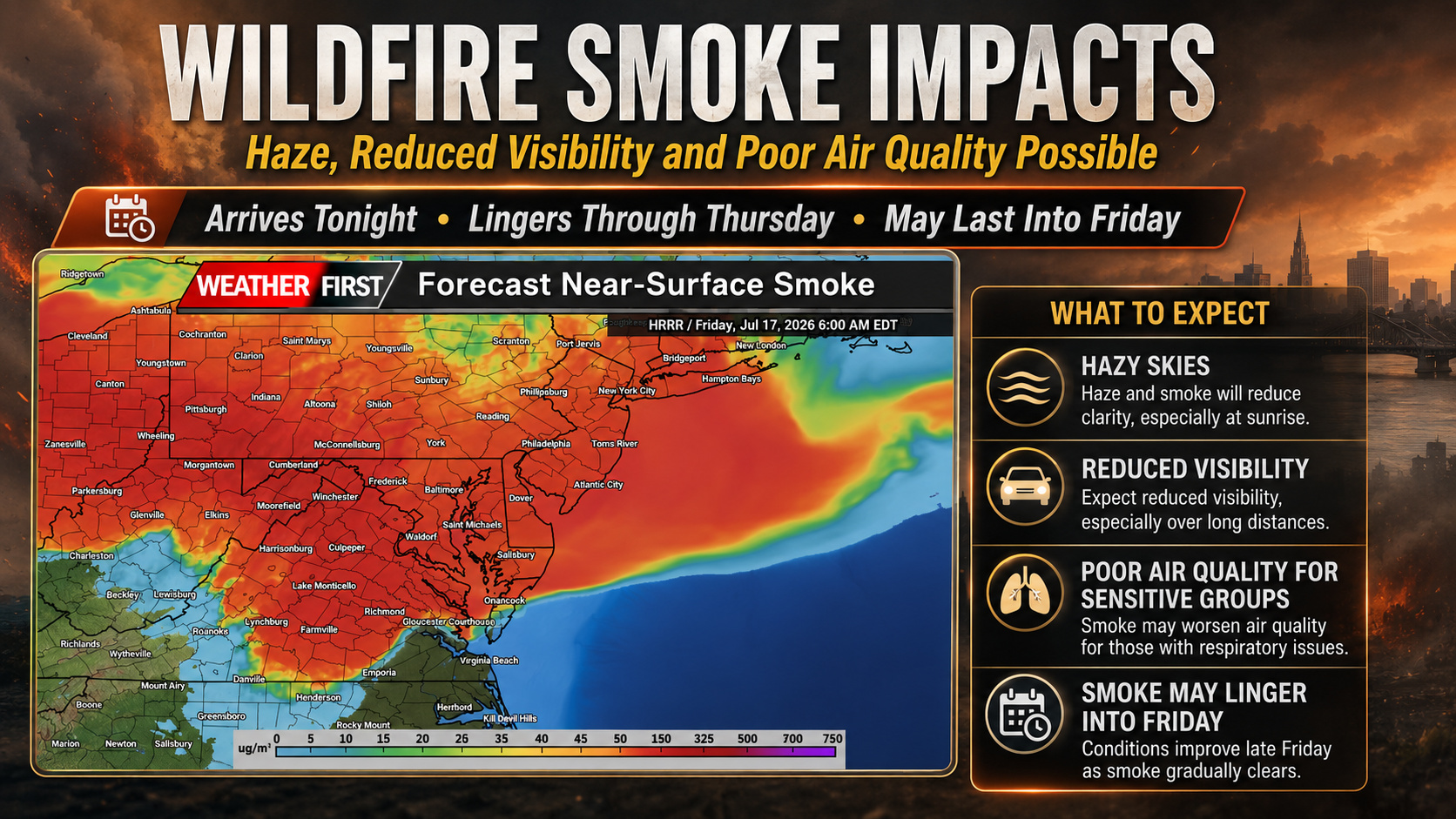
Smoke from large wildfires burning across western Ontario is expected to spread into the Mid-Atlantic beginning Wednesday night, potentially creating hazy skies, reduced visibility and periods of unhealthy air quality.
A cold front moving through the region late Wednesday will cause winds to shift from the northwest. That change in wind direction will help transport a large plume of Canadian wildfire smoke toward Delaware, Maryland, Pennsylvania and New Jersey.

Unlike smoke that remains several thousand feet above the ground, the latest high-resolution forecast guidance indicates that at least some of this smoke could reach the surface. Smoky conditions are expected to become more noticeable overnight Wednesday and continue throughout Thursday and Thursday night. Some smoke may remain across the region Friday and possibly into Saturday.
Reduced Visibility and Hazy Skies Possible

Residents may notice a milky or gray appearance to the sky, a dimmer sun and potentially more colorful sunrises and sunsets. A smoke odor may also become noticeable in locations where the highest concentrations reach ground level.
Visibility restrictions are expected to become increasingly likely Wednesday night before becoming more widespread Thursday. The National Weather Service says visibility could occasionally become significantly reduced, particularly during the afternoon and evening Thursday when smoke concentrations may be highest.
These restrictions could affect motorists, aviation operations and boaters across the coastal waters. Visibility over the ocean and Delaware Bay could fall to around three nautical miles at times.
Air Quality Concerns Increasing
The severity of the air-quality impact remains somewhat uncertain because small changes in wind direction, atmospheric mixing and the concentration of the incoming smoke plume can produce large differences from one community to another.
Delaware’s Department of Natural Resources and Environmental Control is forecasting Code Orange air quality for Thursday, July 16. The current forecast places both ozone and fine-particle pollution in the “Unhealthy for Sensitive Groups” category, with the PM2.5 Air Quality Index forecast to reach 124.
People in sensitive groups may experience health effects during Code Orange conditions. This includes children, older adults, pregnant individuals and people with asthma, COPD, heart disease or other respiratory and cardiovascular conditions.
Wildfire smoke contains extremely small particles that can travel deep into the lungs. Exposure can result in coughing, wheezing, difficulty breathing, irritated eyes, a scratchy throat, headaches or chest discomfort.
Not Expected to Rival the June 2023 Smoke Event

Current indications suggest this event will not be as severe as the historic wildfire smoke outbreak experienced across the Mid-Atlantic in June 2023. During that event, extremely dense smoke caused widespread hazardous air quality and dramatically reduced visibility.
However, the exact intensity of an incoming smoke plume is difficult to predict ahead of time. Air quality can also change considerably over only a few hours, especially as daytime heating mixes smoke from higher levels of the atmosphere toward the surface.
Residents should continue monitoring updated air-quality readings and forecasts throughout Thursday rather than relying only on the appearance of the sky.
How to Reduce Your Smoke Exposure
When air quality deteriorates, sensitive individuals should limit strenuous outdoor activities and take additional breaks indoors. Keep windows and doors closed when smoke is present and operate air-conditioning systems using the recirculation setting when possible.
Portable air cleaners equipped with HEPA filters can help reduce fine-particle concentrations indoors. Anyone who must remain outside for an extended period may receive some protection from a properly fitted NIOSH-approved N95 respirator. Cloth and surgical masks do not effectively filter the fine particles found in wildfire smoke.
Air-quality forecasts and observations should be monitored through Delaware DNREC, the Maryland Department of the Environment and AirNow. Maryland provides three-day fine-particle and ozone forecasts for ten regions, including the Eastern Shore.
The smoke forecast will continue to be refined as the plume moves closer to the region. Conditions may vary significantly across Delmarva, with some locations experiencing only a light haze while others could see noticeable surface smoke, reduced visibility and unhealthy air quality.