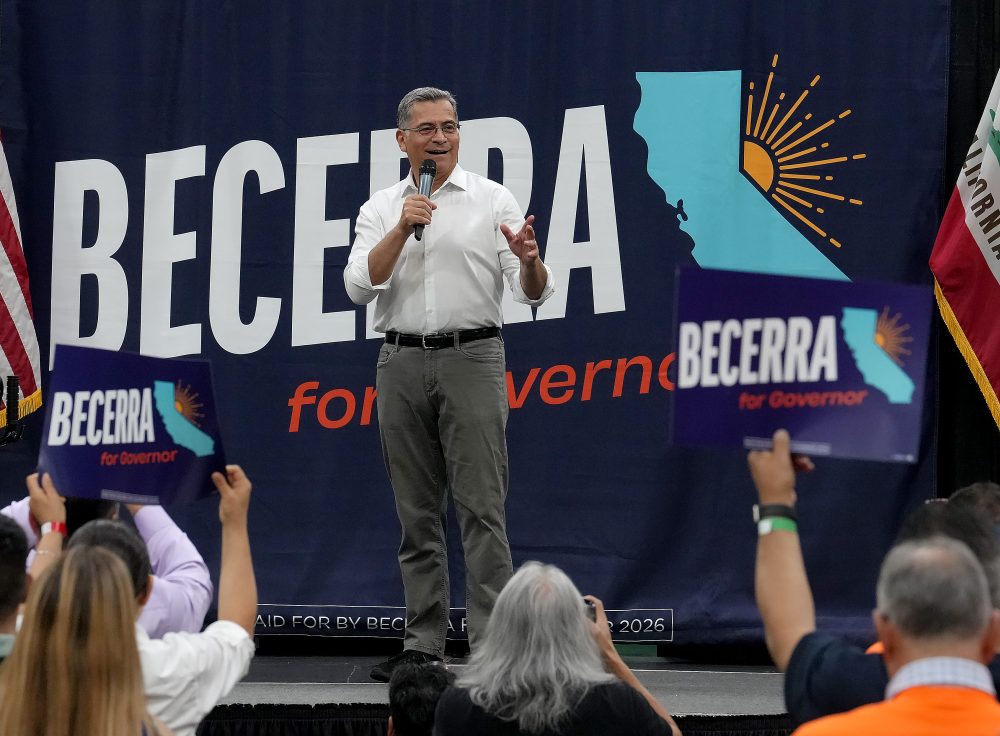

SACRAMENTO, Calif. — Democratic candidate Xavier Becerra is relying on his extensive government background spanning more than three decades to propel him toward California’s highest office, though his extensive political history has simultaneously provided ammunition for opponents to challenge his effectiveness as the campaign enters its final stretch.
Becerra’s career encompasses over 35 years across state and federal positions, including senior positions in the U.S. House, serving as California’s attorney general, and working as former President Joe Biden’s health secretary.
“The governor’s office is not a place with training wheels,” he’s said repeatedly.
While this messaging initially failed to connect with voters during his campaign’s first year, Becerra now appears to be gaining ground with balloting in progress before the June 2 primary, particularly following a significant campaign shift after Democrat Eric Swalwell’s departure from the race. Since then, Becerra has secured backing from powerful labor organizations and Latino state officials, while his previously weak fundraising efforts have strengthened considerably. His status as the primary focus of debate attacks suggests his Democratic opponents view him as the candidate gaining traction.
Political observers note that Democrats appear drawn to Becerra as what they consider a reliable option.
“He has this breadth of experience that none of the other candidates have,” said Matt Barreto, faculty director of the University of California, Los Angeles, Voting Rights Project, which Becerra partnered with in a recent lawsuit. “What that means is that he has the ability to portray himself to the voters as having been through the fight.”
However, certain Biden administration veterans have raised concerns about Becerra’s performance as health and human services secretary. His opponents have highlighted the federal charges against Becerra’s former chief of staff, who admitted guilt for stealing Becerra’s campaign money. While Becerra faces no accusations himself, Democrat Katie Porter recently labeled him “too much of a risk.”
Becerra has rejected such attacks as political mudslinging.
“We’re going to talk about the truth and we’re going to move forward,” he told reporters this week.
Becerra references his time as California’s attorney general during President Donald Trump’s first administration to position himself as a seasoned advocate against an overwhelming federal government. He played a central role in the state’s emergence as what became known as the resistance, initiating over 120 legal challenges covering topics from immigration to environmental policy.
Multiple attendees at a recent Becerra event in Sacramento cited his experience across different government levels as their reason for supporting him.
Becerra “knows how to navigate through the complexities of running a government,” said Ruben Hoyos, who voted for Becerra despite being more aligned with billionaire Tom Steyer’s progressive platform.
Similar to his competitors, he has positioned affordability as a cornerstone of his agenda. Becerra has pledged to announce a state of emergency addressing high living costs and housing shortages. He claims this would enable him to halt home insurance rate increases as Californians face difficulties obtaining or affording coverage due to the state’s intensifying wildfire situation.
Most insurance commissioner candidates contend a governor lacks legal authority for such action since the insurance sector falls under an elected commissioner’s regulation. Becerra maintains he would possess that power.
“I’d be willing to go to court to tell you that I could call that freeze,” Becerra said in a recent debate.
During his congressional tenure, he contributed to passing the Affordable Care Act and protected it from Republican challenges as California’s attorney general. He’s also recognized for advocating abortion rights and has received backing from Planned Parenthood Affiliates of California.
However, after previously supporting the elimination of private health insurance for a government-operated system, he seems to have shifted his stance. When pressed by competitors for a definitive position, he stated his focus remains on expanding coverage.
“Californians don’t care what you call it, so long as they have affordable health care,” he said.
Becerra’s period as federal health secretary has faced scrutiny.
Steyer has consistently attacked Becerra regarding his management of the surge of unaccompanied migrant children arriving at the U.S.-Mexico border in 2021, primarily escaping violence, poverty, or natural disaster impacts in Central America.
These children underwent processing in temporary facilities before transfer to emergency shelters operated by the Department of Health and Human Services, with some facilities receiving criticism from child welfare advocates for substandard conditions. They were subsequently placed with family members, relatives, or sponsors.
A New York Times investigation in 2023 revealed the health department’s failure to properly screen sponsors, with many children subsequently working in exploitative positions. The investigation also found Becerra advocated for faster processing of children through the system and that the agency lost contact with tens of thousands of minors after they departed federal custody. Steyer has claimed the federal government “lost” children under Becerra’s supervision. Traditionally, the federal government has not monitored unaccompanied children following their release to adult care.
Becerra has characterized the criticism as “Trump talking points.” Several California immigrant rights organizations and Biden administration members have supported Becerra’s record.
Throughout the COVID-19 pandemic, Becerra remained largely behind the scenes, with figures like Dr. Anthony Fauci serving as administration representatives.
Xochitl Hinojosa, a former spokesperson in Biden’s Department of Justice, stated on CNN earlier this month that she lacked confidence in Becerra’s leadership capabilities.
“He was not effective in government,” she said.
The competition to succeed term-limited Gov. Gavin Newsom has remained volatile, with leading state Democrats encouraging lower-performing candidates to withdraw from the contest. This initially included Becerra.
Following Swalwell’s scandal, Becerra’s campaign has emphasized his reserved personality to attract voters seeking a controversy-free alternative.
Becerra adopted TikTok early with emphasis on Spanish-speaking voters. When he and other minority candidates were excluded from a scheduled debate due to poor polling and fundraising, Latino creator Jay Gonzalez invited them to address his audience. Becerra accepted the invitation. Gonzalez has subsequently joined the campaign staff. Additional creators are urging their followers to support Becerra and attending his events. Some of Becerra’s social media content refers to him as “Tío Xavier,” which translates to “Uncle Xavier” in Spanish, presenting him as a trustworthy, familiar figure.
Latinos — California’s largest ethnic group — typically show low participation in California primaries. However, efforts to energize this portion of the electorate could prove beneficial, according to Kim Nalder, director of the Project for an Informed Electorate at California State University, Sacramento. Becerra, if successful, would become California’s first Latino governor since the late 1800s.
“There’s some evidence that folks — if they have choices that are close like in a primary — will choose based on identity groups, sometimes,” she said.