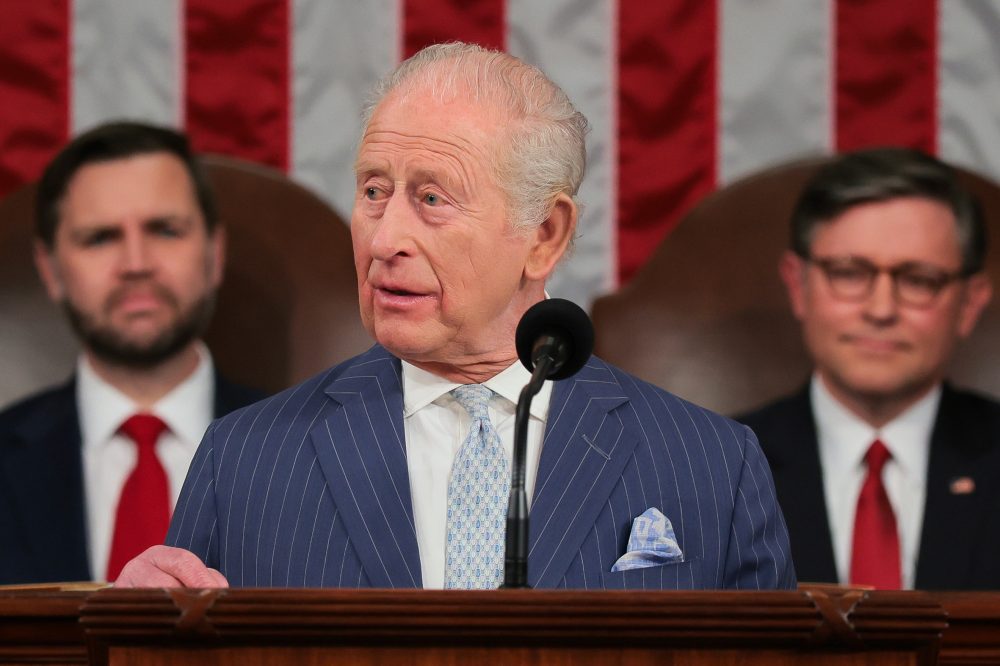

WASHINGTON — Britain’s King Charles III celebrated the enduring alliance between his nation and the United States during a historic address to Congress, marking his first speech to American lawmakers as monarch.
Speaking to members of both chambers, the King expressed appreciation for the opportunity to address the joint session and thanked Americans for their hospitality during this commemorative year marking 250 years since the Declaration of Independence.
“Mr. Vice President, Mr. Speaker, members of Congress, representatives of the American people across all states, territories, cities and communities,” Charles began his remarks.
“I would like to take this opportunity to express my particular gratitude to you all for the great honor of addressing this joint meeting of Congress and, on behalf of the queen and myself, to thank the American people for welcoming us to the United States to mark this semi-quincentennial year of the Declaration of Independence.”
The monarch acknowledged the challenging global environment, referencing conflicts spanning from Europe to the Middle East and recent violence near the Capitol building.
“We meet in times of great uncertainty; in times of conflict from Europe to the Middle East which pose immense challenges for the international community and whose impact is felt in communities the length and breadth of our own countries,” he stated.
“We meet, too, in the aftermath of the incident not far from this great building that sought to harm the leadership of your nation and to foment wider fear and discord.”
Charles emphasized unwavering opposition to violence, declaring: “Let me say with unshakeable resolve: such acts of violence will never succeed. Whatever our differences, whatever disagreements we may have, we stand united in our commitment to uphold democracy, to protect all our people from harm, and to salute the courage of those who daily risk their lives in the service of our countries.”
Reflecting on the weight of history, the King noted his position as the 19th British sovereign to closely monitor American affairs across more than four centuries of shared history.
“Standing here today, it is hard not to feel the weight of history on my shoulder — because the modern relationship between our two nations and our own peoples spans not merely 250 years, but over four centuries. It is extraordinary to think that I am the 19th in our line of sovereigns to study, with daily attention, the affairs of America.”
Charles paid tribute to his late mother, Queen Elizabeth II, who addressed Congress in 1991, noting he now spoke “under the watchful eye of the Statue of Freedom above us.”
“Speaking in this renowned chamber of debate and deliberation, I cannot help but think of my late mother, Queen Elizabeth, who, in 1991, was also afforded this signal honor and similarly spoke under the watchful eye of the Statue of Freedom above us.”
Adding a touch of humor, the King referenced British parliamentary tradition: “As you may know, when I address my own Parliament at Westminster, we still follow an age-old tradition and take a member of Parliament ‘hostage,’ holding him or her at Buckingham Palace until I am safely returned. These days, we look after our ‘guest’ rather well – to the point that they often do not want to leave. I don’t know, Mr. Speaker, if there were any volunteers for that role here today?”
Charles traced the historical foundations of the US-UK relationship, noting how disagreement ultimately strengthened their bond.
“With the spirit of 1776 in our minds, we can perhaps agree that we do not always agree – at least in the first instance. Indeed, the very principle on which your Congress was founded – no taxation without representation – was at once a fundamental disagreement between us, and at the same time a shared democratic value which you inherited from us.”
“Ours is a partnership born out of dispute, but no less strong for it,” he continued. “Drawing on these values and traditions, time and again, our two countries have always found ways to come together. And by Jove, Mr. Speaker, when we have found that way to agree, what great change is brought about – not just for the benefit of our peoples, but of all peoples.”
The monarch referenced a quote from former President Trump’s state visit to Britain: “As President Trump himself observed during his state visit to Britain last autumn, ‘The bond of kinship and identity between America and the United Kingdom is priceless and eternal. It is irreplaceable and unbreakable.’”
Charles revealed this marked his 20th visit to the United States and his first as King, joking about his ancestry: “This is a city which symbolizes a period in our shared history, or what Charles Dickens might have called ‘A Tale of Two Georges’: the first President, George Washington, and my five-times Great Grandfather, King George III. King George never set foot in America and, please rest assured, I am not here as part of some cunning rearguard action.”
He praised America’s founders as “bold and imaginative rebels with a cause” who “declared Independence” 250 years ago, noting they carried forward “the great inheritance of the British Enlightenment” and ideals rooted in “English common law and Magna Carta.”
“The Founding Fathers were bold and imaginative rebels with a cause. Two hundred and fifty years ago, or, as we say in the United Kingdom ‘just the other day,’ they declared Independence. By balancing contending forces and drawing strength in diversity, they united 13 disparate colonies to forge a nation on the revolutionary idea of ‘life, liberty and the pursuit of happiness.’”
Charles highlighted the deep constitutional connections between the nations, noting how Britain’s Declaration of Rights of 1689 influenced the American Bill of Rights of 1791, and how Magna Carta has been cited in at least 160 Supreme Court cases since 1789.
The King addressed the role of faith in governance, sharing his personal perspective: “And, Mr. Speaker, for many here – and for myself – the Christian faith is a firm anchor and daily inspiration that guides us not only personally, but together as members of our community. Having devoted a large part of my life to interfaith relationships and greater understanding, it is that faith in the triumph of light over darkness which I have found confirmed countless times.”
Turning to contemporary security challenges, Charles emphasized the importance of the Atlantic alliance, particularly referencing Henry Kissinger’s description of Kennedy’s “soaring vision” of partnership between Europe and America.
He recalled his grandfather King George VI’s 1939 visit to America as fascism threatened Europe, drawing parallels to current global instability: “Today, we find ourselves in a new era, but those values remain. It is an era that is, in many ways, more volatile and more dangerous than the world to which my late mother spoke, in this chamber, in 1991.”
The monarch announced Britain’s commitment to significantly increased defense spending: “The United Kingdom recognizes that the threats we face demand a transformation in British defense. That is why our country, in order to be fit for the future, has committed to the biggest sustained increase in defense spending since the Cold War.”
Charles solemnly referenced the 25th anniversary of September 11th, promising continued remembrance: “This year, of course, also marks the 25th anniversary of 9/11. This atrocity was a defining moment for America and your pain and shock were felt around the whole world. During my visit to New York, my wife and I will again pay our respects to the victims, the families, and the bravery shown in the face of terrible loss. We stood with you then. And we stand with you now in solemn remembrance of a day that shall never be forgotten.”
He called for continued resolve in supporting Ukraine: “Today, Mr. Speaker, that same, unyielding resolve is needed for the defense of Ukraine and her most courageous people. It is needed in order to secure a truly just and lasting peace.”
The King highlighted military cooperation, including the AUKUS submarine program with Australia and joint F-35 production, noting thousands of American service members stationed in Britain and British personnel serving across 30 American states.
Charles emphasized economic ties, citing “430 billion dollars in annual trade that continues to grow, the 1.7 trillion dollars in mutual investment that fuels that innovation, and the millions of jobs on both sides of the Atlantic supported across both economies.”
He praised educational exchanges through the Marshall Scholarship program and called for environmental stewardship, noting how Scottish and Appalachian mountains were once connected as “a single, continuous range, forged in the ancient collision of continents.”
“Yet even as we celebrate the beauty that surrounds us, our generation must decide how to address the collapse of critical natural systems which threatens far more than the harmony and essential diversity of nature,” Charles warned.
Concluding his address, the King invoked President Lincoln’s Gettysburg Address: “President Lincoln understood this so well, with his reflection in the magisterial Gettysburg Address that the world may little note what we say, but will never forget what we do.”
“And so, to the United States of America, on your 250th birthday, let our two countries rededicate ourselves to each other in the selfless service of our peoples and of all the peoples of the world,” Charles declared, ending with: “God bless the United States and God bless the United Kingdom.”