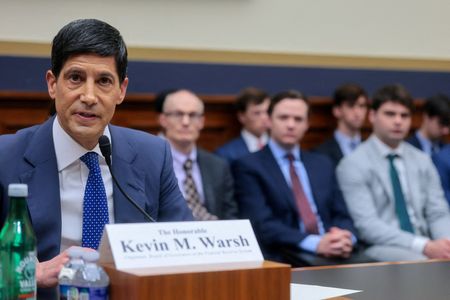

Federal Reserve Chairman Kevin Warsh set out to run a central bank that spoke less and let economic data do the talking. But right now, the bond market is doing plenty of talking on its own — and it is not whispering.
A steep selloff in U.S. Treasury bonds has sent some longer-term yields to their highest points since the financial crisis, raising concerns about whether wild swings in interest rates could become the new normal now that the Fed has pulled back on its market guidance.
Two-year Treasury yields recently climbed to 4.37%, their highest level since February 2025. The benchmark 10-year yield hit 4.71% on Thursday, the highest it has been since January 2025. Thirty-year yields reached 5.19%, approaching a level not seen since 2007. Meanwhile, 30-year real yields — which account for inflation expectations — rose to 2.98%, the highest since 2008.
Analysts point to geopolitics as the immediate spark. Gennadiy Goldberg, who leads U.S. rates strategy at TD Securities, says the selloff reflects a rapid reassessment of what the Fed will do next, driven by climbing oil prices and uncertainty about how long the conflict with Iran will last — both of which are stoking fears about inflation.
A resilient U.S. economy, paired with Warsh’s hands-off approach to steering market expectations, is making the situation worse.
“That’s partly a function of a lack of forward guidance from the Fed by design,” Goldberg said. “And partly it’s a function of the economic data being relatively firm and no real clarity for markets on the geopolitical conflict.”
Much of the yield movement is being driven by so-called real yields — bond returns adjusted for inflation — which suggests traders are rethinking where the Fed’s interest rate will ultimately land, according to Leslie Falconio, who heads taxable fixed income strategy at UBS Global Wealth Management.
“Most of this rise is really by the real yield component, which is repricing the terminal Fed funds rate, and the fact that the growth outlook currently still remains on solid footing,” Falconio said.
Markets currently expect the Fed’s key interest rate to peak near 4.23% by next June, up from its current range of 3.50% to 3.75%.
Expectations of further rate hikes had cooled after the U.S. and Iran reached a ceasefire in June, but renewed fighting reversed that sentiment. Lingering questions about how Warsh’s Fed will respond are adding to the confusion.
That confusion is partly a product of Warsh’s deliberate strategy to break markets of their dependence on Fed forecasts, steering investors toward incoming economic data instead. This is a notable departure from the approach of his predecessor, Jerome Powell, who carefully telegraphed policy decisions to avoid catching markets off guard.
“We got so used to eight years of the Powell Fed where they really didn’t want to go into the pre-communications blackout with market expectations divergent from what the Fed was going to do,” said Will Compernolle, macro strategist at FHN Financial.
“It’s very possible that Warsh’s perspective is that the market shouldn’t be following them inch by inch based on what they’re saying,” Compernolle added.
The result has been whiplash for investors. Fed funds futures now show a 38% chance of a rate hike at next week’s meeting, compared to just 12% a week ago. Goldberg noted that even keeping rates where they are would represent the second-largest gap between market expectations and actual Fed policy in the past decade. An actual hike would be the biggest mispricing in that period, surpassing the surprise 50-basis-point cut in September 2024.
The Fed and oil prices are not the only forces dragging down the bond market. Fiscal concerns are also weighing on longer-term debt as the Iran conflict continues. Defense Secretary Pete Hegseth said Tuesday that the cost of the conflict has risen to $37.5 billion.
The Treasury Department is also scheduled to release its next quarterly funding update on August 5. Traders will be watching closely to see whether it drops language promising to keep auction sizes steady “for at least the next several quarters” — a change that would signal larger sales of longer-term bonds are coming.
Thin economic data and nervous investors unwinding bets on lower rates are adding more pressure to an already tense situation.
Still, some strategists urge caution about placing too much blame on fiscal concerns.
“The driver of the long end is growth and inflation,” Falconio said.
UBS does not expect the Fed to actually raise rates, since inflation driven by oil supply is typically not enough to move policy. That dynamic makes current yields look attractive, Falconio said, noting that interest rate risk “is cheap to spread products, it’s cheap to equity.”
Both Falconio and Goldberg point to a relatively contained term premium — the added return investors require for holding longer-term bonds instead of short-term debt — as evidence that fears about the government’s debt supply have not taken over the long end of the bond market. The term premium on 10-year notes sits around 70 basis points, far below the peaks reached during the financial crisis.
That likely means the economy and Fed policy will remain the main forces moving markets for now — and that could mean more turbulence, not less.
“There is just lots and lots of uncertainty about inflation going forward, and conviction levels among investors are very low,” Goldberg said.