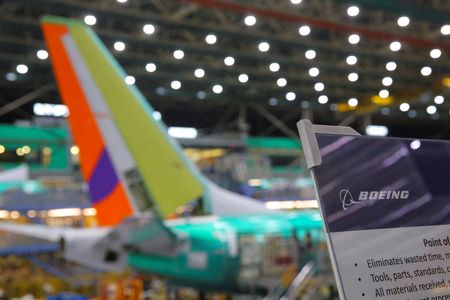

Boeing delivered better-than-anticipated financial results for the first quarter, signaling the aerospace manufacturer’s ongoing recovery following several years of operational challenges and financial difficulties.
The Seattle-based company announced a net loss of $7 million for the three-month period ending in March, representing a significant improvement from the $31 million loss recorded during the same timeframe last year. Wall Street analysts had projected a much steeper core loss of 83 cents per share, but Boeing’s actual results showed only a 20-cent per share loss, according to LSEG data.
Investors responded positively to the news, pushing Boeing’s stock price up 5% during midday trading sessions.
“We’re off to a good start and continue building on our momentum with stronger performance across our business,” CEO Kelly Ortberg said in a memo to employees after the results were released.
During a Reuters interview, Ortberg discussed potential business opportunities, noting that a significant order from Chinese airlines might materialize during a May meeting between U.S. President Donald Trump and Chinese President Xi Jinping. He emphasized that Trump’s backing would be crucial for finalizing such a deal.
Regarding geopolitical concerns, Ortberg indicated he doesn’t anticipate major disruptions to Boeing’s operations from the Iran conflict.
“We’ve had no dialogue with any customer about deferral of deliveries” of jetliners, he said. “This is a very long-cycle business. I’d be surprised if we see any major changes coming out of them.”
Rather than experiencing cancellations, Ortberg noted that customers have requested “that if we do see any slots opening up because of delays, that they’d like to jump in and take those airplanes.”
The company experienced a $1.5 billion cash outflow during the quarter, primarily attributed to substantial investments in expanding 787 manufacturing capabilities in South Carolina, military aircraft production in the St. Louis region, and establishing a new 737 MAX assembly line in Everett, Washington.
Boeing currently manufactures approximately 42 of its popular single-aisle aircraft monthly and plans to increase production to 47 units by the end of the year.
Certification processes for the 737-7 and 737-10 variants, along with the 777X program, also contributed to the cash expenditure.
Company officials anticipate U.S. regulatory approval for the MAX 7 and 10 models this year, with initial deliveries scheduled for 2027.
Chief Financial Officer Jay Malave explained during an analyst conference call that Boeing is implementing design modifications to early-production 777X aircraft in preparation for next year’s initial delivery.
The commercial aviation segment generated $9.2 billion in revenue, marking a 13% increase driven by the strongest first-quarter delivery numbers since 2019. Despite this growth, the division still recorded a $563 million loss for the quarter.
Ortberg told Reuters that Boeing’s late-2025 acquisition of Spirit AeroSystems, the manufacturer of 737 fuselages, resulted in higher-than-anticipated expenses that impacted the commercial airplane division’s performance. He clarified that these elevated costs weren’t related to production quality problems that have affected Spirit AeroSystems recently.
The defense and space segment showed strong performance with earnings climbing 50% to $233 million in the first quarter. During this period, the Space Launch System rocket, developed jointly with Northrop Grumman, successfully launched NASA’s Artemis II lunar mission.
Industry experts and company executives expect continued benefits from increased global defense spending amid ongoing conflicts in the Middle East and Ukraine, plus rising geopolitical tensions worldwide.
The Pentagon recently awarded Boeing the contract for the nation’s first sixth-generation fighter aircraft, the F-47, and the company remains a contender for the U.S. Navy’s sixth-generation F/A-XX fighter program.
Boeing’s most stable business unit, global services, reported a 3% rise in operating income to $971 million. However, operating margins declined slightly to 18.1%, which management attributed to last year’s $10.6 billion sale of its Jeppesen digital aviation services subsidiary.
Overall, Boeing recorded an 11-cent loss per diluted share, or 20 cents per share for core operations in the first quarter, compared to a 16-cent loss per diluted share during the previous year’s comparable period.