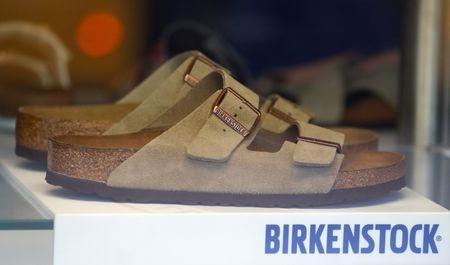

The famous sandal manufacturer Birkenstock is experiencing a dramatic decline in investor confidence as its strategy to become a high-end luxury brand appears to be stumbling.
When the company launched its stock market debut in 2023, it marketed itself as a centuries-old footwear maker transforming into a contemporary luxury brand. However, recent market performance indicates investors are now viewing the business more as a specialized footwear company with a dedicated but limited customer base, rather than a potential luxury giant comparable to companies like LVMH, which holds a partial stake in the ergonomic shoe manufacturer.
These concerns deepened following last week’s earnings report, where the company revealed slower quarterly expansion and declined to increase its yearly revenue projections, citing trade tariffs and Middle Eastern conflicts as contributing factors. Stock prices plummeted over 14% to hit an all-time low of $32.44, reducing the company’s total market value by nearly 38% from its $9.3 billion initial public offering valuation.
This market reaction highlights a widening gap between the company’s original positioning and current investor assessment. The brand occupies a middle ground between luxury and mainstream markets – more upscale than typical footwear companies in terms of distribution control and pricing strategies, yet lacking the scope and product diversity of established luxury brands.
“Investor expectations likely became inflated once the brand was valued more like a luxury fashion company than a footwear company,” explained Keith Fraley, an assistant professor at the Fashion Institute of Technology in New York. According to Fraley, the current challenge involves preserving exclusivity while pursuing worldwide expansion.
This fundamental tension permeates the company’s operations. Manufacturing most of its products in Germany strengthens its premium positioning but exposes the business to elevated production costs compared to competitors who manufacture in Asian markets.
Meanwhile, consumer demand shows signs of weakening. While affluent customers have accepted price increases, budget-conscious shoppers are reducing purchases as elevated living expenses impact discretionary spending.
These challenges were apparent in the most recent quarter, with profit margins declining due to dollar weakness against the euro and tariff costs doubling to 20%, damaging profitability in the United States, its primary market. The company’s adjusted EBITDA margin dropped 270 basis points in the latest quarter, with management indicating these pressures will continue affecting margins throughout the year.
Industry analysts and brand specialists note that the company’s signature contoured cork footbed sandals, which define its brand identity, function primarily as seasonal summer footwear, making substantial growth difficult despite expansion into clogs, boots and sneakers. Rather than achieving high-growth luxury status, investors are now adjusting expectations toward viewing it as a stable but more limited consumer brand.
“Fashion markets eventually ask the same question: is this timeless or did everyone who wanted in buy enough?” commented Michael Ashley Schulman, a partner at Cerity Partners.
This sentiment change is reflected in current valuations. Company shares now trade at approximately 13 times projected earnings, matching industry standards – a significant drop from the premium valuation when the stock reached its peak of 123.17.
In comparison, rival company Crocs has escaped similar market punishment partly because it already trades at mainstream footwear valuations – 7 times its upcoming 12-month earnings – while maintaining profit margins exceeding 20%.
“If (Birkenstock) chases volume by opening too many wholesale doors or relying on promotions, they will lose the luxury premium they’ve spent decades building,” warned Eric Tsytsylin, a brand strategy partner at Lippincott, a global brand consultancy.