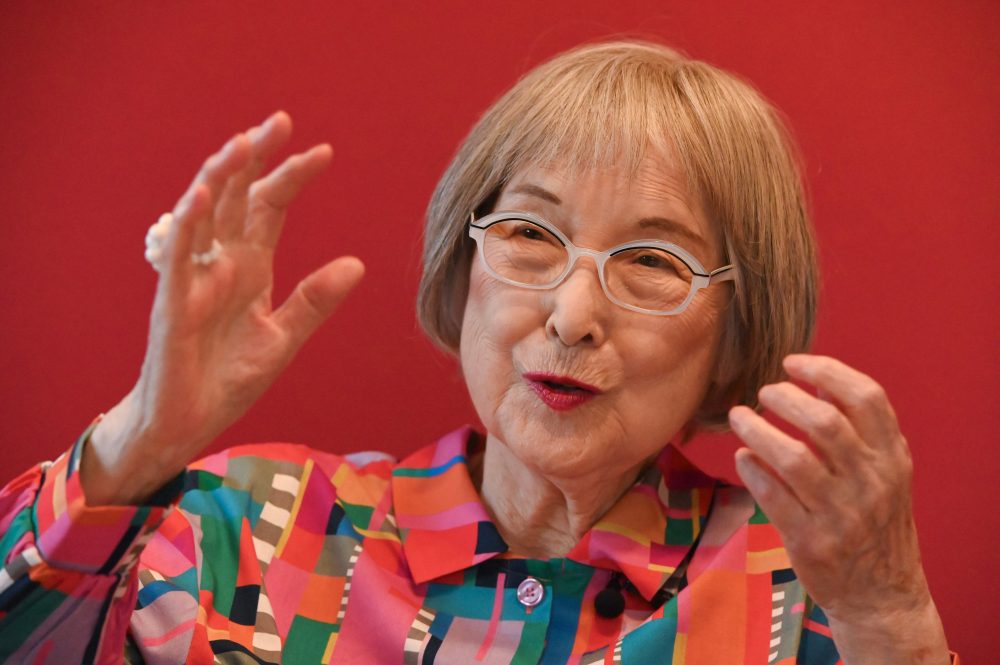

KAMAKURA, Japan — The Japanese author behind one of the country’s most cherished literary characters — a young witch named Kiki — has a bit of difficulty climbing stairs these days. But at 91 years old, Eiko Kadono hasn’t slowed down when it comes to writing.
Kadono still sits down to write every single day, still loves the color pink, still dresses up, and still holds firmly to her belief in the transformative power of books.
Her most famous work, “Kiki’s Delivery Service,” was first published in 1985 and later adapted into an animated film in 1989 by Hayao Miyazaki’s Studio Ghibli. It is just one of roughly 200 books she has authored.
“I never tire of writing,” she told The Associated Press during a visit to her home in the scenic coastal town of Kamakura, located south of Tokyo.
Her home, marked by a small pink gate, is packed with books, pink chairs, and a collection of animal figurines.
“I’m probably a child at heart,” Kadono said with a quiet laugh.
She was dressed in a colorful smock — designed specifically for her by her daughter — and wore her trademark boldly framed glasses. She noted with pride that the smock’s sleeves have elastic at the wrists so they can easily be pushed up while she writes.
Today, she types on a keyboard, pressing each key slowly and deliberately. But every story still begins the old-fashioned way — written by hand. She also sketches drawings as part of her creative process.
“I want to write so that the reader can visualize what I am writing,” she said. “I love to write.”
Kadono remains sharp and quick-witted. She’s unbothered about wearing a wig and doesn’t understand why anyone would feel the need to hide it. She wears red lipstick and is only slightly self-conscious about her wrinkles.
Her writing style has remained largely consistent over the decades, though looking back at her earlier work, she feels it was more wordy compared to the cleaner, more precise style she favors now.
The original Japanese Kiki series spans six books along with three spinoff titles. The first book was translated into English in 2020 by Delacorte Press and is now available in 25 languages worldwide.
The second installment in the English series, “Kiki and the New Magic,” is scheduled for release in August, translated by Emily Balistrieri and illustrated by Yuta Onoda.
Kadono never planned to become a writer. She was, by her own description, primarily a housewife — married to a designer and raising a daughter. During her 30s, she spent two years living in Brazil and was later asked to write about that experience. That’s when she realized she genuinely enjoyed writing — not as a profession, but as something she found fun and fulfilling.
The spirited, no-nonsense character of Kiki was actually born from a drawing her daughter made at age 12 — a cute little witch flying on a broomstick toward the moon. From that image, Kadono crafted a coming-of-age adventure featuring Kiki and her black cat, Jiji.
Kiki’s Museum of Literature opened in Tokyo in 2023 and now sells Kadono’s signature smocks, pink mugs, and T-shirts featuring her characters, alongside shelves upon shelves of books by various authors.
A statement displayed in pink lettering on the museum wall reads: “The other-worldly fantasy that Kadono creates has overcome the boundaries of language, to become appreciated by a wide global audience, including children and adults, and won international accolades.”
A five-year-old visitor named Tsukiko Fukuda, who was touring the museum with her family, put it more simply: the books are fun, and pink is her favorite color too.
Kadono, who received the prestigious Hans Christian Andersen Award in 2018, says she hopes a steady stream of talented children’s book authors will emerge so that future generations can grow up loving to read.
She believes we are at a critical crossroads that will determine whether that vision becomes reality. The outdoor adventures and imaginative play that once shaped children’s lives have largely faded away, replaced by digital entertainment and modern distractions.
That’s why reading matters more than ever, she says.
“People must think on their own to be able to create. That’s what being human means,” Kadono said, her voice filled with conviction. “Books are the only thing now that can bring about creation and imagination.”