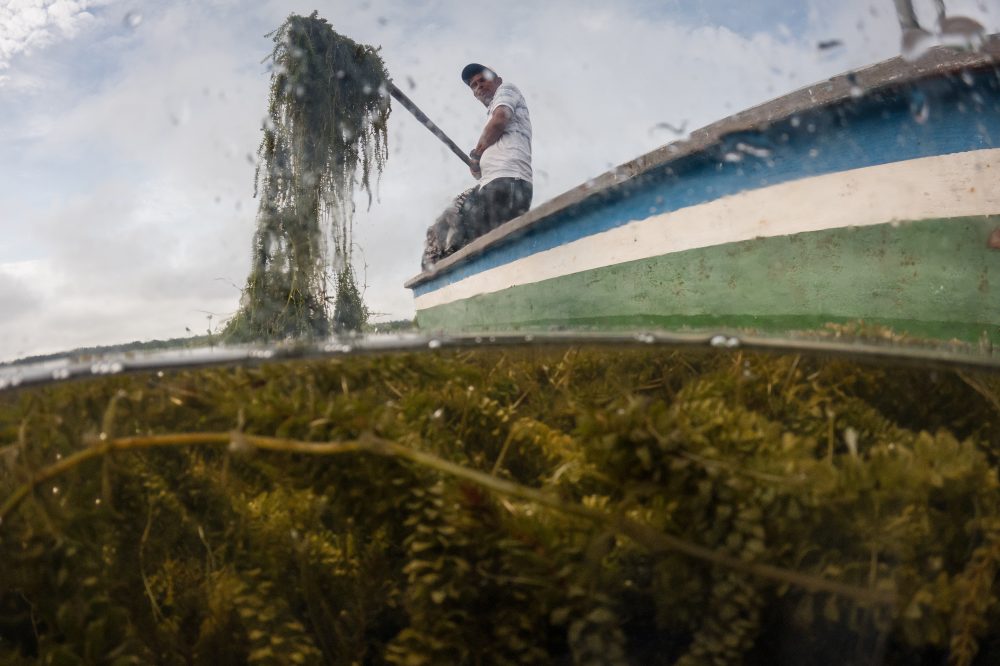

NUEVA VENECIA, Colombia — Standing in his small speedboat, Jhon Cantillo pulls up a dense mass of bright green aquatic vegetation and points toward the endless expanse of water now blanketed by the invasive plant.
The thick vegetation creates an almost solid green carpet across the water’s surface when viewed from above. Below the surface, lengthy stems dive deep into the water column with roots stretching toward the bottom, making complete removal nearly impossible.
This environmental disaster is playing out in Colombia’s Cienaga Grande de Santa Marta, an enormous coastal marsh system located roughly 19 miles from Santa Marta on the Caribbean shoreline. What once served as a crucial transportation route and fishing ground has transformed into what local leaders call an ecological emergency as thick plant growth strangles the waterways.
“What we’re seeing here today is a problem. One that affects not only movement or fishing, but the community as a whole,” said the 32-year-old Cantillo, who works as an environmental and social advocate in the Cienaga Grande de Santa Marta region.
Local residents report that the rapidly expanding invasive species from Asia — known scientifically as Hydrilla verticillata — has taken over the wetland during the past twelve months after initially emerging around mid-2025. The thick plant growth, which community members call “horse tail,” is blocking traditional fishing paths, jamming waterways and preventing access to areas where people gather freshwater, while increasing expenses for communities that depend almost completely on the lagoon for survival.
The Cienaga Grande de Santa Marta represents one of Colombia’s most critical fishing habitats, functioning as breeding grounds for numerous marine species.
In Nueva Venecia and Buenavista — two remote fishing villages constructed almost completely on wooden platforms above the water — vast areas of previously open water now lie beneath the invasive vegetation. Both communities exist largely as informal settlements without access to many essential government services.
Nueva Venecia — established in 1847 as a fishing village — houses approximately 4,500 residents in roughly 500 brightly painted dwellings. Buenavista, which developed during the 1950s, contains about 1,150 people living in 163 equally colorful structures, where residents navigate between homes, businesses and educational facilities using small watercraft and canoes.
“A year ago, there were canoes fishing here. Teachers and students crossing the lagoon. Today, what we see is a problem,” Cantillo said.
The consequences are spreading throughout these already struggling communities. Fishing yields have declined, transportation has grown more challenging and households are experiencing increased expenses as they must purchase drinking water.
In Nueva Venecia, a local fisherman worked without a shirt under the intense midday sun, removing dried pieces of vegetation from his fishing equipment, which he had spread in the sunlight to facilitate cleaning.
“We can’t work because of this plant,” said 61-year-old Santander Cueto. “It doesn’t let us cast our nets — everything gets tangled.”
Tasks that were once simple now require much more time to complete.
“The lagoon’s completely covered. There’s nowhere left to fish,” said Demóstenes Guerrero, 58, a fisherman and representative of a fishing association in Buenavista.
In certain locations, community groups venture out in wooden vessels to carve narrow pathways through the densest plant growth, creating channels for canoes to navigate without fouling their motors. These activities require intensive labor and depend primarily on community volunteers, and must be repeated every few days since the quickly growing vegetation rapidly blocks the passages again.
The marsh system covers approximately 1,600 square miles of lagoons, mangrove forests and wetlands — roughly equivalent to Los Angeles — and has held UNESCO biosphere reserve status since 2000.
The Cienaga Grande de Santa Marta receives water from the Magdalena River — one of Colombia’s primary waterways — which transports untreated sewage from throughout much of the nation, explained Julián Arbelaez, a water and sanitation engineer working in the area.
This influx of nutrients, including nitrogen and phosphorus, establishes perfect conditions for invasive plants when water movement slows in wetland environments like this one.
“That load causes the river to enter a state of eutrophication,” Arbelaez said, describing a phenomenon where excessive nutrients promote accelerated plant development.
The plant growth is also preventing access to cleaner water sources. Community members normally travel by boat to gather freshwater from channels linked to the Magdalena River, but many of these pathways are now obstructed. Consequently, Arbelaez explained, people are increasingly obtaining water nearer to their residences — frequently in locations contaminated by raw sewage.
Community members report that another invasive species, Eichhornia crassipes, which remains on the water’s surface, has existed in the lagoon for an extended period and also interferes with fishing and transportation, although its effects have been less dramatic.
Local officials say modifications in water circulation have also contributed to the emergency, with freshwater now controlling areas where saltwater previously helped control or eliminate Hydrilla verticillata.
Sandra Vilardy, a Universidad de los Andes professor with a doctorate in ecology who has studied the region for approximately two decades, explained that research remains limited regarding how the plant arrived and that current theories are still hypothetical.
She indicated that maritime shipping represents one of the most probable introduction methods, with the vegetation possibly entering through major river networks before expanding into wetlands via smaller boats and dredging operations. Another possibility, she noted, involves the disposal of aquarium plants into waterways, a frequent source of biological invasions worldwide, though she observed this explanation seems less probable given the area’s environmental characteristics.
“This is a monster in terms of growth,” Cantillo explained, detailing how it expanded from minimal presence early last year to encircling entire communities within months.
Attempts to eliminate the plant can actually worsen the problem, since pieces can separate and spread to new areas. Community members say removal efforts have been mostly restricted to small-scale manual clearing by fishermen and occasional test programs by government agencies, with no successful comprehensive solution implemented.
The emergency is now causing some residents to contemplate relocating permanently.
“We now face a risk that we didn’t have 20 or 25 years ago — the risk of mass displacement,” Cantillo said.
Demonstrations and highway blockades have occurred as anger increases over what locals characterize as an inadequate and delayed government response.
Alfredo Martínez, director of CORPAMAG, the regional environmental agency, stated that Hydrilla verticillata lacks official classification as an invasive species in Colombia and that national management protocols remain under development. He reported that monitoring and removal activities are proceeding with local community participation, noting that no additional expansion has been detected since March and that reduced water levels may be limiting its growth.
César Rodríguez Ayala, a community leader in Nueva Venecia, described how the emergency is impacting virtually every element of daily life.
“If the fisherman can’t work, the shop doesn’t sell,” he explained. “We are living a very difficult situation, economically and environmentally.”
Although mechanical removal techniques are available, complete elimination appears unlikely in the near future due to expensive costs and restricted resources, according to Cantillo.
“We are part of Colombia too,” Rodríguez stated. “We live on the water, but we also deserve to be seen — and helped — in a moment like this.”