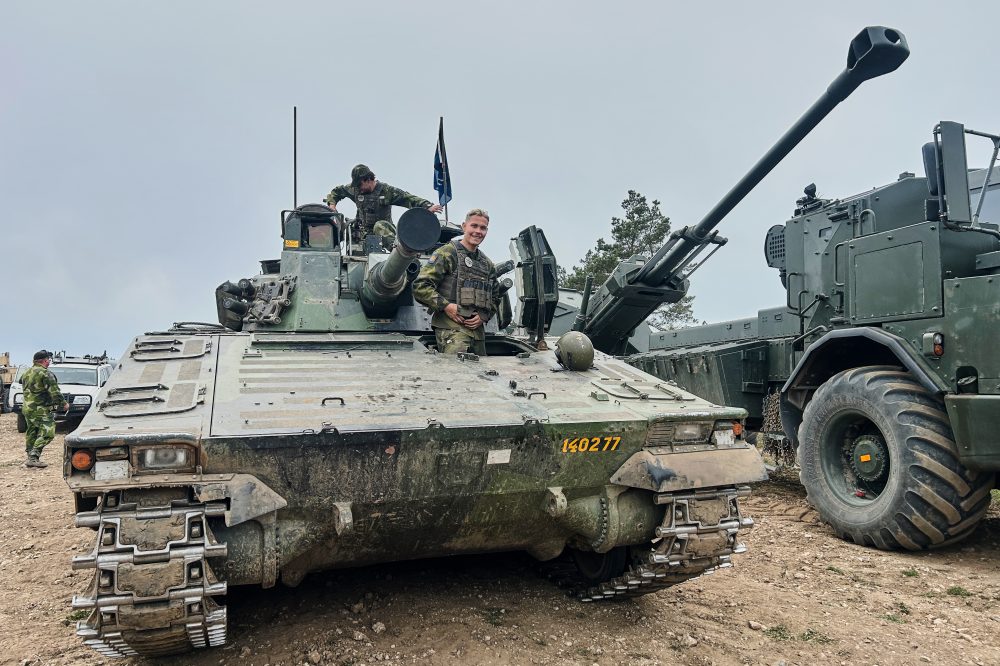

GOTLAND, Sweden — Military leaders from NATO nations gathered this week on a strategic Swedish island to conduct war games simulating an attack by an unnamed adversary massing forces near the alliance’s eastern frontier. In a notable development, Ukrainian military advisors joined the exercise to share their battlefield expertise in drone combat.
The Associated Press observed the Swedish-organized training exercise as European nations grapple with dual challenges: escalating Russian aggression and uncertainty about America’s continued NATO commitment.
The military simulation, which included American personnel, addressed real-world security concerns. An Associated Press investigation has documented Russia’s intensified sabotage campaign across Europe, featuring cyberattacks on vital infrastructure and widespread disinformation operations.
Exercise planners designed a scenario where Gotland island faced electrical blackouts and food supply disruptions from sabotage attacks, examining potential NATO responses before triggering Article 5, the alliance’s mutual defense provision.
“In theory, it could happen tomorrow,” said Rear Adm. Jonas Wikström, director of the exercise.
Swedish Defense Chief Gen. Michael Claesson acknowledged America’s crucial military role in European security, explaining that “any change in the American presence” impacts alliance capabilities. He emphasized to the AP that despite President Trump’s announced European troop reductions, interpretations “as the Americans are leaving — and they are not” miss the mark.
Nevertheless, European defense officials are closely monitoring the Trump administration’s NATO policies. Trump has previously characterized the alliance as a “paper tiger” and recently ordered at least 5,000 American troops withdrawn from Germany, threatening additional removals.
The president has also criticized NATO partners for failing to support America in Iran-related conflicts, while U.S. air defense systems and missiles have been relocated from Europe to the Middle East, creating potential security gaps. Several European countries have been informed of delays in their American weapons purchases.
Claesson dismissed suggestions that recent initiatives — including a “hybrid navy” partnership among Nordic, Baltic, British and Dutch forces — represent preparation for reduced American support.
However, he noted, “everything that offers European allies freedom of action is good.”
Britain and Norway are also developing joint frigate capabilities, according to Marte Gerhardsen, state secretary at Norway’s Defense Ministry.
Since Trump’s January 2025 return to office, he has suspended intelligence sharing with Ukraine and occasionally supported Moscow’s positions in war-ending negotiations.
During this week’s exercises, Ukrainian forces demonstrated their combat experience and potential value as future NATO members.
Ukrainian drone specialists invited to train Western troops in aerial warfare tactics decisively defeated Swedish forces during simulations, a 24-year-old pilot reported to the AP.
“They stopped the training three times” to allow troops tactical adjustments, but in actual combat “they would have been dead,” explained the pilot, identifying himself by his military call sign Tarik.
Swedish personnel show promise but require improved drone technology and tactics, while commanders need enhanced understanding of unmanned warfare, said another pilot using the call sign Karat.
He detailed operating small, first-person-view attack drones against Russian positions on front lines. Drone operators sometimes receive reconnaissance support but often work “blindly.”
Western military personnel cannot comprehend the reality, he added: “You need to see this with your own eyes.”
All Western forces must “learn rapidly” in drone operations and countermeasures, with Ukrainians offering the “fastest” learning opportunity, Claesson stated.
“What they’ve taught us is you have to really focus on your survivability and how you can’t be detected,” explained U.S. Brig. Gen. Curtis King. Simultaneously, Western nations must develop “deep” detection systems for long-range drone identification.
This expertise is critically needed along NATO’s Russian border, where recent months have seen multiple drone violations, including Ukrainian aircraft diverted by Russian electronic jamming.
The objective involves creating integrated systems allowing radar from various manufacturers and countries to share threat data, King explained. While this process has begun, “we’re not there yet.”
Exercise planners selected Gotland island due to its strategic Baltic Sea position between Russian-controlled Kaliningrad — where Moscow has deployed missiles — and mainland Sweden.
“If you control Gotland, you pretty much control the central part of the Baltic Sea,” Claesson observed.
The Baltic Sea serves as Russia’s economic lifeline, with “shadow fleet” vessels transporting oil and liquefied natural gas that funds Moscow’s Ukrainian war effort.
Following the Cold War’s end, Sweden essentially eliminated Gotland’s military presence, but Russia’s 2022 Ukrainian invasion prompted reconsideration and reinforced military deployment. Sweden and Finland both joined NATO in 2024.
“A very reasonable scenario” involves Russian President Vladimir Putin using Gotland to challenge NATO by seizing a small portion of alliance territory to test collective response, Claesson suggested.