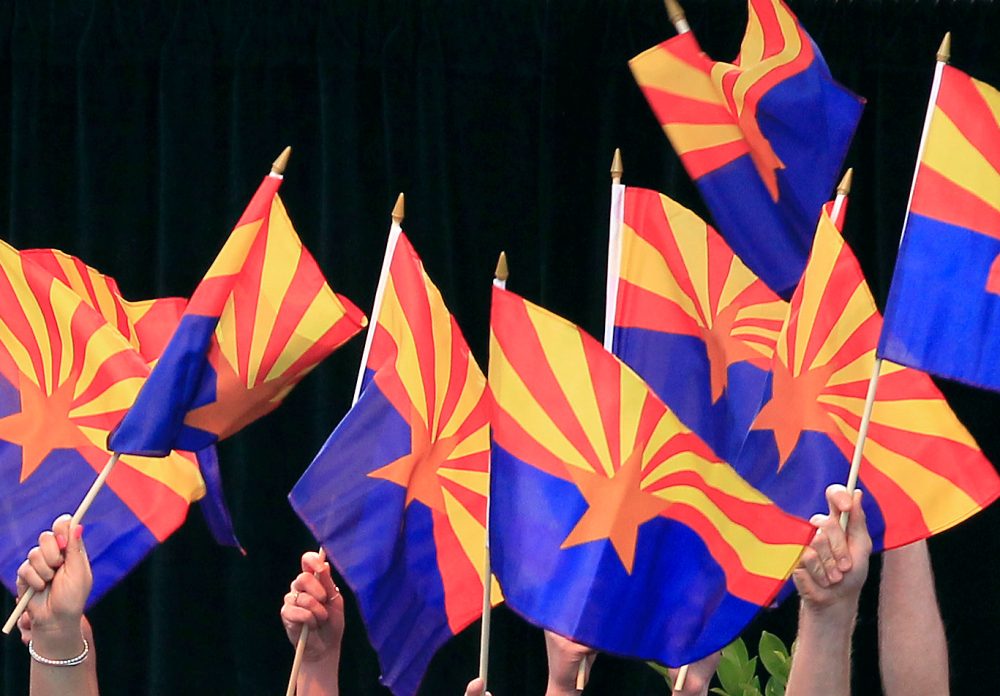

WASHINGTON — Arizona voters are casting ballots Tuesday in a state primary that will determine who Republicans send to challenge Democratic Gov. Katie Hobbs in November’s general election. Voters statewide will also lock in matchups for competitive U.S. House races and a full slate of state and local contests.
The Arizona governor’s race is seen as a prime pickup opportunity for Republicans, especially in a midterm election year when the party in the White House has historically faced a backlash from voters. Whoever wins the governorship — and the statewide political network that comes with it — could be a key player in the 2028 presidential race, since Arizona is once again projected to be a critical swing state.
Of the seven Democratic governors currently leading states that Donald Trump carried in 2024, only two face reelection in 2026. Among them, only Hobbs is expected to be in a truly competitive general election.
Four candidates are fighting for the Republican gubernatorial nomination: two sitting members of Congress and two businessmen. Five-term U.S. Rep. Andy Biggs, a former chair of the conservative House Freedom Caucus, is one of the congressional contenders. Eight-term U.S. Rep. David Schweikert is the other, having chosen to give up his competitive swing-district seat after barely fending off strong Democratic challenges in each of the past three election cycles. Rounding out the field are businessmen Ken Miceli and Scott Neely, both of whom have backgrounds in the construction industry.
Biggs holds an important endorsement from Trump. The president had previously backed another candidate — billionaire housing developer Karrin Taylor Robson — but issued a second endorsement for Biggs shortly after Biggs entered the race in early 2025. Taylor Robson withdrew from the race in February. Trump has been known to endorse multiple candidates in the same contest; he recently endorsed both candidates in the Republican primary runoff for South Carolina governor.
In the race to fill Schweikert’s seat in the 1st Congressional District, the Republican primary field includes state Rep. Joseph Chaplik, sportscaster and former Arizona Cardinals placekicker Jay Feely, and technology and telecommunications executive John Trobough. Feely had initially entered the race in the 5th Congressional District, but after Trump endorsed a different candidate there and encouraged Feely to seek a different seat or office, Feely shifted to the 1st District. Trump then endorsed both Feely and former state party chair Gina Swoboda for that nomination. Swoboda later exited the congressional race to instead run for secretary of state.
On the Democratic side, the 1st District primary includes two candidates who also competed for the same seat in the 2024 primary: former state Rep. Amish Shah and former local news anchor Marlene Galán-Woods. Shah won the Democratic nomination two years ago, while Galán-Woods placed third among six candidates. In the 2024 general election, Shah captured 48% of the vote against Schweikert. Publisher Rick McCartney and entrepreneur Jonathan Treble also appear on the Democratic primary ballot.
The 1st Congressional District sits just northeast of Phoenix and takes in Scottsdale. The district falls entirely within Maricopa County. Schweikert won his 2024 and 2022 reelection races with 51.9% and 50.4% of the vote, respectively. In the 2024 presidential contest, Trump received roughly 51% of the district’s vote, compared to about 48% for then-Democratic Vice President Kamala Harris.
Another Republican-held seat that Democrats are eyeing in their effort to reclaim the U.S. House is in the 6th Congressional District, where Rep. Juan Ciscomani is seeking a third term. Both Ciscomani and his Democratic opponent, Marine Corps veteran JoAnna Mendoza, are running unopposed in their respective primaries.
All 30 Arizona state Senate seats and all 60 state House seats are also on the ballot. Republicans currently hold narrow majorities in both chambers. Democrats have not controlled the state Senate since 1992, and they last held the state House in 1966 — the most recent time the party simultaneously held the governorship and both legislative chambers.
Maricopa County is by far the largest and most influential county in both parties’ statewide primaries. Home to Phoenix, Scottsdale, Tempe, and Mesa, the county accounted for roughly 61% of the total vote in the 2024 presidential general election. Pima County ranked a distant second, contributing about 15% of the vote.
Polls close at 7 p.m. local time, which translates to 10 p.m. ET for most of the state. No results will be made public before 11 p.m. ET. Most of Arizona does not observe daylight saving time, though the Navajo Nation is an exception — polls there close at 9 p.m. ET.
Registered Democrats and Republicans are limited to voting in their own party’s primary. Voters not affiliated with either party may choose to participate in either the Democratic or Republican primary.
As of July, Arizona had approximately 4.3 million registered voters — about 1.5 million Republicans, roughly 1.2 million Democrats, and approximately 1.5 million voters with no party affiliation.
In the 2022 gubernatorial primaries, about 596,000 Democratic ballots and roughly 831,000 Republican ballots were cast. Arizona conducts most of its elections by mail, with around 93% of Democratic primary votes and about 79% of Republican primary votes cast either early in person or by mail in the 2022 state primaries.
As of Thursday, approximately 755,000 ballots had already been submitted for Tuesday’s election — about 335,000 from Democrats and 347,000 from Republicans.
Arizona counties typically release the bulk of their early in-person and mail voting results in the first vote update of the evening, generally before any Election Day in-person votes are reported. In the 2024 state primary, the first results were published at 11:02 p.m. ET, just two minutes after the state permitted their release. About half of all votes had been counted by 11:05 p.m. ET, and the final update of the night came around 5:35 a.m. ET, at which point roughly 83% of total votes had been tallied.
In Arizona, an automatic recount is triggered if the margin between candidates is 0.5% or less of the total votes cast. As of Tuesday, 105 days remain until the 2026 midterm elections.