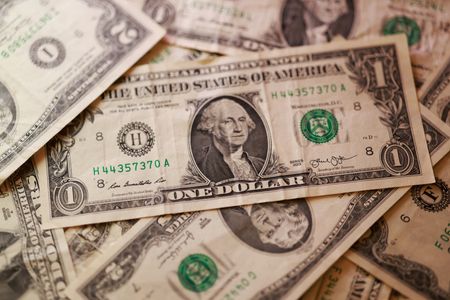

The U.S. dollar held steady near a one-week high on Tuesday as financial markets struggled to make sense of contradictory signals coming out of the Middle East, where ongoing hostilities are raising fresh concerns about global energy supplies even as ceasefire talks offer a glimmer of hope.
Against the Japanese yen, the dollar was largely unchanged at 162.50 yen. The euro showed little movement, trading at $1.1415, while the British pound held its ground at $1.3434 after Britain’s new Prime Minister Andy Burnham pledged to maintain the country’s fiscal rules.
The U.S. dollar index — a measure of the currency’s strength against six other major currencies — was steady at 100.96, putting it near its strongest point since July 15.
Currency markets remained deeply influenced by the situation in the Middle East, with oil prices swinging sharply near six-week highs. Yemen’s Iran-aligned Houthi forces announced a naval blockade against Saudi Arabia, heightening concerns about threats to the world’s energy supply chains. At the same time, some optimism remained after Tehran received a 10-day ceasefire proposal from international mediators.
Rodrigo Catril, a senior currency strategist at National Australia Bank, addressed the uncertainty in a podcast, saying: “There is the hope for easing in a little bit of tensions and we’ll hit a pause button at some stage. It’s all still very volatile.”
He added, “We have to wait and see how it develops. We need to see whether this escalates.”
On the inflation front, U.S. Treasury yields edged higher as investors weighed whether a fresh surge in oil prices — driven by the broadening conflict with Iran — could eventually push consumer prices upward. The benchmark 10-year Treasury yield remained elevated at 4.5937%, while yields on 30-year Treasuries stayed firmly above the 5% threshold.
The New Zealand dollar climbed 0.4% to $0.5860, reaching its highest point since early June, following strong inflation figures that reinforced expectations for additional interest rate increases. The Australian dollar also gained slightly, trading at $0.7001.
In Europe, a survey released Monday by the European Central Bank showed that businesses in the euro zone expect to raise their selling prices at a more modest pace going forward. The ECB is widely expected to leave interest rates unchanged this week, though elevated oil prices are fueling speculation that another increase to the 2.25% deposit rate could come in September.
The Canadian dollar stabilized after falling to a one-month low following the United States’ decision to impose a sweeping 50% tariff on a broad range of Canadian goods. Washington justified the move by citing what it described as Ottawa’s “discriminatory treatment” of American trade interests.