
BUENOS AIRES, Argentina — Argentina’s President Javier Milei has taken his hostility toward the press to new extremes, banning all credentialed journalists from the nation’s presidential palace while launching vicious social media tirades against reporters.
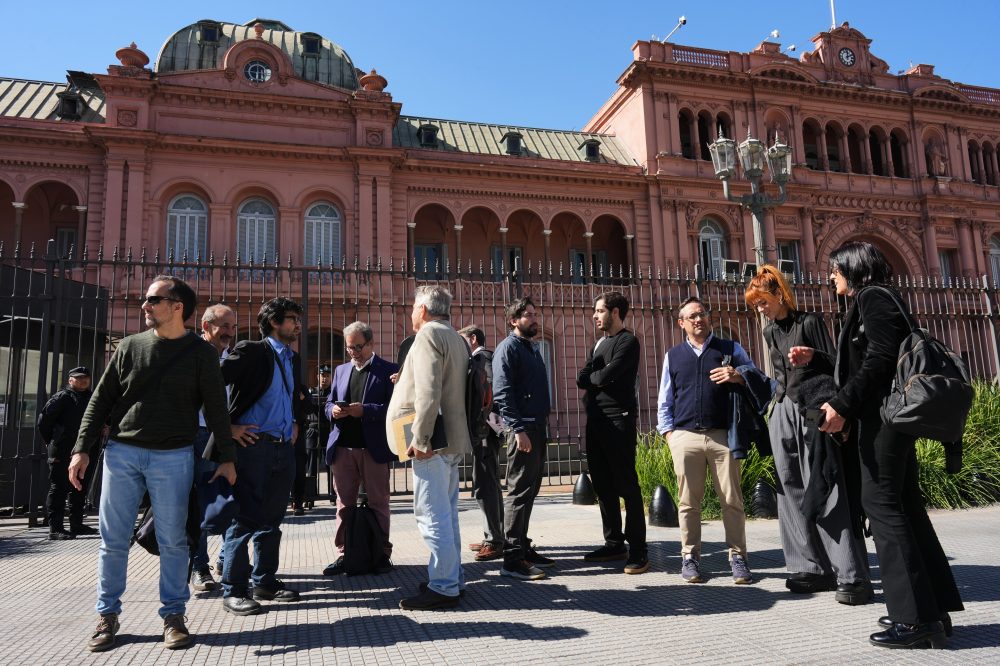
The libertarian leader recently prevented approximately 60 accredited journalists from accessing the Casa Rosada, Argentina’s equivalent to the White House. On social media, Milei unleashed a barrage of insults in capital letters, calling the nation’s press “filthy scum that claims to be journalists.” He even shared an artificial intelligence-created image depicting a local television reporter wearing an orange prison uniform.
This dramatic escalation represents the most severe restriction on press access since Argentina’s military dictatorship ended in 1983, according to media rights organizations and political leaders across party lines.
“It’s the culmination of the government’s contempt for journalism and its value in a democracy,” said Fernando Stanich, president of the Argentine Journalism Forum, a professional group.
The nation has historically celebrated its robust and independent news media, making Milei’s actions particularly shocking to democracy advocates.
“Argentina is still a democracy, but these are the actions of an autocrat,” said Cristina Zahar, Latin America coordinator for the Committee to Protect Journalists, a watchdog group. “An autocrat who tries to curtail press freedoms, who tries to prevent journalists from reporting and keeping society informed about public interest matters.”
Government spokesperson Javier Lanari defended the press ban Thursday, describing it as “a preventative measure” following a local television station’s broadcast of footage captured with smart glasses inside the presidential palace, allegedly without proper authorization.
Casa Rosada security officials are pursuing legal action against the Todo Noticias network, with Lanari accusing the outlet of “illegal espionage.” He declined to provide additional details when contacted for comment.
However, Luciana Geuna, a Todo Noticias journalist involved in the incident, stated during her Sunday program that they had informed press officials about their filming intentions beforehand. Geuna explained the footage captured publicly accessible areas of the Casa Rosada that had been televised previously.
Milei’s confrontational approach and inflammatory rhetoric helped establish his outsider credentials during his 2023 campaign, drawing comparisons to Donald Trump and former Brazilian President Jair Bolsonaro. The former television commentator rode this provocative style to victory on promises to dramatically reduce government spending.
Rather than tempering his hostile language after assuming office, Milei has intensified his media attacks over the past two years.
Analysis of Milei’s social media activity by the prominent Argentine newspaper La Nación revealed that between April 2 and 5, he published 86 posts mocking and attacking journalists while resharing 874 similar messages. Many of these posts included requests to classify the press as a terrorist organization and contained sexually suggestive content.
His typical posts about media outlets feature his trademark phrase, “We don’t hate journalists enough,” along with claims that 95% of journalists are criminals. He frequently targets specific reporters who criticize his administration, using derogatory terms ranging from “dirty operative” to “human garbage.”
While revoking press credentials from roughly 60 Casa Rosada reporters Thursday, Milei continued his online assault: “Disgusting scum, how about you try stopping the lies?” he wrote. “Oh I forgot, you lot are corrupt junkies hooked on advertising bucks and bribes.”
This approach mirrors Trump’s first-term strategy of labeling journalists as the “enemy of the people.”
Since becoming president, Milei has avoided holding any press conferences, preferring to communicate through slogans and AI-generated internet memes — another similarity with his American counterpart. While he rarely grants interviews to established news organizations, he frequently appears on programs hosted by right-wing influencers.
The president has elevated social media provocateurs to government roles and energized a new wave of digital supporters to attack traditional news outlets he claims have leftist bias.
“When he hires influencers to work at the presidency, it’s like saying, ‘You journalists don’t matter anymore,’” Zahar said. “Everyone suddenly feels empowered to use stigmatizing discourse against the press.”
Following Trump’s example of pursuing legal action against major news organizations including The Associated Press, The New York Times, Wall Street Journal, ABC and CBS News, Milei has filed defamation lawsuits against at least eight journalists within the past year while encouraging his supporters to do likewise.
“Milei’s followers are extremely fanatical. They’ve harassed me, doxxed me, dragged me into mediation,” said Alejandro Alfie, a media reporter for Clarin, Argentina’s largest newspaper, who has investigated networks of anonymous social media accounts promoting Milei. Alfie currently faces four defamation lawsuits from Milei’s close associates seeking millions in damages.
“People say, ‘Oh, it’s not real. It’s just social media.’ But when you have someone telling you on Instagram every day that they will kill your children, it is something else entirely.”
Milei has also amended transparency laws to restrict public access to government information and closed Argentina’s state news agency Telam in 2024, claiming it served as a propaganda tool for left-leaning opposition groups. The agency has since been converted into an advertising company. Similarly, Trump cut funding to PBS and NPR last year due to dissatisfaction with their coverage of conservatives.
Journalists emphasize that public ridicule and mockery of their profession creates genuine safety concerns — a dynamic also evident in the relationship between American media and Trump.
Reporters barred from the Casa Rosada Thursday said the action was predictable.
Last year, the government restricted media movement within the building, declaring certain sections off-limits and limiting attendance at news briefings.
Earlier this month, authorities prevented six accredited media organizations from accessing both the Casa Rosada and the lower congressional chamber, alleging the journalists participated in Russian-backed disinformation campaigns. The reporters denied any connections to the Russian government.
The lawsuit against the two journalists who recorded footage using Meta smart glasses followed shortly after.
“It was the perfect excuse to extend the punishment to the entire press corps,” said Jaime Rosemberg, a political correspondent for La Nación who was among 60 accredited journalists blocked from the Casa Rosada on Thursday.
Opposition response has been immediate, with one lawmaker filing suit against the government over the ban and a dozen legislators demanding urgent meetings with senior officials regarding what they termed an “institutional undermining of freedom of expression.”
The press ban arrives during a challenging period for Milei, whose approval ratings have dropped to their lowest point since taking office, according to AtlasIntel polling.
His campaign to eliminate Argentina’s persistent inflation has stagnated, unemployment has risen, and the economy has shrunk. Corruption investigations reminiscent of the scandals that affected the political establishment Milei promised to replace have compounded his difficulties, with his close ally and chief of staff, Manuel Adorni, now under investigation for misusing public funds.
Some journalists connect the government’s growing problems with its increasingly aggressive attacks on news media.
“It’s a very bad moment for the president,” Rosemberg said. “And often the easiest thing to do in that moment, what you have closest at hand, is to blame the press for everything.”