
DEARBORN, Mich. — A year and a half after America’s most prominent Arab American community backed Donald Trump’s return to the White House, residents continue their daily prayers for peace.
Families in this Detroit suburb anxiously await updates from overseas relatives, hoping for safety news while grieving those they’ve already lost to violence.
The initial heartbreak over Gaza’s conflict has expanded significantly. With Dearborn’s substantial Lebanese American residents, Lebanon’s escalating warfare has brought the crisis closer to home. This overseas turmoil now intersects with domestic challenges including stricter immigration policies, economic difficulties, and rising local tensions following a recent synagogue attack.
“The community now sees that it could have got worse — and it did get worse,” said Nabih Ayad, founder of the Arab American Civil Rights League. “But the community was just so desperate.”
The election-season media attention that once focused intensely on Dearborn has diminished. Large-scale demonstrations have subsided. Yet within religious centers, at memorial services, and during family gatherings, discussions show a community still struggling and beginning to consider future options.
Recently, Ayad met with fellow Arab American community leaders for an Associated Press interview. Several had participated extensively in discussions with both Kamala Harris’ Democratic campaign and Trump’s Republican effort as each sought their electoral support.
“We get this all the time by media, okay? It’s basically, ‘How’d that decision go? How’d that work out for you?’” Ayad said.
Nearly a dozen leaders attended — including county officials, state legislators, and business operators — and most agreed that circumstances haven’t improved since Trump’s inauguration.
However, few expressed remorse about their choice. Most explained that Democrats failed to provide a credible option because Harris, serving as vice president then, didn’t sufficiently separate herself from Joe Biden’s pro-Israel stance regarding Gaza operations.
Most don’t intend to back Trump or other Republicans going forward.
“I think November 3rd couldn’t come soon enough,” said Wayne County Commissioner Sam Baydoun, referring to the midterm elections.
Following America’s joint action with Israel against Iran, the regional conflict expanded to encompass Lebanon, Hezbollah’s operational base.
A tentative two-week ceasefire announced recently didn’t cover Israel-Hezbollah hostilities, allowing continued violence there. The warfare has forced over one million Lebanese to flee their homes and resulted in more than 2,000 deaths, including over 500 women, children, and healthcare personnel. Lebanon and Israel conducted their first direct diplomatic discussions in decades this Tuesday in Washington.
Michigan hosts America’s largest Arab American population, with nearly 25% claiming Lebanese heritage. Within Wayne County, encompassing Detroit and Dearborn, approximately one-third of the roughly 140,000 residents who identified as Middle Eastern or North African in 2020 census data are Lebanese.
For many families, this translates to persistent anxiety.
“I have family in Lebanon. I have an uncle with his wife and his kids and his grandkids. And to be honest with you, I’m just waiting for the call from overseas saying that he’s perished,” said Assad Turfe, a Wayne County official who was among the few Arab Americans to endorse Harris in 2024.
“This is the kind of environment that this community is living with every day,” he added. “That story is in the minds and the hearts of almost everyone that lives in this community.”
During Friday services in Dearborn Heights, more than one hundred worshippers filled a mosque for afternoon prayers. The imam began by addressing Middle Eastern conflicts and criticizing Trump’s statements that a “whole civilization will die” unless Iran accepted his conditions.
“Political leaders are supposed to build the bridges, not promote scorched earth policies,” the imam said.
The moment highlighted how profoundly the conflict has penetrated everyday routines, transforming religious spaces into venues extending beyond worship.
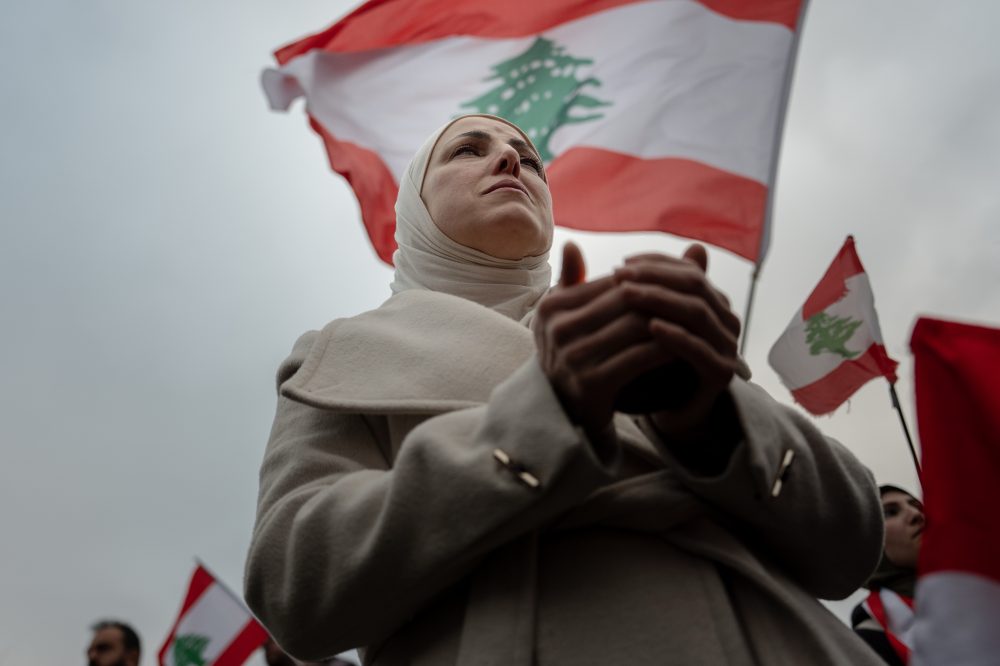
That evening, Peace Park in Dearborn became filled with Lebanese flags as a memorial service occupied the central plaza.
Young people sat on flag-draped steps, carrying photographs of children killed during the war. Meanwhile, speakers alternated describing a conflict spanning multiple presidential administrations with minimal progress toward resolution.
“What we have witnessed is not just another headline. It is not distant. It is not abstract,” Suehaila Amen, a Lebanese American, said at the vigil.
“We are a community in mourning,” she said, “and we have been mourning for a long, long time.”