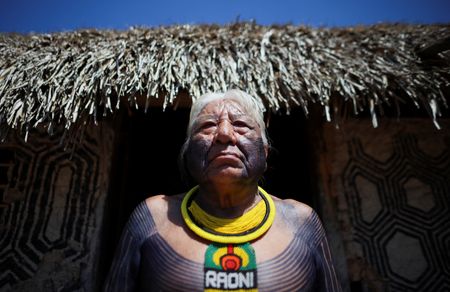

A veteran Indigenous leader in Brazil is stepping up to continue his uncle’s decades-long battle to protect the Amazon rainforest and Indigenous rights.
Chief Megaron Txucarramae, 75, has dedicated his life to defending the Kayapo people’s interests, working to establish boundaries for their Amazon territory and fighting against unauthorized mining operations and dam construction projects.
The leader now faces his biggest responsibility yet: carrying on the work of his uncle and teacher, Chief Raoni Metuktire, a 94-year-old Indigenous activist recognized around the world for his environmental advocacy.
Chief Raoni recently spent a week receiving intensive medical treatment for pneumonia before returning to his community. His health struggles have occurred multiple times in recent years. For many years, Chief Raoni has been an international symbol of Indigenous activism, meeting with world leaders, religious figures, and celebrities like musician Sting during 1980s campaigns to save the rainforest. Both chiefs guide Kayapo settlements along the Xingu River, where the Amazon rainforest borders Brazil’s expansive grasslands.
The Kayapo people first encountered non-Indigenous Brazilians during the 1950s, when Chief Megaron was just a child.
Soon afterward, he started collaborating with Chief Raoni and now declares his readiness to take up the cause.
“I have followed it closely,” he said. “And I will continue it, continue his struggle.” He made these comments to Reuters while in Pykany village during a Greenpeace-organized expedition to investigate unauthorized mining activities on Kayapo territory.
Megaron’s mission comes during a critical period for the Amazon. Almost 20 percent of the rainforest has disappeared due to agricultural development, cattle ranching, and mining operations, while climate change has brought more severe dry periods and forest fires.
“The best thing is to preserve the Amazon, to preserve what is ours, what belongs to everyone,” he said. “It helps people breathe better, it holds back the winds, it keeps the heat from becoming too intense.”
His goals include continuing advocacy for the Kayapo and other Indigenous communities, building international understanding of the forest’s significance, and working toward greater Indigenous participation in Brazil’s government.
Brazilian lawmakers have enacted multiple measures in recent years that restrict Indigenous rights, including legislation that reduces land protections for certain Indigenous communities.
Chief Megaron expressed particular concern about the possibility of an anti-Indigenous candidate winning the October general elections.
Chief Raoni had backed President Luiz Inacio Lula da Silva during his 2023 swearing-in ceremony, following the tenure of former president Jair Bolsonaro, who had promised to stop creating new Indigenous reserves. Senator Flavio Bolsonaro, the ex-president’s son, is challenging Lula in the upcoming election.
“They can’t kill us with weapons, but they want to pass laws to exploit [our land], to destroy our culture, to put an end to our customs,” he said. “The more Indigenous people there are in Congress, the better for us.”
During the 2022 elections, seven Indigenous candidates won seats among the 594 total Congressional positions.
He also aims to support his uncle’s efforts to prevent young Indigenous people from abandoning their forest homeland and traditional ways of life.
“You can learn, you can reach university, but you must not stop being Indigenous,” he said. “That is his struggle.”