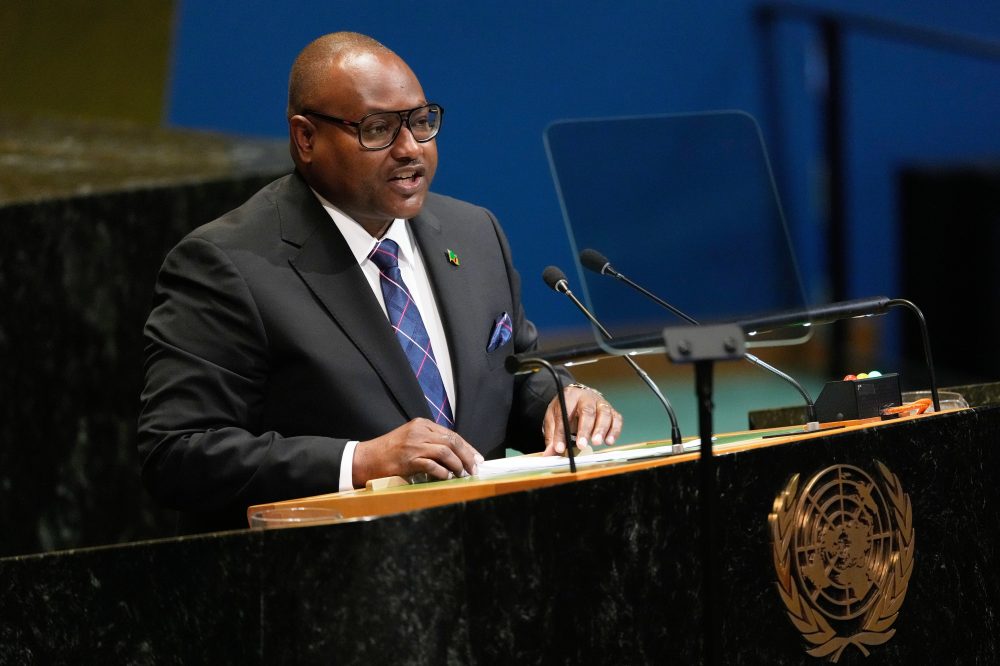

Tensions between Zambia and the United States have erupted into public view as the African nation’s top diplomat condemned what he described as America’s attempt to tie health aid to mineral access and criticized the departing U.S. ambassador’s corruption claims.
Foreign Affairs Minister Mulambo Haimbe spoke out Monday against the Trump administration’s approach to a $2 billion health assistance package, exposing underlying friction over the president’s “America First” foreign policy that transforms traditional aid into business-like transactions.
African leaders and health policy experts have voiced opposition to Washington’s new strategy, which demands sensitive health information in return for desperately needed support for healthcare systems weakened by the administration’s foreign aid cuts. Critics worry they won’t gain access to medical breakthroughs like vaccines despite providing data.
The United States is also working to compete with China, which has established itself as a major force in Zambia and across Africa, controlling minerals essential for renewable energy technology, including components for solar equipment, electric car batteries and power storage devices.
Haimbe characterized departing Ambassador Michael Gonzales’ corruption accusations and claims of slow negotiations as “mischievous” and “deeply regrettable, undiplomatic and inconsistent with the spirit of mutual respect.”
The minister further alleged that America was connecting mineral access to completing the health agreement, which Gonzales previously rejected as “alarmist allegations” that he termed “disgusting” and “absolutely and patently false.”
Talks have stretched on for months to finalize this agreement, which represents one of many similar deals the Trump administration is pursuing across some of the globe’s most aid-reliant nations.
In late April, Gonzales stated that Zambian officials had “abdicated their responsibilities, letting the United States pay for healthcare while officials diverted government funds to their own pockets.” He claimed Zambian leadership had “ignored” American attempts to complete a new agreement.
However, Haimbe explained that discussions had broken down over “unacceptable” information-sharing requirements “in violation of our citizens’ right to privacy” and “the insistence on preferential treatment of U.S companies over Zambia’s critical minerals.”
Zambia “takes the view, first and foremost, that Zambians must have a say on how her critical minerals are used, and second that no one strategic partner is to be treated preferentially to others,” he stated.
The U.S. Embassy did not immediately respond to a request for comment.
This American strategy replaces decades of involvement built around the now-eliminated United States Agency for International Development and the President’s Emergency Plan for AIDS Relief, known as PEPFAR.
Instead, American officials are creating individual nation agreements that transform aid into business deals, connecting funding to requirements including trade provisions, domestic spending commitments, disease monitoring, pathogen sharing and even religious considerations.
Since the end of last year, the United States has completed agreements with approximately 30 nations, predominantly in Africa. Washington claims this method aims to decrease aid dependence, encourage local control and protect American interests, particularly against an assertive China that controls African trade while providing less assistance.
Resistance has emerged.
Ghana announced last week it had turned down a proposed agreement due to provisions allowing extensive access to confidential health information without protections. Zimbabwe abandoned a $367 million package over similar issues. In Kenya, a $2.5 billion deal signed in December has been suspended following a legal challenge claiming it breaks data protection regulations.
In Lesotho, initial American proposals requested 25 years of health data and biological sample access before local officials negotiated a reduced five-year agreement.
Opponents argue the data-sharing requirements favor American interests and caution that information exchange would primarily flow in one direction: toward Washington.
These new agreements seek to guarantee disease monitoring data and biological samples flow through direct channels, following America’s January withdrawal from the World Health Organization, explained Asia Russell, executive director of advocacy organization Health GAP.
Nations currently report disease outbreaks mainly through the WHO, which manages responses and is developing new frameworks for pathogen-sharing and fair vaccine access.
The United States, now excluded from those discussions, is seeking direct access instead.
“They (the U.S.) want to understand what’s actually happening,” noted Jen Kates, a senior vice president at the Washington-based nonprofit KFF. “But they are trying to do it in a very different way.”
Health advocates warn this could create a separate global health system. In Zimbabwe, a government representative said in February that officials ended negotiations because the United States was not providing a “corresponding guarantee of access to any medical innovations — such as vaccines, diagnostics, or treatments — that might result from that shared data.”
“That raises serious concerns about who benefits,” said Atilla Kisla of the Southern Africa Litigation Center.
Advocates reference the difficult COVID-19 pandemic experience, when African nations provided data and samples but received vaccines among the last globally.
The American agreements face criticism for private negotiations and minimal public oversight.
“Secrecy is at the center of this. That puts accountability for results at risk,” said Health GAP’s Russell. “It’s impossible to evaluate these deals properly without seeing the full terms. Part of what made PEPFAR successful was transparency. Now that’s been taken away.”
These deals also include stricter financial requirements. Many feature decreased funding compared to previous American assistance levels, while demanding countries boost domestic health investment, with aid threatened if goals aren’t achieved.
“These are going to be very heavy lifts,” said KFF’s Kates. “Countries are already under strain.”
Critics argue some agreements also promote American commercial and political interests, making the distinction between aid and transactional diplomacy unclear.
“When health becomes a bargaining chip, everyone becomes less safe,” Russell cautioned.