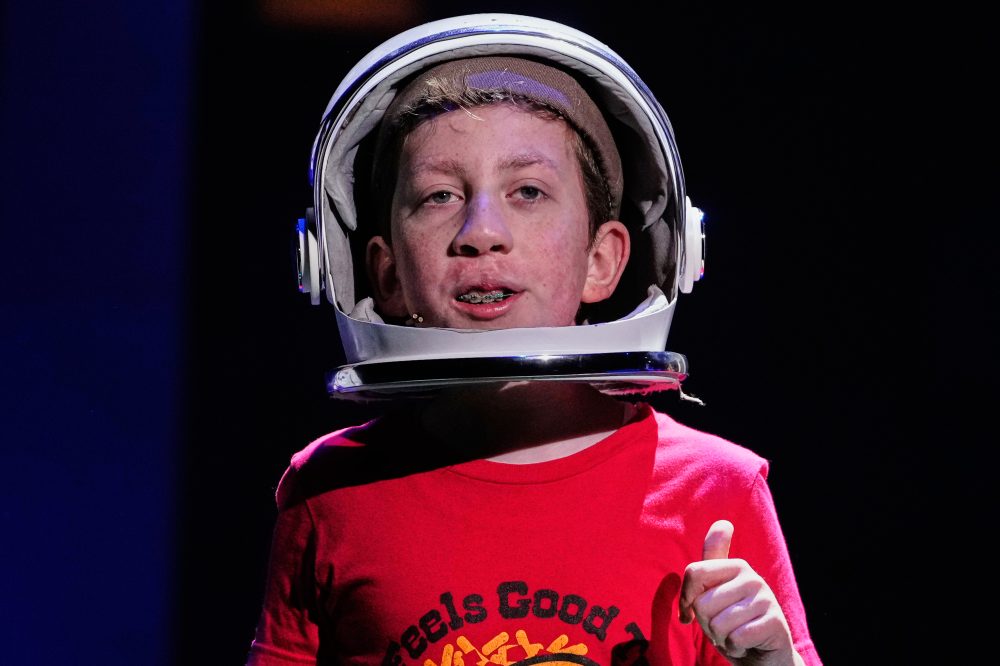

CAMBRIDGE, Mass. — Two young performers with facial conditions discovered a powerful connection while bringing the character of Auggie Pullman to life in the musical version of “Wonder” at Harvard University’s American Repertory Theater.
Max Voehl, a 12-year-old from Utah born with bilateral cleft lip and palate, felt an immediate kinship with the character during his audition. Having undergone 13 surgeries compared to Auggie’s 28, and experiencing bullying similar to the character who faces challenges due to Treacher Collins syndrome, Voehl found the role deeply personal.
“Channeling Auggie on stage is actually pretty easy for me because I have felt the emotions he has felt, and I have gone through what he has gone through,” Voehl explained following a matinee show. He shares the starring role with 16-year-old Garrett McNally from California, who actually has Treacher Collins syndrome. Voehl described performing as “pure joy.”
The stage adaptation draws from R.J. Palacio’s 2012 novel about compassion and perseverance, following 10-year-old Auggie as he transitions from homeschooling to attending regular classes in New York. The book also inspired a 2017 movie featuring Julia Roberts and Owen Wilson as the protagonist’s parents.
The narrative centers on Auggie’s academic year, where the science-loving “Star Wars” enthusiast initially faces curious stares and awkward inquiries about his appearance from classmates. Though he contemplates leaving school, support from friends and family helps him continue, ultimately earning recognition for his bravery and determination at graduation.
The theatrical version explores multiple viewpoints, including sister Via’s feelings of being overlooked, parents struggling between protection and independence for their son, and friend Jack’s journey from betrayal back to loyalty when he chooses Auggie over popular classmates for a science assignment.
Director Taibi Magar discovered the “Wonder” material during 2021’s pandemic uncertainty when theater’s future seemed unclear. She embraced the opportunity to adapt the story, finding it offered audiences a model for more compassionate living.
“I was pretty sad and the world was feeling really cold and mean,” said Magar, who previously helmed “Night Side Songs; The Half-God of Rainfall” and “Macbeth In Stride; We Live in Cairo” at the venue. “Then I got a phone call from my agent to take a look at this material, and it just cracked me open.”
Casting young performers with facial conditions for Auggie presented initial difficulties. The film version used an actor without facial differences, relying on makeup and prosthetics for the transformation.
Project consultant Matthew Joffee, a former therapist and learning disability expert who has Moebius syndrome, insisted the role required someone with an actual facial difference. He worried that casting otherwise would alienate the craniofacial community.
“They were so desperate to get actors that will be able to play the role. They were willing to consider looking for actors and just making them up, and I put my own foot down,” he stated. “The community would be completely outraged to know that an actor with a craniofacial condition wasn’t being used.”
Eventually, the production successfully cast both Voehl and McNally, whom Magar called “two extraordinary actors.”
McNally, making his acting debut, discovered the opportunity through a Facebook group posting and decided auditioning sounded enjoyable. He identified with Auggie’s experience of people viewing him “differently” and not always treating him as a “normal” person.
Learning via Zoom call that he’d landed the major musical role brought excitement mixed with opening night nerves.
“I was nervous because I thought I would mess up or get stage fright, but it generally went pretty smoothly, except for that one time where I hit my shin on one of the tables,” McNally recalled. “Other than that, it was a really good show and I was really proud of myself.”
His mother Jules McNally, while never questioning her son’s abilities, was amazed by his “dedication and commitment” to the performance. Watching audiences respond to her son, whom she describes “as his own unique person,” she hopes the production inspires action.
“I want people to leave the show taking the things that they felt, the empathy that they experienced,” she explained. “I want them to go out into their own communities and do what they need to do to make people feel safe and accepted and welcome.”
Both young actors recognize how portraying Auggie provides an unexpected opportunity to shift attitudes about facial differences.
“I’m making a difference in helping people understand that even though some people may look different or have like a facial difference, we are all in the end the same the on inside,” Voehl observed. “It does not matter what we look like because we are all human.”
During one of the final performances before the February 15 closing, hundreds of enthusiastic students packed the theater after the two-month run. Many, including 14-year-old Dylan Marion from Malden, Massachusetts, sought autographs afterward, collecting signatures from seven cast members on book copies. Students who had read the novel in class eagerly compared the written story with the stage version.
“I loved it. It was amazing,” said 10-year-old Aili Sparandara from a Cambridge school whose entire grade studied the book. “It’s nice how he has people out there who can help him. It was a lot of equality. I like it. This book is based on someone with differences that can be shown. It’s not like everybody in every book has to be perfect.”