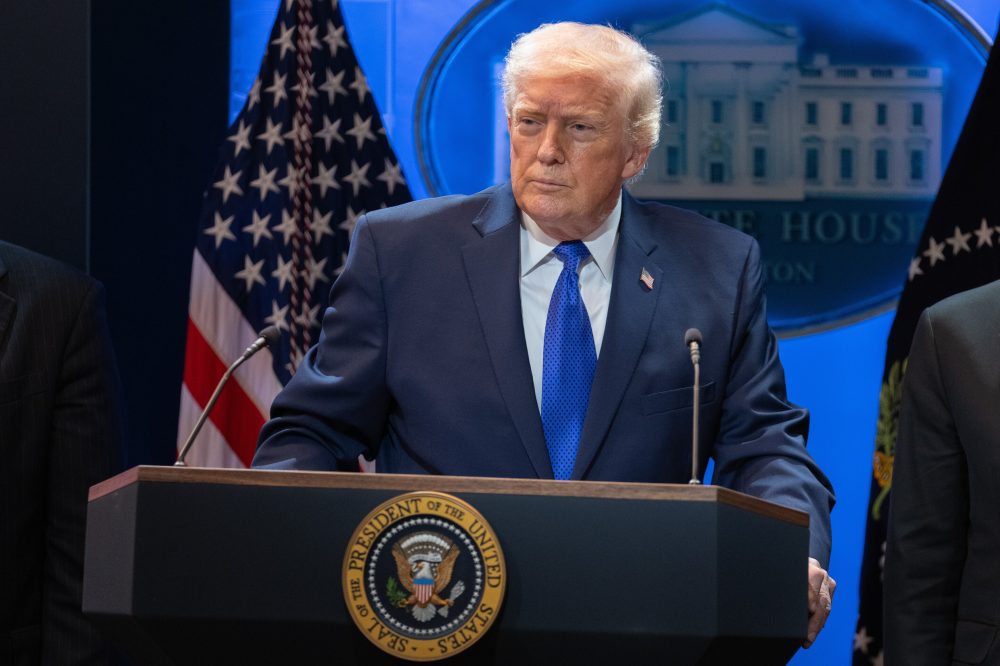

WASHINGTON — President Donald Trump takes the podium Tuesday evening for his annual State of the Union address, speaking to a nation that has undergone dramatic changes during his first year back in the White House.
Twelve months into his return to office, Trump has defied traditional political norms while pursuing an aggressive policy agenda. His administration has reshuffled domestic priorities, strained international partnerships, and tested the nation’s system of governmental checks and balances. Two individuals lost their lives during confrontations with federal officers conducting immigration enforcement operations and deportation activities.
While members of Congress gather in the House chamber to hear Trump outline his upcoming priorities, many observers view this as a critical moment for the legislative branch, which appears to have ceded significant influence to the executive branch as the Republican president has consolidated unprecedented authority despite holding only narrow GOP majorities.
“It’s crazy,” said Nancy Henderson Korpi, a retiree in northern Minnesota who joined an Indivisible protest group and plans to watch the speech from home. “But what is disturbing more to me is that Congress has essentially just handed over their power.”
She said, “We could make some sound decisions and changes if Congress would do their job.”
The nation finds itself at a pivotal juncture, marking its 250th anniversary amid some of the most dramatic shifts in politics, policy, and national sentiment that many Americans have witnessed in their lifetimes.
When legislative action was necessary, the president has forced his priorities through Congress — frequently applying pressure to lawmakers through personal phone calls during crucial votes — but has more commonly bypassed the complex legislative process to circumvent both his own party and unified Democratic resistance.
Trump’s most notable legislative achievement remains the Republican tax reform package, featuring new baby savings accounts, tip tax exemptions, and various specialized deductions, alongside significant reductions to Medicaid and SNAP nutrition assistance. The legislation also allocated over $170 billion to Homeland Security for immigration enforcement operations.
However, the Republican-controlled Congress has largely remained passive as Trump has dramatically expanded executive power through hundreds of administrative orders, many facing legal challenges, demonstrating his determination to implement his agenda by any means necessary.
“Retrieving a lost power is no easy business in our constitutional order,” wrote Justice Neil Gorsuch in the Supreme Court’s landmark rebuke of Trump’s tariffs policy on Friday.
Gorsuch said that without the court stepping in on major questions, “Our system of separated powers and checks-and-balances threatens to give way to the continual and permanent accretion of power in the hands of one man.”
Trump’s influence has extended from reducing federal employment to modifying childhood vaccination protocols to military intervention in Venezuela and the capture of that nation’s leader, with his authority appearing virtually unlimited.
His government has initiated investigations targeting potential political opponents, placed his name on historic landmarks including the renowned John F. Kennedy Center for the Performing Arts, and most prominently has been conducting widespread arrests while converting warehouse facilities into detention centers for deportation proceedings.
Throughout these developments, numerous opportunities existed for Congressional intervention, yet lawmakers consistently chose not to act.
Democrats, serving in the minority, have attempted resistance efforts, including blocking routine Homeland Security funding unless immigration enforcement receives additional oversight.
However, Republicans maintain that voters elected the president and granted their party Congressional control specifically to support his agenda, according to a senior GOP leadership aide who requested anonymity to discuss internal dynamics.
House Speaker Mike Johnson of Louisiana has declared Trump will be the “most consequential” president of the modern era.
Democrats are planning to either skip the speech entirely or remain silent throughout the address.
“The state of the union is falling apart,” said House Democratic Leader Hakeem Jeffries of New York.
Instances of Congress asserting its authority against the White House have occurred but remain uncommon — such as the notable bipartisan effort from Reps. Thomas Massie, R-Ky., and Rep. Ro Khanna, D-Ca., to demand release of the Jeffrey Epstein documents, despite opposition from Johnson and GOP leadership.
Congressional pushback has more frequently emerged when several Republican defectors join most Democrats to constrain the president, as occurred when the House voted to prevent Trump’s tariffs on Canada. The Senate moved forward with a war powers resolution to block military action in Venezuela without Congressional authorization, but retreated after Trump’s intervention.
These votes have been largely symbolic, since Congress lacks sufficient numbers to override any anticipated Trump veto.
More commonly, Congress has accommodated Trump by reversing previously approved bipartisan funding for USAID foreign assistance and public broadcasting, or failing to prevent U.S. military attacks on suspected drug-smuggling vessels that resulted in two Caribbean casualties. When Trump issued Day One pardons for approximately 1,500 individuals charged in the January 6, 2021 Capitol attack, Congressional Republicans offered no objections.
As Trump’s Department of Government Efficiency with billionaire Elon Musk began terminating federal workers, GOP lawmakers demonstrated support by establishing their own DOGE caucus on Capitol Hill.
“The central question for us is does the public understand what’s at stake” said Max Stier, CEO of the Partnership for Public Service, a nonprofit organization focused on government management and democracy. “We are in the midst of the most significant transformation of our government and our public servants in our history as a country.”
He reported that approximately 300,000 federal employees were terminated or transferred, while 100,000 new appointments or rehires have primarily gone to Homeland Security.
Across the country, legal challenges against the administration are being filed at unprecedented levels, as Congress was “asleep at the wheel,” said Skye Perryman, president of Democracy Forward, which has filed more than 150 cases against the administration, contributing to the largest legal campaign against an executive branch in U.S. history.
The judicial system faces significant pressure, and the White House has not consistently complied with court decisions. GOP lawmakers have supported Trump’s judicial criticism, posting outside their offices images of judges they seek to impeach.
An upcoming major test involves a citizenship verification voting bill that Trump wants before the midterm elections.
The House has approved the SAVE America Act, requiring birth certificates or passports for federal election registration and photo identification at polling locations. Advocates claim it’s necessary to prevent fraud, while opponents contend it will exclude millions of Americans who lack readily accessible citizenship documentation.
The Senate has majority support for the measure but lacks the required 60 votes to overcome an expected Democratic filibuster.
Trump has promised executive action if Congress fails to pass the legislation.