
A low-profile facility south of Cleveland, Ohio has quietly become one of the first battlegrounds in the auto industry’s push to strip Chinese technology out of American vehicles.
The plant is home to Eagle Wireless, an electronics manufacturer that was established in late 2025 — largely in direct response to a federal rule requiring that certain Chinese connected-car software and hardware be removed from U.S. vehicles before the decade is out.
“There’s a massive opportunity for us,” said TJ Dembinski, president of Eagle Wireless. He explained that the company was born out of a recognized need to offset China’s stronghold on the module market — something he knew would become a serious challenge for American automakers once the new regulations kicked in.
The scramble is centered on modules — small circuit boards that allow vehicles to wirelessly communicate with the outside world. Eagle Wireless began operations with roughly 140 employees and is targeting a workforce of 1,000 within the next three years. Its projected revenue for the year has nearly doubled, climbing to close to $100 million.
“It’s been insane,” Dembinski said.
The connected-vehicle regulations were finalized in January 2025 under President Joe Biden, driven by national security and data privacy concerns. The rules have remained in effect under the Trump administration. They prohibit the use of Chinese connectivity software beginning with the 2027 model year, and Chinese hardware starting with the 2030 model year. Although those cutoff dates may appear distant, automakers plan vehicle programs several years in advance — meaning compliant suppliers need to be secured right now.
Against a backdrop of rising geopolitical tensions and unpredictable trade disputes, car companies are in the midst of a major separation from Chinese suppliers — covering everything from low-cost parts like Eagle’s modules to battery materials and critical rare earth minerals.
Industry anxiety over compliance intensified after electric vehicle manufacturer Polestar — which is majority-owned by China’s Geely Holding — was barred last month from selling new vehicles in the U.S. under the rule.
Costly Changes
The hardware components most impacted by the new rule include satellite communications systems, external antennas, and microcontrollers that handle a vehicle’s external communications, according to Matt Wyckhouse, CEO of security firm Finite State and an adviser to Eagle Wireless.
Moving parts sourcing away from China typically means paying significantly more. One former Detroit executive described comparing the cost of a non-Chinese automated-driving system against one using Chinese technology, including LiDAR sensors, as a jarring experience.
“My jaw dropped when I looked at the price increase,” the former executive said. Most advanced driver assistance system components are not currently restricted under the connected-vehicle rule, though the federal government has signaled it may take up that issue separately down the road.
Eagle Wireless says it is working toward cost parity with Chinese rivals, but currently still faces a 5% to 15% price gap on its modules.
The transition away from Chinese suppliers also creates logistical headaches. Parts supplier executives say automakers are demanding far greater transparency into their supply chains to confirm that no Chinese components are slipping through in violation of U.S. rules.
The regulation “requires a deep examination of supply chains and aggressive compliance timelines,” said Hilary Cain, senior vice president of policy for the Alliance for Automotive Innovation, an industry group that represents most of the major automakers.
Electric vehicle startup Rivian says it is better positioned to comply than some longer-established automakers because it can more quickly shift suppliers or develop its own components. The company’s software chief, Wassym Bensaid, told Reuters he has been deliberate about which suppliers he works with and frequently builds in backup options in case geopolitical disruptions arise.
Some automakers are pursuing exemptions. Ford Motor has requested authorization to continue importing certain China-produced models, according to a Reuters report. Volvo Cars, also owned by Geely, was among the first automakers to receive such an authorization.
China’s foreign ministry has previously called on the United States “to respect the laws of the market economy and principles of fair competition,” arguing that Chinese vehicles have earned global popularity through technological innovation driven by a fiercely competitive home market.
A Conveyor Belt of Modules
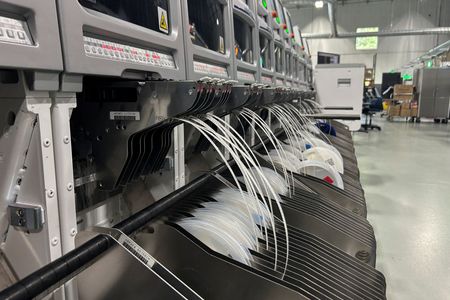
Inside Eagle’s Solon, Ohio facility, machines produce modules for a range of industries, with a planned expansion nearby dedicated to vehicle applications. The company expects to hit an annual production rate of approximately 2 million modules by the close of the third quarter, with its new facility set to handle even greater output, Dembinski said.
Eagle’s tech chief, Joel Young, describes one piece of equipment as a “fancy vending machine” that sorts capacitors, diodes, and other small components. Those parts are placed onto circuit boards that travel along a conveyor belt through a 500-degree oven. The finished modules are then engraved with serial numbers, inspected for quality, and picked up by robotic arms for packaging.
Production of connectivity modules is dominated by a handful of manufacturers, according to market intelligence firm Counterpoint Research. Chinese vendors account for nearly half of all global automotive cellular IoT module shipments, the firm noted. In North America, Eagle competes primarily against Rolling Wireless and LG.
While Eagle markets itself as a U.S.-compliant option for automakers, the company itself still has ground to cover before it fully meets the rules. Eagle initially got off the ground by licensing its module design from China’s Quectel Wireless Solutions, the global leader in the industry.
Eagle must replace that licensed design with its own proprietary technology before the 2030 model-year deadline, since the rules prohibit any connected hardware that was designed, developed, manufactured, or supplied by China.
Young said he is working urgently to develop a product that can seamlessly replace the existing Quectel-based modules for automakers. “I have to add a lot of engineers,” he said. “We’ll embrace all the tools that we can possibly have.”
The strategy of licensing technology from China is not new to the auto industry. Ford, for example, is licensing battery technology from China’s CATL for domestic U.S. battery production.
“You could end up with a situation where you end up becoming more dependent on China through these partnerships,” said Ilaria Mazzocco, deputy director and senior fellow at the Center for Strategic and International Studies. At the same time, she acknowledged that such collaborations may be the only path for the U.S. to build expertise in an increasingly competitive global landscape.
“You could end up in a situation where, through these partnerships, you end up becoming a lot less dependent,” she added.