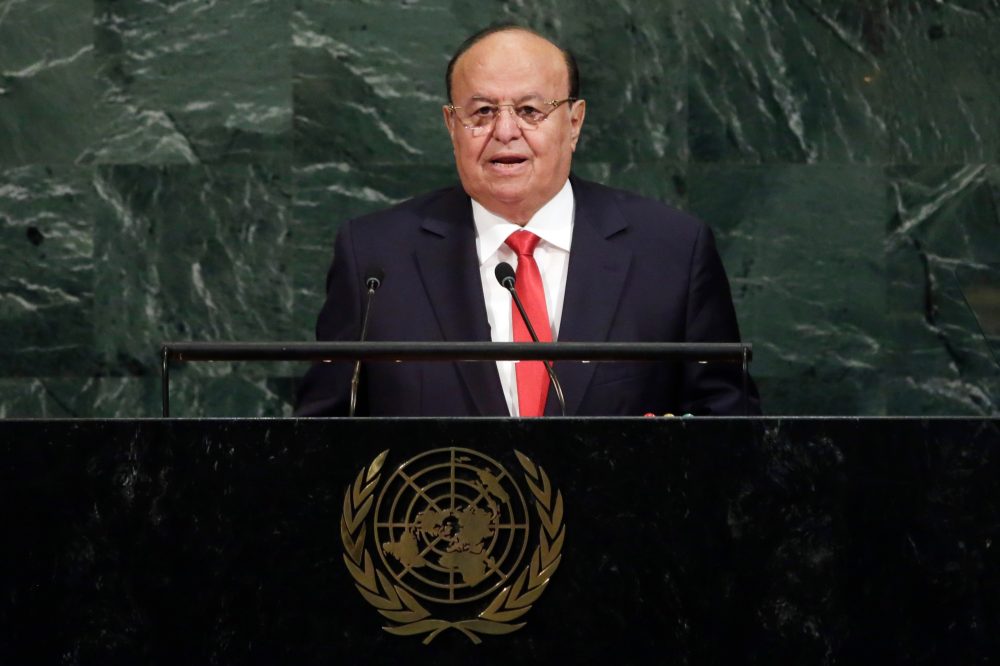

ADEN, Yemen (AP) — Yemen’s former president Abdrabbuh Mansour Hadi passed away Thursday at 80 years old, ending a life marked by leading a divided nation through civil conflict and humanitarian crisis while governing primarily from foreign soil for nearly a decade before relinquishing power in 2022.
According to state television in Yemen, Hadi’s death occurred at his home in Riyadh, Saudi Arabia’s capital, though additional circumstances were not provided.
Rashad al-Alimi, who heads the Presidential Leadership Council that serves as the governing body for Yemen’s internationally recognized administration, praised Hadi’s commitment to the Yemeni people’s “right to a just state, freedom and human dignity.”
“He led the battle to defend the republican system,” al-Alimi posted on X.
Officials declared a three-day period of mourning with flags to be displayed at half-mast.
Hadi assumed the presidency in 2012 following the departure of long-serving leader Ali Abdullah Saleh amid Arab Spring demonstrations. With backing from the United States and Gulf nations, Hadi won a single-candidate election designed to shepherd Yemen through democratic transformation.
However, his administration quickly faced mounting turmoil.
In his early presidential term, Hadi attempted sweeping governmental changes, including bringing together the nation’s disparate military groups under unified command.
Critics charged him with showing preference to Yemen’s eastern petroleum-rich regions while neglecting the mountainous interior areas controlled by Houthis, the Iranian-supported faction.
Additional threats emerged from Al-Qaida in the Arabian Peninsula, widely regarded as among the terrorist network’s most lethal offshoots. The organization executed an attack in Sanaa during 2012 that claimed more than 100 lives.
The pivotal crisis of Hadi’s tenure occurred in 2014 when Houthi militants advanced southward from their northern territories and seized Sanaa as public frustration mounted over economic difficulties and governmental chaos.
Aided by forces supporting former President Saleh, Houthi troops occupied Yemen’s presidential compound in January 2015. Hadi stepped down and fled to Aden, though he subsequently reversed his resignation as a Saudi-led military alliance joined the fighting in March 2015 attempting to reinstall Hadi’s administration.
Despite maintaining international recognition as president, much of the actual governance was shaped by Saudi Arabia and the United Arab Emirates, the coalition’s primary members.
His power eroded further as fractures developed within the anti-Houthi partnership.
Relations with the UAE deteriorated after Hadi removed senior Emirati-supported officials, including Aidarous al-Zubaidi, who commanded the separatist Southern Transitional Council, or STC.
The STC ultimately gained control of Aden and portions of southern Yemen, restricting Hadi’s government to exile in Riyadh and isolated eastern territories.
Though the STC avoided directly calling for Hadi’s ouster, it declined to subordinate its military units to his authority and charged his administration with embracing Islamist groups connected to the Islah party, Yemen’s affiliate of the Muslim Brotherhood. The STC was dissolved earlier this year.
Hadi’s remaining time in office was spent largely away from public attention in the Saudi capital. In April 2022, following announcement of a U.N.-mediated truce, he handed authority to al-Alimi, who took charge of the newly established presidential council supported by Saudi Arabia.
Born September 1, 1945, in Yemen’s coastal Abyan province during the period when the country’s southern region remained under British control, Mansour Hadi came from the prominent Al-Fadl tribe, among the south’s largest and most established clans.
Following his education, Hadi entered military service, completing training at Britain’s Royal Military Academy Sandhurst. His initial military assignments took him to Egypt and Russia before his return to Yemen.
Hadi held senior military rank when civil conflict began in 1986, stemming from disputes between competing factions within Southern Yemen’s governing Socialist party. He aligned with President Ali Nasser Mohammed, accompanying him in escape to northern Yemen, which remained a separate nation at that time.
Following Yemen’s unification in 1990, Hadi received promotion to general rank and later to defense minister under then-President Saleh. As recognition for commanding successful military operations against southern independence movements in 1994, Saleh named Hadi as vice president of the unified republic.
Hadi leaves behind his spouse, Hala, and six children. Memorial service details have not been announced.