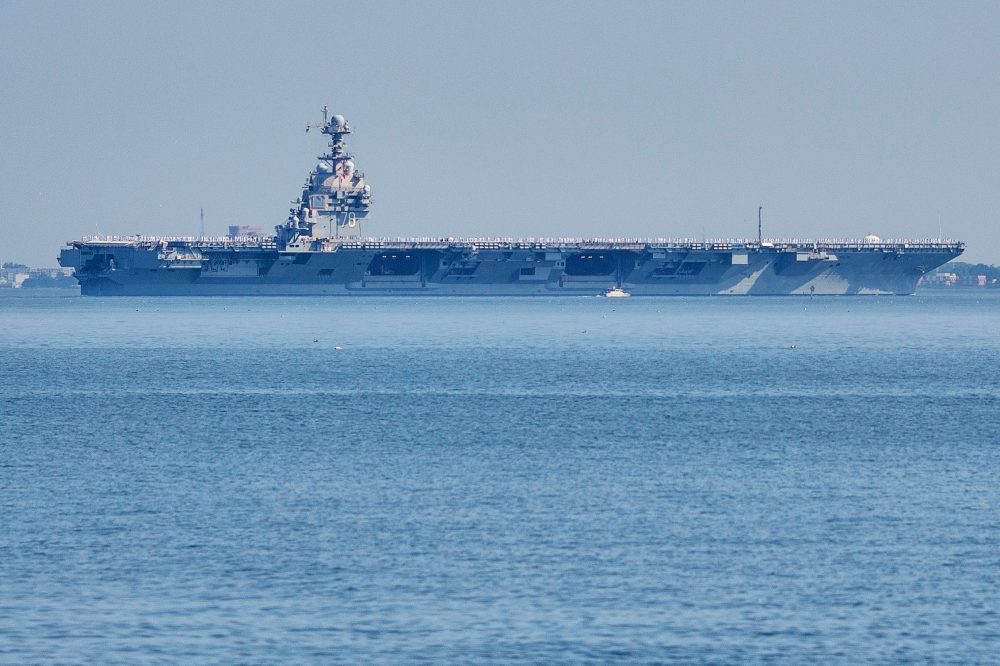

The massive USS Gerald R. Ford will return to its Virginia home base following an unprecedented deployment lasting more than 300 days, during which the vessel participated in military operations against Iran and the capture of Venezuelan leader Nicolás Maduro, according to two U.S. officials who spoke Wednesday.
The enormous aircraft carrier will depart the Middle East within days and arrive at Naval Station Norfolk in Virginia by mid-May, said the officials, who requested anonymity when discussing classified military operations. The Washington Post first reported this development.
Last week’s arrival of the USS George H.W. Bush created an unusual situation with three American aircraft carriers stationed in the Middle East simultaneously — a concentration not witnessed since 2003 — as a fragile ceasefire continues in the Iran conflict. The USS Abraham Lincoln has also maintained a presence in the area since January amid rising tensions with Tehran.
Earlier this month, the Ford established a new U.S. military record for the longest deployment since the Vietnam War ended, spending nearly 10 months away from Naval Station Norfolk after departing in June.
The vessel’s 295th day at sea exceeded the previous record for aircraft carrier deployments over the past five decades, surpassing the Lincoln’s 294-day mission in 2020 during the COVID-19 pandemic, based on information gathered by U.S. Naval Institute News, a publication of the nonprofit U.S. Naval Institute.
The Ford’s extended mission has sparked concerns about the effects on military personnel spending prolonged periods away from their families, as well as increased wear on the ship and its systems, particularly after the carrier suffered a fire requiring extensive repairs.
During Wednesday’s House Armed Services Committee hearing, Defense Secretary Pete Hegseth addressed questions about the Ford’s lengthy deployment, explaining he had discussed the matter with Navy leadership who acknowledged challenges related to readiness and maintenance.
“Multiple times the operational requirements — whether it was down in Southcom or up to Centcom — demanded additional assets in real time, which through a tough decision-making process led to an extension,” Hegseth stated, referencing U.S. Southern Command’s oversight of Latin America and U.S. Central Command’s Middle East operations.
The Ford initially sailed to the Mediterranean Sea when its deployment began, but was redirected to the Caribbean Sea in October during what became the region’s largest naval presence in decades.
The carrier participated in military actions to apprehend Maduro before encountering additional combat situations as it moved toward the Middle East amid escalating Iranian tensions.
From the Mediterranean Sea, the carrier engaged in initial phases of the Iran conflict before traveling through the Suez Canal and entering the Red Sea in early March.
A fire in the ship’s laundry facilities, however, forced the vessel to reverse course and return to the Mediterranean for repairs, displacing hundreds of sailors from their sleeping quarters.
While the Ford’s 295-day mission sets a post-Vietnam record, it remains shorter than Cold War-era deployments, particularly the decommissioned USS Midway’s 332-day mission spanning 1972 and 1973.
The USS Nimitz crew spent 341 days away from home during 2020 and 2021, though that period included extended quarantine time on U.S. soil designed to limit COVID-19 transmission.