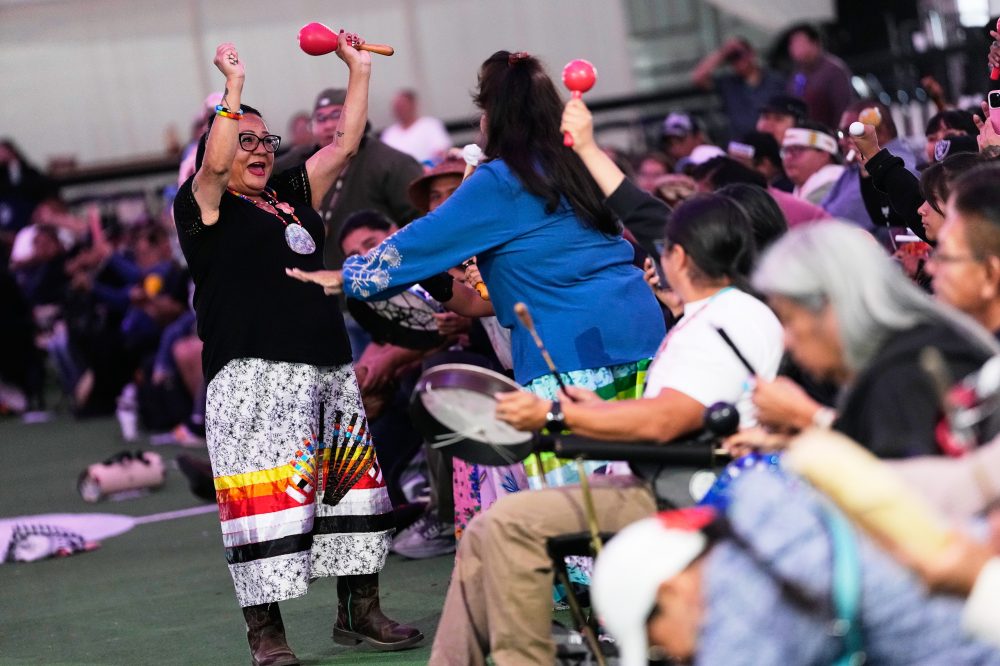

TACOMA, Wash. — Standing inside a tent filled with thunderous drumming and chanting, Yangbin Wu gripped two small “bones” in his fists, shaking them in time with the beat as his opponents tried to guess which hand held the unmarked piece.
They pointed left. They were wrong. Wu broke into a wide grin — his team had scored.
The hundreds of competitors gathered at the Puyallup Tribe of Indians’ Stick-Games Tournament wouldn’t have been there without a much larger event unfolding nearby: the FIFA World Cup, being played in Seattle and across the U.S., Mexico, and Canada. That once-in-a-generation tournament has created an unusual opportunity for the tribe to introduce its language, history, and culture — traditions the federal government once actively worked to destroy — to soccer fans from across the globe.
“It’s pretty cool, with the music and the chanting, it’s like a full sensory experience,” said Wu, a Seattle-area landscaper who attended the event.
According to organizers, the Puyallup Tribe became the first Indigenous group in the country to enter into a formal partnership with a World Cup host city after announcing the agreement in 2023. Earlier this year, several First Nations groups in Canada — the Musqueam Indian Band, Squamish Nation, and Tsleil-Waututh Nation — announced comparable partnerships with Vancouver.
Soccer fans have been welcomed onto the tribe’s reservation, which covers roughly 28 square miles south of Seattle, to experience traditional cultural gatherings featuring dancing and singing that historically marked coastal tribes visiting each other by canoe. A powwow celebrated broader Native American traditions through colorful regalia, and the tribe also hosted well-attended World Cup watch parties.
“It means a lot for us to share who we are to the world,” said Connie McCloud, a tribal elder and heritage division manager. She noted that most people form their impressions of Native Americans through movies and television, but that those portrayals “don’t represent the people from Puyallup right here in the Pacific Northwest.”
The stick games, held last weekend, are rooted in endurance and strategy. According to Puyallup creation stories, the game once determined whether humans or animals would hold dominion over one another.
In June, the tribe organized a World Cup parade. At the first match held in Seattle, tribal Chairman Bill Sterud performed the ceremonial coin toss before a game that ended 1-1 between Belgium and Egypt. Stadium screens broadcast a land acknowledgment informing fans that the matches are being played on ancestral lands shared by many tribes of the Puget Sound Villages. Tribal members also gave demonstrations in wood carving and weaving inside the stadium.
An official World Cup app rewards fans with points for visiting the tribe’s reservation and other locations, and it incorporates the Puyallup language, Lushootseed. In one section of the app, users are asked to repeat the word “yəhaw,” which translates to “let’s go, let’s proceed,” according to Amy McFarland, the tribe’s project director for the World Cup.
“You can see people walking down the street, saying ‘yəhaw! yəhaw,’” McFarland said.
The reservation sits along the Puget Sound and blends into the surrounding area of Tacoma and several smaller communities. The tribe, which has approximately 5,000 members, has grown into a major employer in the county, with ventures that include the Emerald Queen Casino. The tribe also played a pivotal role in a landmark 1974 legal victory that secured treaty rights for Northwest tribes to harvest fish.
“We’re not surviving, we are thriving,” McFarland said.
The connection between the tribe and the World Cup traces back to a longstanding relationship with Major League Soccer’s Seattle Sounders. The team’s former president of business operations, Peter Tomozawa, later became CEO of Seattle World Cup 2026 and began working with the tribe to find ways to collaborate on the event, which has drawn enormous crowds to the city. The World Cup concludes July 19.
Throughout Washington state, visitors already encounter city and waterway names derived from tribal languages, Native-language signage, and Indigenous art and businesses. But this World Cup partnership has significantly amplified the Puyallup Tribe’s visibility on a global scale.
“This is the biggest spotlight that is shining on our region in a very long time. And who gets included in that, who gets highlighted I think is a really important question,” said Leo Flor, chief legacy officer at Seattle’s Local Organizing Committee for FIFA World Cup 2026. “I think our region has answered that in a really important way.”
While the tribe is listed as a sponsor for World Cup Seattle, neither Flor nor tribal representatives would disclose the financial details of the arrangement.
Tribal Chairman Sterud said he hopes the international attention will open doors to economic growth. The reservation is situated on the Port of Tacoma, one of the largest container ports in the United States.
“Going into possibly international trade is what we’ve been geared up for,” Sterud said. “We’re developing contacts with these different countries and different organizations to move forward in that respect for economic development.”
Josiah Devine Johnson spotted advertisements for the tribe’s World Cup events on Tacoma buses and decided to attend the Stick-Games Tournament. He tried a “rez burger” — a combination of fry bread and a burger patty — and watched from the sidelines as he tried to grasp the game’s complexity. The object is to win all of the sticks by correctly guessing which hands among the opposing team are hiding the unmarked bones.
“I think that’s incredible, to have their own sport, to be showing that off in combination with what’s going on with the World Cup,” said Devine Johnson, who arrived by shuttle. “I see soccer on TV, but you don’t see this. It felt like something I couldn’t miss.”
Puyallup Tribal Council member Amber Hayward noted that while the tribe is opening the stick games to outside visitors, the spiritual dimension of the tradition will not be on public display. Other tribes across the region have their own versions of the game, which has historically been used to resolve disputes and is now more commonly played for recreation.
On Saturday, mostly Indigenous participants — some traveling from as far as Canada, Montana, and Utah — competed in two large tents while vendors outside sold beaded earrings and tribal sweatshirts. Children played on bouncy houses and a small soccer field nearby.
The sun set and the competition pressed on into Sunday morning. Wu’s team won its first three matches, advancing further than he ever anticipated, before dropping two consecutive games and being eliminated.
“I didn’t think we’d make it out of the first round,” he said.