
When players take the field at this year’s World Cup — being held across the United States, Canada and Mexico — their jerseys carry more than just team colors. Behind many of the designs are rich stories rooted in culture, history, and in some cases, controversy.
Cape Verde, the smallest nation by population at the tournament, is making its World Cup debut with jerseys that honor its roughly 525,000 residents living across 10 volcanic islands off the African coast. A geometric, triangular print on both the blue home and white away kits represents the web of flight routes linking those islands together. The message: the nation stands united behind its players. That unity was on display as Cape Verde held heavily favored Spain to a 0-0 draw in their opening match.
Belgium’s multicolor away shirt carries a message on its collar that reads, “This is not a jersey.” The Belgians haven’t lost it — it’s actually a tribute to the country’s surrealist artistic tradition, particularly the work of Belgian artist René Magritte. Throughout his career, Magritte explored the puzzling relationship between perception and reality, famously writing beneath his iconic pipe painting, “Ceci n’est pas une pipe (This is not a pipe).” The light-blue jersey incorporates pink patterns, black detailing, and soccer-inspired imagery like pitch lines and a ball. As the Belgian federation put it, “True to the surrealism theme, the kit sparks the imagination and invites conversation.”
Haiti, another first-time World Cup participant, ran into trouble with soccer’s governing body FIFA over its original jersey design. The kit had featured an image depicting the final battle of the Haitian War of Independence in 1803. Colombian sportswear company Saeta described it as a “tribute to the men and women who contribute every day to Haiti’s future.” FIFA rejected the design during its approval process, calling it too political. Haiti was forced to submit a revised blue kit without the battle imagery.
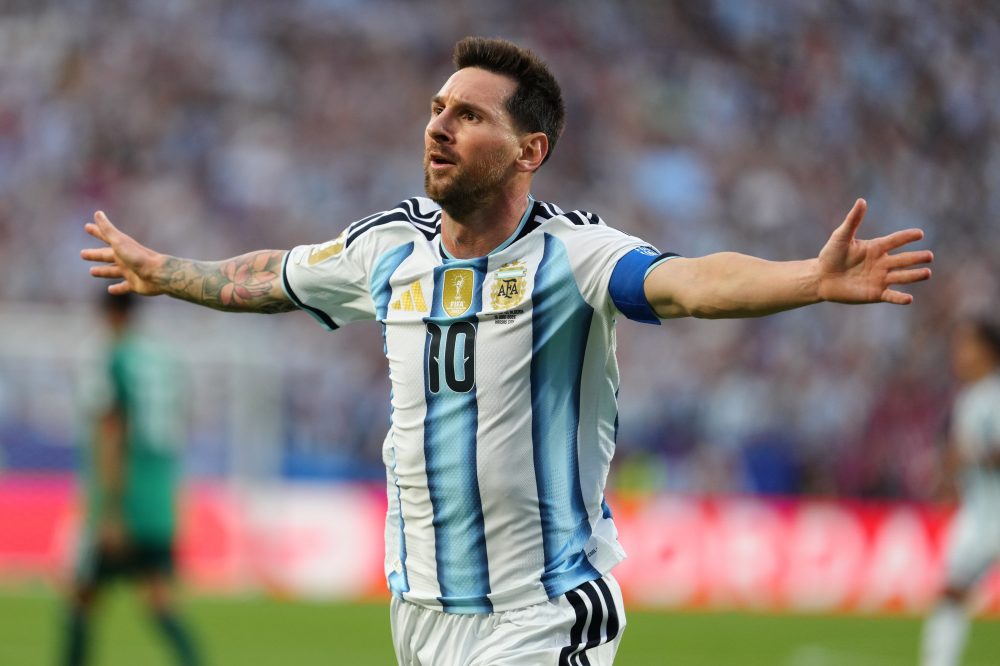
The defending World Cup champion is blending sporting tradition with artistic flair in its uniforms. The home kit — worn by Lionel Messi during his hat trick against Algeria on Tuesday — features three shades of blue in its stripes, a nod to the nation’s championship uniforms from 1978, 1986, and 2022. The dark blue away jersey draws inspiration from a traditional Buenos Aires painting style known as filete porteño, a decorative art form combining vivid swirling colors with distinctive lettering.
France brought an away jersey that pays tribute to one of the most famous gifts the country ever gave to the United States: the Statue of Liberty. The kit has a greenish tone resembling the oxidized appearance of the iconic statue, which was designed by Frenchman Frédéric-Auguste Bartholdi and presented to the United States in 1886 as a symbol of friendship between the two nations. A copper-colored logo — reflecting the statue’s original hue — appears on the jersey alongside the phrase “Nos différences nous unissent,” meaning “Our differences unite us.”
Iran’s home and away jerseys feature a striking image: an Asiatic cheetah stretching low across the front, with cheetah spots running up the sleeves to the shoulders. The Asiatic cheetah, a close relative of the African variety and equally fast, is critically endangered. Iran has long worked to protect the species. Once numbering as many as 400 in the 1990s, fewer than an estimated 70 are believed to remain in the country today.
Norway’s jerseys may be the most visually sharp at the tournament — in a literal sense. The font used for player names and numbers is inspired by runic writing, the angular characters found in several Germanic alphabets used across northern Europe before the Latin alphabet took over. The pointy, geometric lettering reflects the Norwegian team’s connection to its ancient heritage. Viking-style patterns in an Urnes design flank the large blue cross on the chest.
Colombia’s characteristically bright yellow jersey features a pattern of butterfly imagery on close inspection. The design pays homage to the country’s Nobel Prize-winning novelist Gabriel Garcia Marquez and his celebrated work “One Hundred Years of Solitude.” Marquez became literature’s most famous practitioner of magical realism — a genre blending everyday life with fantastical elements — including the image of a man followed by a cloud of yellow butterflies.
Mexico’s home jersey revives the Aztec calendar design that was a fan favorite in the 1990s. In the lead-up to the tournament, the team visited the National Museum of Anthropology in Mexico City and posed for photos in their uniforms in front of the Aztec “Piedra de Sol,” or Stone of the Sun — the artifact widely known as the Aztec calendar.
Saudi Arabia’s dark green home jersey is dotted with symmetrical lavender squares and diamond shapes, honoring the geometric, triangular decorative patterns commonly found on doorways of homes throughout the kingdom. Wild lavender flowers bloom across Saudi Arabia’s desert landscape each spring, making purple a cherished color in the nation and a recognized symbol of generosity.
Brazil’s navy blue-and-black away jersey, made by Nike, features a yellow “Jumpman” logo associated with Michael Jordan-branded sportswear. But the deeper cultural reference lies in the kit’s color scheme, which was inspired by the skin of the poison dart frog native to the Amazon rainforest — a nod to the threat posed by Brazil, the record five-time world champion.