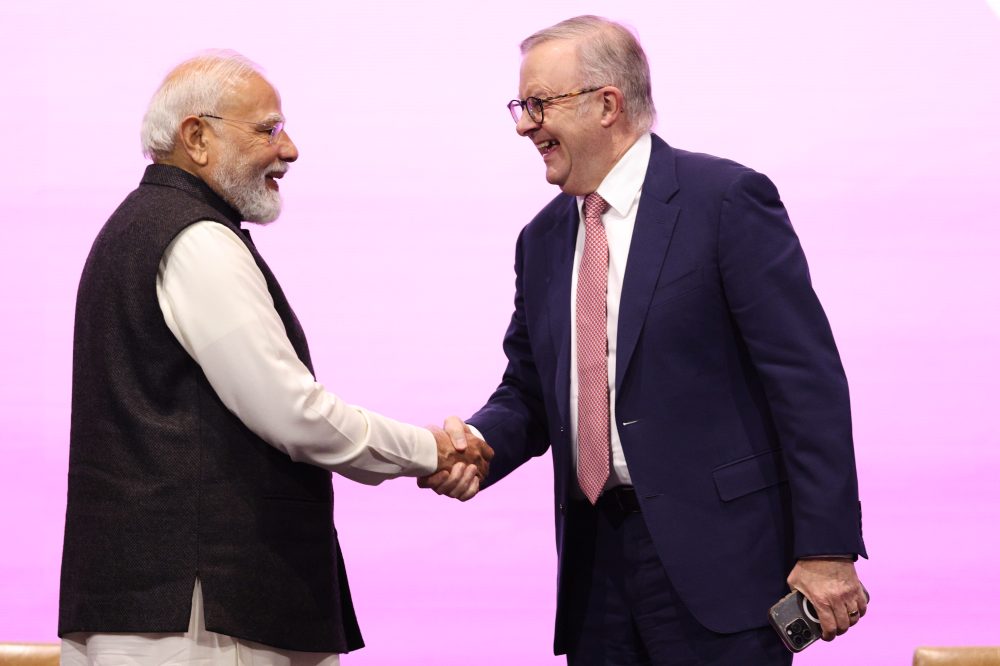

Australia and India have broken a long-standing deadlock, signing an administrative agreement Thursday that clears the path for Australia to supply uranium to India for peaceful energy use. The announcement came following a face-to-face meeting in Melbourne between Australian Prime Minister Anthony Albanese and Indian Prime Minister Narendra Modi.
While the two leaders confirmed the deal jointly, neither provided specifics on how much uranium would be exported or when shipments might begin. The move resolves a years-long impasse that had blocked a 2014 export agreement, which had been frozen due to fears the nuclear material could potentially be diverted for weapons development.
Australia sits on the world’s largest known uranium reserves, though the country itself uses no nuclear power and operates no nuclear weapons — meaning all uranium it mines is sold abroad. India, home to 1.4 billion people and a rapidly expanding middle class, has set an ambitious goal of reaching 100 gigawatts of nuclear power capacity by 2047, a level that would generate enough electricity to power roughly 60 million Indian homes annually. Despite doubling its nuclear power output over the past decade, nuclear energy still accounts for only 3% of India’s total electricity supply.
A key complication has been India’s status outside the Nuclear Non-Proliferation Treaty, which only recognizes the United States, China, Britain, France, and Russia as legitimate nuclear weapons states. Australia, as a treaty signatory, has traditionally refused to sell uranium to countries that haven’t signed on. India has argued the treaty is unfair because it only acknowledges nations that tested nuclear devices before January 1967, a cutoff that permanently excludes India. The country faced international sanctions and uranium trade restrictions following nuclear tests it conducted in 1998.
A turning point came in 2008, when the Nuclear Suppliers Group — which includes the U.S. — granted India a special waiver, allowing it to purchase uranium from member nations. Since then, India has worked to establish bilateral agreements with individual countries. It signed a similar deal with Canada in March.
Australia’s position on the matter gradually softened over the years. While Canberra had long insisted India must sign the Non-Proliferation Treaty before any uranium sales could happen, the country agreed in 2014 to allow exports under conditions including International Atomic Energy Agency safeguards and a clear separation between India’s civilian and military nuclear programs. Thursday’s administrative agreement was designed to remove the remaining barriers to putting that earlier deal into action.
Modi’s visit to Australia is part of an annual summit between the two nations’ leaders. In a joint statement, both Modi and Albanese committed to deeper defense and security cooperation throughout the Indo-Pacific region, describing it as representing “a step-change in the depth and ambition” of the bilateral relationship.
The announcement of stronger security ties came just days after Australia publicly criticized China for test-firing a long-range ballistic missile from a nuclear-powered submarine into the South Pacific Ocean — a region covered by an anti-nuclear treaty. However, neither leader mentioned China by name during Thursday’s statements, and both declined to take questions from reporters afterward. Thousands of people gathered in Melbourne hoping to catch a glimpse of the Indian prime minister during his visit.
India ranks as Australia’s fifth-largest trading partner. Two-way trade in goods and services between the two countries reached 54.4 billion Australian dollars — approximately $37.7 billion U.S. — during the 2024-2025 financial year, based on Australian government data.
Modi began the week with a stop in Indonesia and is scheduled to travel to New Zealand on Friday, marking his first visit to that country. India and New Zealand finalized a free trade agreement in April.