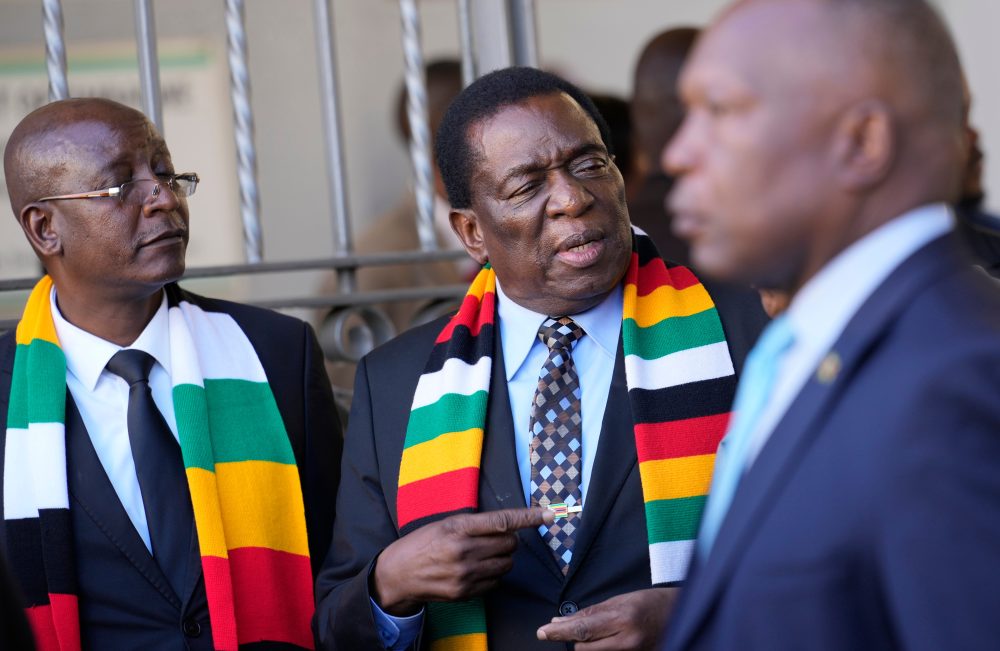

HARARE, Zimbabwe — Zimbabwe’s lawmakers cast votes Thursday in favor of constitutional changes that would delay upcoming elections and stretch the current president’s time in office from five years to seven.
The move shines a light on a striking reality across Africa: some of the planet’s oldest leaders govern a continent whose population is among the youngest in the world.
The country’s National Assembly passed the constitutional amendments by a wide margin. The changes would push elections originally scheduled for 2028 back to 2030, adding two years to President Emmerson Mnangagwa’s term. The bill must still clear the Senate, where passage is also widely anticipated.
Should the legislation become law, Mnangagwa would join the ranks of some of Africa’s oldest and longest-serving heads of state. He first took power in 2017 following a military-led removal of the late Robert Mugabe, who was 93 at the time and held the distinction of being the world’s oldest sitting head of state. The bill also proposes changing how the president is chosen — moving from a direct public vote to selection by members of parliament.
A recent analysis from the Pew Research Center found that 16 of the world’s 186 national leaders are older than U.S. President Donald Trump, who celebrated his 80th birthday last week. Seven of the ten oldest leaders on the global stage are from Africa — a continent where the median age is roughly 20 and more than 60% of residents are under 30, according to United Nations data.
Blessing Vava, a researcher focused on democracy and governance, put it plainly: “The population in Africa is getting younger, but the average age of presidents is rising, and tenures are getting longer.”
Vava, who also serves as director of the Johannesburg-based Southern Africa Coalition for Democracy and Accountability, added that Zimbabwe’s situation is far from unique. “Zimbabwe is not an exception. It’s the continental norm. Zimbabwe is just one data point in a much broader story of constitutional erosion for political survival.”
Cameroon’s Paul Biya, 93, holds the title of the world’s oldest sitting head of state. He has governed since 1982 — a year after Ronald Reagan took office in the United States — in a country where roughly 70% of the population is under 35. The U.S. has cycled through seven presidents in the time Biya has held power.
In neighboring Equatorial Guinea, Teodoro Obiang Nguema Mbasogo has ruled for 47 years. At 84, he is Africa’s longest-serving leader and has gone so far as to name his own son as vice president.
Ivory Coast’s Alassane Ouattara, also 84, was sworn in for a fourth presidential term in December 2025 following an election that saw low voter participation and civil unrest.
Malawi returned Peter Mutharika, now 85, to the presidency last year. He previously served as the country’s leader from 2014 to 2020.
In Uganda, 81-year-old Yoweri Museveni — an American ally on regional security matters who has drawn criticism from opponents for authoritarian governance — took the oath of office for a seventh straight term in May, pushing his total time in power to four decades.
Mnangagwa, Museveni, Ouattara, Biya, and Obiang have each altered or done away with constitutional limits that were designed to restrict how long a leader could remain in office.
The Africa Center for Strategic Studies notes that leadership patterns across the continent’s 54 nations vary widely. Around 20 African countries actively maintain term limits, while others have eliminated or worked around them. Some nations are under military rule, with constitutional protections suspended entirely, allowing entrenched leaders to stay in power indefinitely.
That said, a younger generation of leaders has emerged in parts of the continent in recent years. Bassirou Diomaye Faye became one of Africa’s youngest elected leaders when he won Senegal’s 2024 presidential election at 44. Ethiopia’s Prime Minister Abiy Ahmed, 49, has held office since 2018. Some younger figures have come to power through military action — Mahamat Idriss Deby, 42, took control of Chad after his father was killed fighting rebels in 2021, then won a democratic election in 2024. In Burkina Faso, army captain Ibrahim Traoré seized power in a 2022 coup and, at 38, is currently Africa’s youngest ruler. Military takeovers have also brought younger leaders to power in Mali and Guinea.
Despite these examples, analysts warn that much of the continent’s political landscape is still dominated by older elites, leaving younger generations with few pathways to democratic leadership.
Vava summed up the imbalance: “So you get 25-year-olds making up the majority of a country’s population, but 75-year-olds decide the candidate or rule. Youth are mobilized for votes and not for power.”