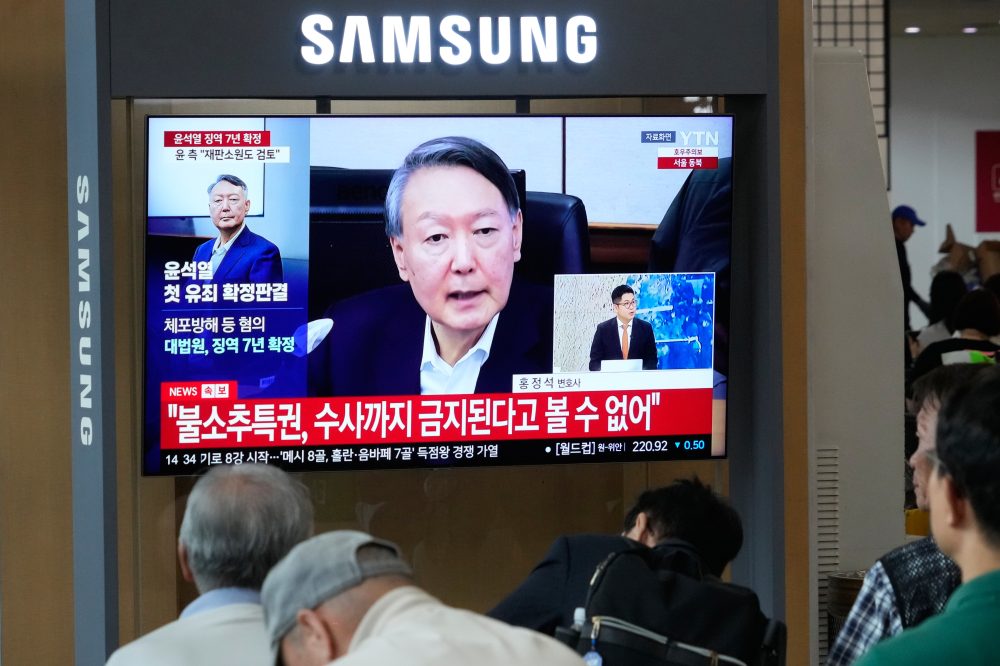

SEOUL, South Korea — South Korea’s Supreme Court has confirmed a seven-year prison sentence for former President Yoon Suk Yeol, marking the first of his several criminal cases tied to his short-lived martial law declaration in 2024 to reach the nation’s highest judicial body.
The court backed an April decision by the Seoul High Court, which had found Yoon guilty on several counts: violating Cabinet members’ right to participate in deliberations before the martial law declaration, falsifying the official proclamation to conceal that procedural failure and later destroying the document, and directing presidential security personnel to unlawfully obstruct law enforcement officers attempting to arrest him following his impeachment.
The martial law declaration lasted only a matter of hours. Lawmakers managed to push past a line of heavily armed soldiers and police stationed outside Seoul’s National Assembly, and once inside, voted to strike down the decree — forcing Yoon’s Cabinet to formally lift it.
Yoon was not present for Thursday’s ruling, which is final and carries no further avenue for appeal. He remains in detention and continues to face proceedings in separate cases. Among them, he has appealed a life sentence handed down on the most serious charge against him — rebellion.
Following the ruling, Yoon’s legal team issued a statement expressing “deep regret,” arguing that the justices had reached a conclusion in a significant case without conducting a thorough enough review.
The Supreme Court’s decision is consistent with the position taken by South Korea’s Constitutional Court, which removed Yoon from office in April 2025, determining that his martial law decree lacked legal justification and was not carried out according to required procedures.
Yoon summoned 11 Cabinet members to his office shortly before going on late-night television to announce the martial law declaration on December 3, 2024. However, several of those present — including then-Prime Minister Han Duck-soo — have testified that Yoon simply informed them of his decision rather than opening the floor for any discussion. The Seoul High Court also found that Yoon violated the rights of nine additional Cabinet members by either not calling them to the meeting at all or notifying them too late to participate.
Although the martial law period was brief, it sent South Korea into a serious political crisis, bringing high-level diplomacy to a standstill, freezing key political functions, and unsettling financial markets. The situation did not stabilize until Yoon’s liberal political rival, Lee Jae Myung, won a special presidential election held in June 2025.
Beyond his rebellion sentence appeal, Yoon is also contesting a separate 30-year prison term. That case centers on allegations that he ordered drone operations in 2024 with the deliberate intent of escalating tensions with North Korea, thereby manufacturing conditions that could justify imposing martial law domestically. His legal team has argued the drone flights were a direct response to North Korea sending thousands of balloons carrying trash across the border into South Korea.