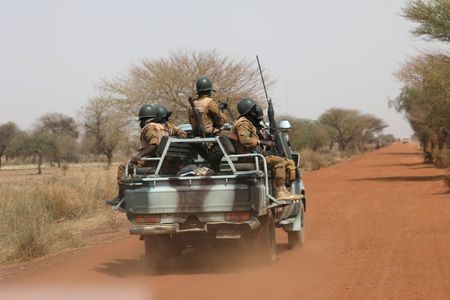

Military forces in two West African nations have caused more civilian casualties than the terrorist groups they’re fighting, according to new research from Human Rights Watch released Thursday.
Data compiled by the human rights organization reveals that since 2023, government troops and their allies in Burkina Faso have been responsible for more than double the civilian deaths caused by Islamic extremist groups.
Similar patterns emerge in neighboring Mali, where Armed Conflict Location & Event Data (ACLED) statistics show government forces and their partners have killed three to four times more civilians than jihadist fighters over the past two years.
Both countries are currently under military rule following recent coups, and both have experienced escalating violence from terrorist organizations since 2021, transforming the Sahel region into a major global terrorism concern.
Experts warn that extensive civilian killings by government troops may strengthen terrorist groups politically and help them recruit new members. These developments could also hinder U.S. efforts to rebuild relationships with Sahel governments that removed French and other Western military forces after their coups.
Ilaria Allegrozzi, Human Rights Watch’s senior Sahel researcher, stated that Burkina Faso’s security forces and allied militias “appear to be more brutal and violent” than extremist organizations like the regional al Qaeda branch, Jama’at Nusrat al-Islam wal-Muslimin (JNIM).
She explained that the behavior of Burkinabe forces reflects a broader regional trend that raises serious questions about military discipline and its impact on anti-insurgency operations.
Neither Mali nor Burkina Faso government representatives immediately responded to requests for comment. Both nations have previously rejected accusations of unlawful killings, claiming their forces have eliminated “terrorists.”
The Human Rights Watch investigation examined the timeframe from January 2023 through August 2025, recording 57 incidents that resulted in at least 1,837 civilian fatalities. Government forces and their allies carried out 33 of these incidents, causing 1,255 civilian deaths.
ACLED figures show that in 2025 alone, Burkina Faso’s military and the pro-government Homeland Defence Volunteers militia killed 523 civilians, while JNIM and Islamic State Sahel Province killed 339.
In Mali during 2025, the military working alongside Russian paramilitary units Wagner and Africa Corps killed 918 civilians, compared to 232 killed by JNIM and Islamic State Sahel Province.
Russia’s defense ministry, which oversees Wagner and Africa Corps, did not respond to comment requests. JNIM representatives could not be contacted.
ACLED gathers information from social media, news reports, and official statements from governments, armed groups, and non-governmental organizations. The organization acknowledges its fatality counts are conservative estimates. Human Rights Watch based its findings on 450 interviews and verified social media content and satellite images, noting their documented incidents don’t represent the complete picture.
Allegrozzi explained that because JNIM controls extensive territory, security forces often escort humanitarian and supply convoys through rural areas, but frequently kill civilians they encounter during these operations.
An eastern Burkina Faso resident, speaking anonymously due to safety concerns, described witnessing such an incident while traveling in a civilian convoy with military protection in July 2024. Many villages they passed appeared deserted until they reached Sakoani village, located 30 kilometers west of Kantchari town.
“When the army arrived in this village and saw that it was populated, they surrounded the entire village and they exterminated everything – every living being,” the witness told Reuters. “People tried to flee, but if you run, they shoot at you.”
The witness estimated seeing at least 100 bodies.
Mali has increasingly relied on drone attacks for many civilian killings, according to ACLED data. Drone operations expanded dramatically after the government started buying Turkish-manufactured drones in 2022. Civilian casualties from Mali’s drone or air attacks increased from four incidents in 2022 to 66 incidents in 2025, killing 155 people.
Government drone strikes in July 2024 killed at least 50 civilians at the Inatiyara artisanal gold mining location in northern Mali, ACLED reported. Three eyewitnesses provided accounts to Reuters.
A 30-year-old gold miner from Niger who worked at Inatiyara and requested anonymity said, “We were surprised by the strikes, we were so scared.”
“It was pure panic… I’m still reeling from the shock,” he added.
Human Rights Watch and ACLED also documented serious crimes by JNIM, including the deaths of at least 133 civilians in Barsalogho, Burkina Faso, during August 2024 and 19 civilians in Diallassagou, Mali, in May 2024.
Despite these actions, the group has successfully presented itself as a protector of marginalized communities like the Fulani, a nomadic herding group whose members are frequently suspected of JNIM connections, according to analysts.
Heni Nsaibia, ACLED’s senior West Africa analyst, noted, “As state responses increasingly rely on retaliation and collective punishment, more civilians find themselves trapped in areas under jihadist control, where JNIM is consolidating its influence through coercion and strategic engagement with local populations.”