
WELLINGTON, New Zealand — New Zealand’s beloved national symbol, the kiwi bird, disappeared from Wellington’s surrounding hills more than 100 years ago. Today, local residents are leading an extraordinary grassroots effort to bring these endangered flightless creatures back to their nation’s capital.
“They are a part of who we are and our sense of belonging here,” said Paul Ward, founder of the Capital Kiwi Project, a charitable trust. “But they’ve been gone from these hills for well over a century and we decided as Wellingtonians that wasn’t right.”
Under cover of darkness Tuesday evening, Ward and fellow volunteers carefully transported seven containers across challenging terrain on a misty hillside overlooking the waters separating New Zealand’s North and South Islands. Each container held a precious cargo — a kiwi bird, with one representing the milestone 250th bird brought back to Wellington through the Capital Kiwi Project’s efforts.
New Zealanders derive their common nickname from this unique bird species. The kiwi presents an unusual appearance with its tiny, undeveloped wings and whisker-like facial features, combined with its naturally timid behavior.
Holding deep spiritual meaning for many New Zealanders, the kiwi’s likeness can be found throughout the country, even adorning the nation’s air force aircraft — an ironic choice given that this bird lacks a tail and cannot achieve flight.
Experts believe approximately 12 million kiwi birds inhabited New Zealand’s landscape before human settlement. Current estimates place the surviving population at roughly 70,000 birds nationwide, with numbers declining by 2% annually.
On the windswept hills where Wellington’s kiwi population now calls home, Tuesday night’s only sounds came from spinning wind turbines. Ward and his team positioned their containers in pairs, carefully opened them, and gently angled the boxes forward.
Several quiet observers became emotional during the release. A participant offered a karakia, a traditional Māori prayer.
Each container gradually revealed a distinctive long, curved beak as the kiwi birds cautiously emerged into their new shadowy environment, then quickly accelerated into runs before vanishing into the night.
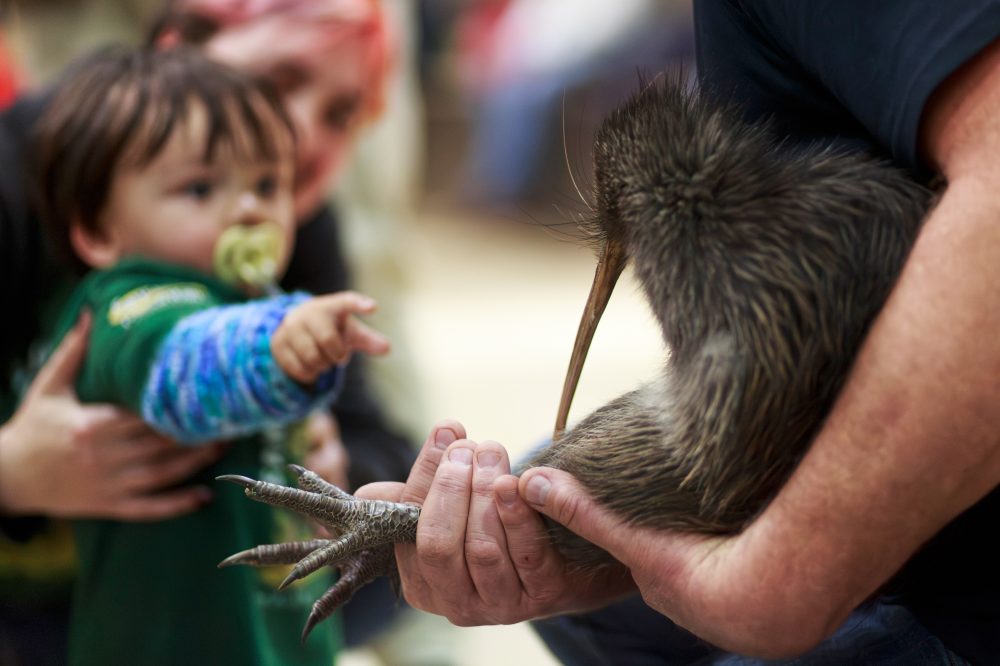
For the first time in history, kiwi birds entered New Zealand’s Parliament building this week. Before the seven newest Wellington residents were taken to their hillside habitat, handlers brought them into Parliament’s elegant banquet hall to commemorate the 250th kiwi’s arrival in the city.
Both legislators and students expressed hushed amazement at observing these shy, nighttime creatures at close range — many experiencing their first encounter as conservation staff held the substantial birds similar to human infants, with their weathered feet extended.
“This animal has given us as a people so much in terms of our sense of identity,” Ward told The Associated Press. “We want to challenge our civic leaders, our politicians and say this is a relationship we need to honor.”
New Zealand hosts several of the planet’s most unusual and rare bird species. Many have survived only through ambitious conservation programs that sometimes operate with uncertain financial support.
Earlier conservation efforts relocated all remaining birds of certain species to predator-free offshore islands or protected sanctuaries where careful monitoring and protection was possible, though few New Zealanders would encounter them there.
Ward and his colleagues envisioned something different: New Zealand’s symbolic national bird thriving alongside residents in a busy capital city, despite human development and non-native predators previously eliminating the kiwi population.
“Where people are is also the places where we can bring them back because we’ve got the means to do that guardianship,” Ward said.
While unprotected kiwi populations continue declining, their numbers have flourished in well-managed wild bird reserves — so successfully that some protected locations have reached capacity.
This success has enabled relocations to areas like Wellington, where organizations like Ward’s encourage residents to welcome their new avian neighbors. Late-night mountain bikers have encountered kiwi, and the birds have appeared on residential security cameras throughout the capital, according to Ward.
“They’re living and calling and being encountered on the hills surrounding our city,” Ward said.
Achieving this required significant coordination. Throughout the past ten years, collaboration between property owners, the local Māori tribe, and the Capital Kiwi Project has created an extensive 24,000-hectare area where kiwi can freely roam.
More than 5,000 traps targeting stoats — the primary threat to kiwi chicks — are distributed across this territory. Wellington’s kiwi population currently maintains an impressive 90% chick survival rate.
This kiwi restoration represents part of New Zealand’s ambitious goal to eliminate introduced predators, including feral cats, possums, rats, and stoats, by 2050. While debate continues regarding the feasibility of this target established by a previous government in 2016, community organizations have embraced the challenge enthusiastically.
Certain Wellington areas now exist completely free of mammalian predators except for domestic pets, allowing native bird species to thrive. Volunteers monitor neighborhoods with exceptional thoroughness, watching for even a single rat’s appearance.
“When I think of endangered species globally, for the most part you can’t do much other than campaign or donate money,” said Michelle Impey, chief executive of Save the Kiwi. “But we have this incredible movement throughout the country where everyday people are taking it on under their own steam to do what they can to protect a threatened species.”