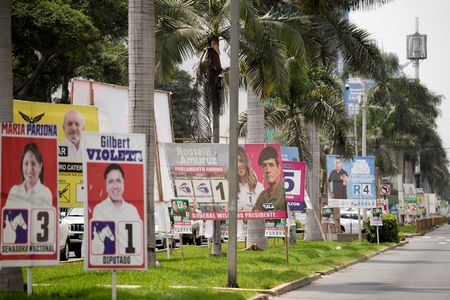

With Peru preparing for its presidential election this Sunday, the United States is launching its most significant diplomatic campaign in years to strengthen relationships with the South American nation that has become increasingly aligned with China, according to government officials and business executives.
The diplomatic initiative, spearheaded by recently appointed U.S. Ambassador Bernie Navarro, represents a notable change following ten years during which China surpassed America as Peru’s primary trading partner, especially in mining operations and infrastructure development.
Sunday’s election features more than 30 presidential candidates with no clear leader, potentially providing Washington an opportunity to restore diplomatic ties while protecting access to essential minerals and countering China’s expanding influence across South America.
“The relationship with the U.S. is really strengthening,” stated Felipe James, leader of Peru’s manufacturing industry chamber, who participated in February meetings with Navarro to establish a working group focused on enhancing trade and investment opportunities.
This past January, the White House granted Peru major non-NATO ally status, a designation that will enhance defense collaboration and broaden access to trade and security initiatives. The following day, the State Department authorized an equipment package designed to help upgrade a naval facility near Callao port.
Peruvian representatives joined former U.S. President Donald Trump and his key regional partners in Florida last month to establish a new alliance targeting Latin American drug trafficking organizations. Additionally, American defense contractor Lockheed Martin is competing against Swedish and French companies to provide Peru with fighter aircraft.
Navarro’s outreach to Peruvian stakeholders demonstrated Trump’s “commitment to strengthening the U.S.-Peru partnership on shared priorities including economic growth and security cooperation,” according to a State Department representative.
SECURITY CONCERNS
Peru ranks as the globe’s third-largest copper producer and serves as a significant source of other essential minerals utilized in semiconductors, defense equipment, and renewable energy technologies. The country’s commerce with China reached a record $50 billion in the previous year, far exceeding the approximately $19 billion in trade with the United States.
Instead of focusing on trade volume, Washington has emphasized the transparency and dependability of American companies operating in Peru, business leaders report, while Ambassador Navarro has encouraged Lima officials to address judicial uncertainties and confront public safety issues amid rising organized criminal activity.
“He has clearly called for legal certainty and stronger public security to attract investment,” explained Julia Torreblanca, director of mining and energy association SNMPE and corporate affairs vice president at Cerro Verde, a copper mining operation managed by Freeport-McMoRan.
Navarro has also highlighted Peru’s recent political instability as an increasing threat to the business climate. The nation has experienced eight different presidents since 2018.
“The United States will never interfere in Peruvians’ right to self-determination, but stability is needed,” he stated during an interview with local radio station RPP last month.
The U.S. Embassy refused to provide Navarro for an interview.
With Peruvian leaders frequently preoccupied with surviving regular impeachment threats rather than developing coherent geopolitical strategies, experts noted that China’s economic influence has overshadowed traditional American connections.
“There’s a correlation between those last ten years of political instability and more Chinese investments being able to trickle to Peru,” observed Martin Cassinelli from the Atlantic Council.
TRADING PLACES
Washington’s renewed diplomatic efforts coincide with Peru establishing itself as a portal for Chinese commerce throughout South America.
The Chinese-constructed Chancay megaport located north of Lima, managed by Cosco Shipping, has reduced shipping times to Asia and is starting to function as a distribution center for products including electric vehicles destined for regional markets.
The facility, which opened in late 2024, has generated concerns in Washington regarding foreign oversight of critical infrastructure.
Former U.S. Southern Command leader General Laura Richardson has cautioned it could function as a “gateway” for Chinese military and intelligence operations throughout South America.
Attempts by Peruvian officials to enhance regulatory supervision were prevented earlier this year when a court sided with Cosco’s argument that Chancay represents private investment. The ruling is currently being appealed.
Peru’s economic connections to China will prove difficult to reverse.
Trade imbalances have increased in recent months, with Peru returning to a deficit with the U.S. following a temporary surplus in 2024. Lima officials are working to eliminate tariffs implemented by U.S. President Donald Trump, which they claim breach a bilateral free trade agreement active since 2009.
“China is not leaving,” stated Margaret Myers from the Inter-American Dialogue, who indicated U.S. efforts will likely concentrate on areas connected to national security interests rather than trying to replace China’s economic significance to Peru.
The outcome will depend on Sunday’s election results. All candidates are polling under 15%, making a June runoff virtually inevitable.
Conservative candidate Keiko Fujimori, who received her education in the U.S. and is considered a top contender, has positioned herself as a more reliable partner for Washington than opponents she connects to Beijing, while conservative Carlos Alvarez has balanced support for renewed U.S. involvement in Latin America with recognition of Chinese investment value.
“They say: do you want a gringo hamburger or some chifa (Chinese fusion)?” Alvarez told Reuters during an interview.
Alvarez indicated he would choose a local dish: fried guinea pig.