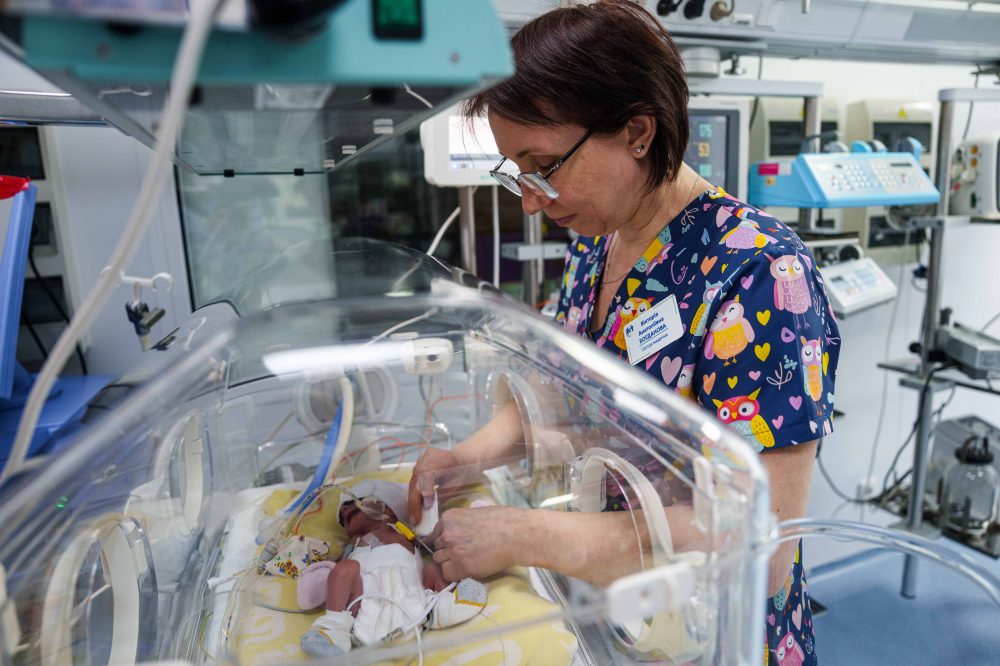

In the war-torn Ukrainian city of Zaporizhzhia, Marharyta Nekhoroshyva experienced overwhelming terror when she first laid eyes on her newborn child. Her son arrived at only 26 weeks gestation, weighing a mere 940 grams (2 pounds), with diapers small enough to fit in an adult’s palm.
“The doctors told me that if he survived the first three days, everything would be OK,” she said, tears filling her eyes. “I don’t believe in God, but I was praying.”
Today, at 9 months old, Mark displays energy and liveliness but struggles with persistent respiratory issues that demand regular hospital visits.
Nekhoroshyva faces the challenge of managing her son’s medical needs while living under continuous threat of bombardment in Zaporizhzhia, where medical facilities cover their windows with boards due to glass regularly breaking from Russian attack blast waves. She handles this burden without her husband, who is serving in the military.
Ukrainian regions are experiencing an upward trend in early births — occurring before 37 weeks of gestation — especially in areas close to combat zones, where certain locations have witnessed rates climbing to nearly twice their pre-conflict levels since Russia’s 2022 invasion began.
Medical professionals explain that early delivery causes are multifaceted, but the severe mental and physical strain that warfare places on expecting mothers plays a role. The delicate process of sustaining these vulnerable infants becomes even more challenging amid ongoing conflict.
At Zaporizhzhia’s primary pediatric medical facility, Nekhoroshyva joins other mothers in bringing their babies to underground shelters nightly. Within these confined, poorly lit corridors, they comfort and lull their infants to sleep.
Although Ukraine sees fewer overall births due to population displacement, emigration, and wartime circumstances, early deliveries represent a growing portion of births, based on United Nations data and recent research findings.
The southern Kherson region experienced its preterm birth rate climbing from 5.4% in 2019 to 9.8% in 2025, according to U.N. statistics. The Zaporizhzhia region, also located in the south, saw increases from 5.7% in 2019 to 7.6% in 2025. Poltava, a northeastern Ukrainian region, witnessed rates climbing from 7.7% to 9.8% during the same timeframe.
Combat lines run through both Kherson and Zaporizhzhia regions, where civilian areas face regular bombardment. While Poltava sits farther from front lines, it experiences frequent aerial bombardments.
The connection between expectant mother stress and early delivery involves complexity, but expanding research indicates that extended psychological pressure raises the likelihood of early birth, according to medical experts. This may connect to heightened infection risk, a recognized catalyst for early labor, explained Dr. Andrew Weeks, a professor of international maternal healthcare at the University of Liverpool.
“Premature birth is very affected by infection,” he said. “And if you can’t get to a place where you can get appropriate diagnosis and treatment early, then actually the chance of you going into premature labor is higher.”
Ukraine faces increases not only in early births but also emergency cesarean deliveries and additional complications, stated Isaac Hurskin, spokesperson for the U.N. Population Fund.
“We’re seeing this real link between acute stress and birthing and pregnancy-related complications,” he said.
These complications may worsen a population crisis. Ukraine’s birth rate has dropped to among the world’s lowest levels, falling to approximately one child per woman during the past three years — significantly below the 2.1 replacement rate, Hurskin noted.
Within an incubator at Zaporizhzhia city’s maternity hospital intensive care unit rests an infant born at 30 weeks weighing only 700 grams (1 pound, 9 ounces) — considerably under the 2,500 gram (5 pounds, 8 ounces) threshold that the World Health Organization defines as low birth weight.
Her small form survives within the climate-controlled incubator. Intravenous tubes provide nutrition and medicine, while breathing equipment assists her lungs. A blanket covers the incubator to shield her delicate, developing vision from the ward’s bright fluorescent lighting.
Medical care concentrates on helping early babies gain weight and develop independent breathing, but potential complications are widespread, explained Dr. Andrii Lobanov, head of neonatal intensive care at Zaporizhzhia’s children’s hospital. Oxygen management requires precision due to risks of abnormal eye blood vessel development, potentially causing blindness in serious cases.
Beyond intensive care discharge, children born early frequently need ongoing medical attention — potentially lifelong — for breathing, neurological, developmental, or immune system issues.
This creates financial strain on resource-limited nations like Ukraine.
“It is very expensive and of course a country in a war situation has to decide what it’s going to spend on, so hospital services invariably get hit. Both literally and metaphorically,” Weeks said.
Warning sirens have integrated into routine operations within neonatal intensive care facilities. When alarms sound, medical staff remain with infants rather than evacuating them to shelters, understanding that relocating these fragile newborns presents greater risks. The alerts occur too regularly to halt operations each time.
Dr. Nataliia Bohuslavska, head of the neonatal unit at the maternity hospital in Zaporizhzhia, started one recent day with air raid warnings about approaching missile strikes. By afternoon, a Russian glide bomb had hit a business district, killing at least 12 people.
Medical services continued throughout: Physicians conducted two cesarean procedures and delivered an infant while treating a 42-year-old woman who lost her pregnancy after experiencing an airstrike.
The following day, a black banner flew near the hospital entrance honoring the deceased.
Bohuslavska recognizes each mother in her ward personally — understanding their complex medical situations, anxieties, and tiny infants struggling for life. She has served at this hospital for 26 years and was delivered there herself.
Warfare intensifies challenges faced by every expecting woman under her care, she explained.
“She wonders what kind of world her child will be born into, under what conditions the birth will happen, and whether it will be a moment of joy or one gripped by fear with shells exploding nearby,” she said.
Numerous mothers face this experience without support while their spouses serve in combat.
“When a patient calls to say her husband has been killed in the war, the only thing I can tell her is: ‘Come to us. We will take care of you,’” Bohuslavska said.
“We have to support her constantly, so that even in the midst of this terrible loss, she can find the strength to give new life a chance and save her baby.”
For Mariia Skladan, the moment for departure had arrived.
Her daughter, Elina, arrived in January at only 26 weeks, weighing 740 grams (1 pound, 10 ounces). Five months afterward, having grown to a robust 3 1/2 kilograms (nearly 8 pounds), physicians determined she was ready for release.
Skladan has a uncommon liver condition that doctors cautioned would make conception nearly impossible. Her pregnancy was viewed as miraculous, Bohuslavska stated.
“If there’s a war, what does it mean? Not to live?” Skladan asked. “You want to keep going.”
When she and Elina exited the maternity facility, her relatives waited with flowers. Skladan wept with happiness.
However, the comfort proved brief.
The following day, Elina returned to intensive care after developing a virus during the night.