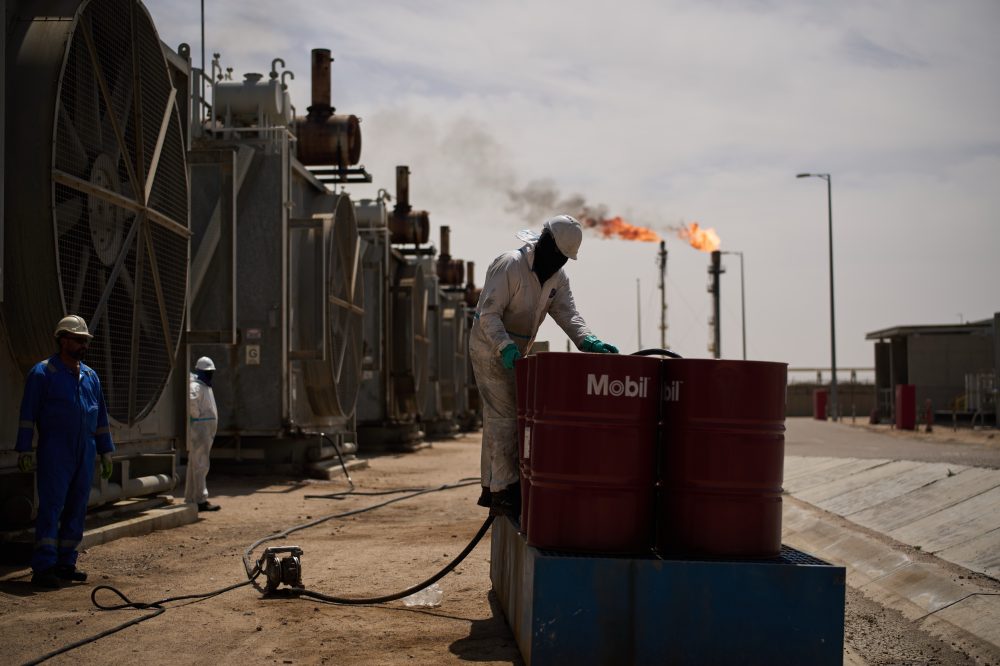

BASRA, Iraq — What were once bustling Iraqi oil facilities filled with workers have become nearly empty landscapes. Shipping terminals that formerly hummed with commercial activity now sit quiet, with only the gentle sound of water lapping against empty docks.
Four weeks into the Iranian conflict, employees at petroleum facilities and shipping terminals throughout Basra province—which handles nearly all of Iraq’s crude oil production and shipments—have become familiar with missiles flying overhead toward American military installations and other strategic targets.
The conflict, which started with strikes by U.S. and Israeli forces, is severely damaging Iraq’s financial foundation. The nation depends on petroleum income for approximately 90% of its government funding, and the majority of its crude oil moves through the Strait of Hormuz, the crucial Persian Gulf passage where Iran has essentially blocked commercial shipping during the fighting. The conflict has also dramatically reduced imported merchandise arriving at Iraq’s southern shipping facilities, while military strikes have shut down movement along the Iranian border.
Iraq finds itself in a unique position among Middle Eastern nations affected by the war, hosting both deeply embedded pro-Iranian forces and substantial American interests, making it vulnerable to strikes from either side. Since hostilities began, petroleum output in Iraq’s southern region has plummeted more than 70%, while imported goods reaching the nation’s ports have been reduced by half. Unmanned aircraft and rocket strikes have hit American corporations and military installations. Iranian-backed Iraqi militias have also attacked petroleum facilities and energy infrastructure. Numerous international workers have evacuated.
Financial experts believe the Iraqi government has sufficient reserves to operate until mid-May without fresh oil income, but will need to seek loans after that point.
“After that, the government would resort to issuing bonds,” said Ahmed Tabaqchali, an expert in Iraq’s economy. “But not without consequences.”
Throughout southern Iraq, the Strait of Hormuz blockade has forced petroleum facilities to reduce output and prioritize domestic requirements, while global oil costs have increased. The Zubair oil field near Basra, previously generating approximately 400,000 barrels daily, has experienced production falling to about 250,000, according to officials.
Iran has provided guarantees that Iraqi petroleum can move safely through the strait, according to Bassem Abdul Karim, who leads the government-operated Basra Oil Company overseeing provincial production. Nevertheless, since Iraq doesn’t own its shipping vessels and relies on leased tankers, deliveries depend entirely on whether ship operators will accept the increased dangers of the voyage. Most refuse.
At a processing facility in Zubair where crude oil is refined, operations have also slowed significantly. “It’s quiet now because of the reductions,” said chief engineer Ammar Hashim. “Of course we are worried.”
The slowdown at Zubair mirrors a widespread decline throughout Basra. Production has fallen from 3.1 million barrels daily to approximately 900,000 across the entire province, Abdul Karim reported.
“Exports are currently completely halted. At the moment, we are considering alternative loading areas, but none are fully operational,” he told The Associated Press.
That same day, an unmanned aircraft crashed at the Majnoon oil field north of Basra without exploding. A security official described this as an increasingly frequent event, noting the drone was probably targeting American bases in Kuwait. Operations at the facility have been suspended because of how often these incidents occur. The official requested anonymity since he wasn’t authorized to speak with reporters.
Hundreds of workers from American, British, Italian, French and other international petroleum companies have departed Iraq because of the war. The exodus intensified following a March 6 drone attack on the Burjisiya complex in Basra, a vital logistics center for Iraq’s oil sector used by multiple companies. The assault targeted American oil services firm KBR, hitting its chemical storage area.
Another drone hit the British Petroleum-managed Rumaila oil field, causing some foreign personnel to evacuate, Abdul Karim said. The facility continues operating, he noted. On Wednesday, several drones struck a fuel storage facility connected to BP in northern Iraq.
Attempts to redirect Iraq’s oil face significant obstacles: The nation lacks capacity to increase shipments through its northern pipeline, and truck transport through Jordan and Syria is expensive and ineffective, Abdul Karim explained.
Umm Qasr, Iraq’s main deep-water shipping facility, was previously so loud with cargo operations that it could cause headaches, workers recalled.
Currently, with the Strait of Hormuz blocked, large cargo vessels bringing supplies to Iraq cannot reach the port. Instead, they dock in the United Arab Emirates, where merchandise is transported by trucks and smaller vessels to reach Umm Qasr—an expensive alternative.
The facility’s loading areas are operating far below previous levels, with cargo volumes cut in half by the war, according to port director Mohammed Tahir Fadhil.
During the AP’s visit, only one cargo vessel from the U.A.E. was docked.
The danger to shipping routes increased after Iran sank two tankers on March 11 in Iraqi waters—the Marshall Islands-registered Safesea Vishnu and the Malta-registered Zefyros.
“Today, our only gateway for goods is the United Arab Emirates,” said Farhan Fartousi, director of the Iraqi Ports Company.
Sunday morning found Haidar Abdul-Samad, assistant director of Basra’s Shalamcha border crossing with Iran, speaking by phone with an Iranian official, protesting power outages that had stopped trade and requesting immediate repairs. The electrical failures followed an airstrike that damaged the Iranian side of the crossing.
Local officials say such interruptions have become commonplace.
Before the conflict, the crossing experienced continuous activity, reflecting strong family and business connections between Iranians and Iraqis in the region. It also serves as an important route for merchants and religious pilgrims traveling to Shiite sacred sites in central Iraq.
That morning, trucks were lined up for miles.
“Priority is given to food supplies to prevent price increases,” Abdul-Samad said. “Passenger movement is not at the same level as before; activity has declined due to the war in Iran.”
After power was restored, 30-year-old Iranian merchant Atefa Al-Fatlawi arrived with her husband and young son. She purchases merchandise at reduced prices in Basra to sell back home.
“We are scared because of the bombings,” she said. “Shalamcha was targeted. Today, there were no transport vehicles at the garage because of the attack.”