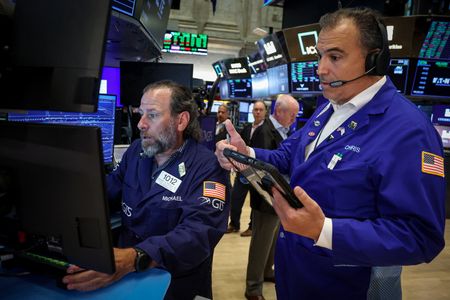

U.S. stock index futures moved slightly higher Monday morning, offering a modest recovery after last week’s steep decline driven largely by a selloff in semiconductor stocks. Investors are now shifting their focus to a busy stretch of corporate earnings reports that could determine whether Wall Street’s artificial intelligence-fueled rally has staying power.
The second quarter earnings season accelerates this week, with several high-profile companies set to release their financial results, including Alphabet, Tesla, Intel, and IBM.
Alphabet, counted among the so-called “Magnificent Seven” group of megacap technology stocks, is considered a major player in AI infrastructure, pouring billions of dollars into data centers and related buildout projects.
That wave of AI-related capital investment has been a significant force behind this year’s stock market gains, boosting semiconductor companies and other businesses seen as beneficiaries of the technology expansion — helping push major U.S. indexes to record highs along the way.
Results from Intel and Texas Instruments will draw particular scrutiny after chip stocks surged earlier this year only to reverse sharply in recent weeks. The Philadelphia SE Semiconductor Index finished Friday more than 20% below its late-June peak, a level that officially marks a bear market decline.
Kathleen Brooks, research director at XTB, offered a cautious outlook: “If earnings reports in the coming weeks suggest that we remain in the spend phase of the AI buildout, investors are likely to get more impatient, and the sell-off could drag on over the summer months.”
As of 5:18 a.m. Eastern Time, Dow E-minis were up 106 points, or 0.2%, while S&P 500 E-minis gained 16.5 points, or 0.22%. Nasdaq 100 E-minis climbed 111.75 points, or 0.39%.
All three major U.S. indexes posted significant losses last week, weighed down by the dramatic pullback in semiconductor shares. Those losses came despite relatively positive inflation data that reduced some fears about a potential Federal Reserve interest rate increase later this month, and even as major U.S. banks reported encouraging earnings to kick off the season.
According to CME’s FedWatch tool, markets are currently pricing in roughly a 12% probability of a quarter-point rate hike at the Fed’s July meeting, with about a 53% chance of another increase in September.
Adding to investor anxiety, the ongoing conflict involving U.S. and Israeli forces against Iran continued to escalate. U.S. forces conducted strikes for a ninth straight day Monday, raising alarm over the potential disruption of shipping through the Strait of Hormuz.
The renewed hostilities have stoked fears that energy prices could climb back toward the elevated levels seen when the conflict began nearly five months ago, potentially reigniting inflation concerns. Brent crude oil rose above $90 per barrel earlier Monday — its highest point since early June.
Brooks added: “The escalations have also eroded the assumption that the crisis in the Middle East is over and energy prices would normalize.”