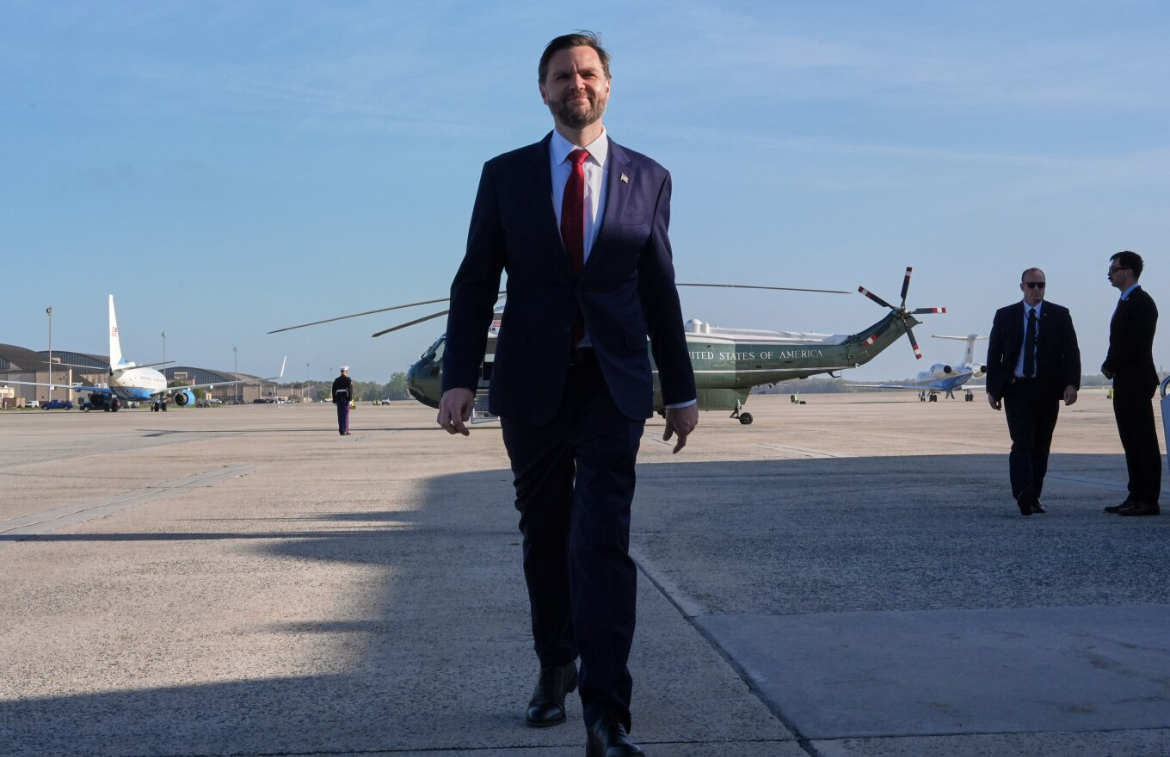

WASHINGTON (AP) — Vice President JD Vance issued a stern warning to Iran on Friday as he departed for overseas peace negotiations, cautioning the nation against attempting to “play” the United States during upcoming talks.
President Donald Trump has assigned his vice president—who has appeared most hesitant about the six-week conflict with Iran—to seek a diplomatic solution and prevent Trump’s dramatic threat to destroy Iran’s “whole civilization” from becoming reality.
The vice president, known for his skepticism toward foreign military interventions and opposition to open-ended troop deployments, departed Friday to oversee mediated discussions with Iran in Islamabad, Pakistan’s capital. Before boarding Air Force Two, Vance expressed optimism about the upcoming negotiations, stating, “We’re looking forward to the negotiation. I think it’s gonna be positive. We’ll of course see.”
Referencing Trump’s position, Vance explained, “If the Iranians are willing to negotiate in good faith, we’re certainly willing to extend the open hand.” However, he cautioned, “If they’re gonna try and play us, then they’re gonna find that the negotiating team is not that receptive.”
The vice president mentioned that Trump “gave us some pretty clear guidelines” for conducting the talks but declined to provide specifics. He avoided answering questions from accompanying reporters.
This diplomatic mission occurs while a fragile temporary ceasefire teeters on the edge of failure. The gap between Iran’s public positions and demands from the U.S. and Israel appears impossible to bridge. Domestically, where Vance may seek the presidency in two years, mounting political and economic pressure exists to conclude the conflict.
Accompanying Vance are Trump’s special envoy Steve Witkoff and the president’s son-in-law Jared Kushner, both of whom participated in three previous rounds of indirect negotiations with Iranian representatives. Those earlier talks focused on addressing U.S. concerns regarding Tehran’s nuclear and ballistic missile programs and its backing of armed proxy organizations throughout the Middle East, occurring before Trump and Israel initiated the February 28 war against Iran.
The White House has released minimal information about the negotiation format—whether discussions will be direct or indirect—and has not outlined specific goals for the meetings.
Vance’s participation represents an uncommon instance of senior-level U.S. government interaction with Iranian leadership. The most significant direct communication since Iran’s 1979 Islamic Revolution occurred when President Barack Obama telephoned newly elected Iranian President Hassan Rouhani in September 2013 regarding Iran’s nuclear activities.
Disagreements over ceasefire conditions emerged almost immediately after the White House and Iran announced the temporary truce Tuesday evening.
Iran maintains that ending Israel’s war in Lebanon forms part of the ceasefire agreement. However, Israeli Prime Minister Benjamin Netanyahu and Trump have stated the truce excludes Lebanon, allowing Israeli operations there to continue.
The United States has insisted Iran must fulfill its commitment to reopen the Strait of Hormuz. The Islamic Republic had blocked this vital shipping corridor following Israel’s escalated attacks against the Hezbollah militant organization in Lebanon.
Trump criticized Iran’s performance Thursday, claiming the country was “doing a very poor job” of permitting oil tanker passage. He wrote on social media, “That is not the agreement we have!”
White House spokeswoman Anna Kelly stated that Vance, Witkoff, Kushner and Secretary of State Marco Rubio “have always been collaborating on these discussions.” She said Trump remains confident a permanent agreement can be achieved during the two-week ceasefire period. “President Trump has a proven track record of achieving good deals on behalf of the United States and the American people, and he will only accept one that puts America first,” Kelly commented.
This represents the most critical moment yet for Vance, who maintained a relatively low profile during much of last year in the Trump White House, particularly as figures like Elon Musk and Rubio became prominent presidential advisers.
Vance’s responsibilities are expanding rapidly, beginning with a domestic mission to eliminate fraud in government programs and now extending to helping resolve a U.S. military conflict in the complex Middle East.
Despite serving in the Iraq War as a Marine, spending two years as an Ohio U.S. senator, and slightly over one year as vice president, Vance possesses limited diplomatic experience.
On Wednesday, he rejected suggestions that Iran specifically requested his involvement in the talks, telling reporters: “I don’t know that. I would be surprised if that was true. But, you know, I wanted to be involved because I thought I could make a difference.”
Jonathan Schanzer, former Treasury Department official and current executive director of the Foundation for Defense of Democracies, a hawkish Washington think tank, described Vance as an intriguing choice to lead the delegation given his limited Iran policy experience.
Trump has acknowledged his vice president was “less enthusiastic” than other senior Republican administration officials, making Vance a compelling negotiator for Iran, according to Schanzer.
“I think they probably prefer him knowing that his perspective on foreign intervention is one of skepticism,” Schanzer said regarding Iranian preferences. “I do think that he’s going to need some help. I don’t think he’s ever been engaged in negotiations with this kind of weight, this kind of seriousness. This is as serious as it gets.”
The White House has disputed characterizations that Iran requested Vance’s participation, describing such claims as attempts to undermine negotiations.
While the White House has not identified other talk participants beyond Vance, Witkoff and Kushner, Kelly confirmed that officials from the National Security Council, State Department and Pentagon “will also play a supportive role.”
During preliminary indirect nuclear negotiations with Iran before the war, Democrats and nuclear experts questioned whether Kushner and Witkoff possessed sufficient technical expertise. The White House has not disclosed whether the pair, whom Trump has entrusted with challenging negotiations since returning to office, had nuclear specialists available during those discussions.
Vice presidents commonly assume significant negotiating responsibilities for presidents, according to Joel Goldstein, a Saint Louis University law professor specializing in vice presidential history.
However, he noted, “I don’t recall a situation where a vice president has been sent to negotiate a ceasefire or peace in connection with a war the United States was involved with.”
Vance and Rubio are considered the Republican Party’s leading potential 2028 presidential candidates, though neither has clearly indicated campaign intentions.
According to a person familiar with internal discussions who requested anonymity, Vance’s team is not approaching these negotiations with future political considerations in mind.
As vice president, Vance would naturally inherit any administration baggage if he eventually seeks the presidency, Goldstein explained. However, leading these negotiations further connects him to the conflict’s outcome.
“The fact that he’s involved in the negotiations in a very visible way, that means that, if things go south, that people will be pointing fingers at him,” Goldstein observed.
Simultaneously, Goldstein added, “If things go well, then it will be something that he could point to.”