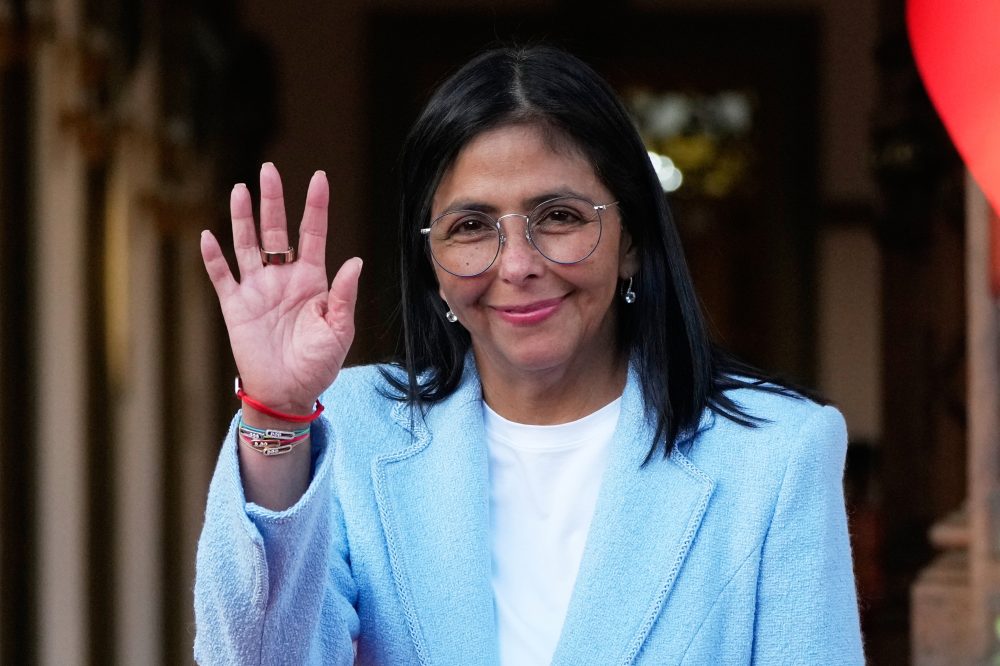

NETHERLANDS — Venezuela’s acting leader Delcy Rodríguez firmly dismissed President Donald Trump’s suggestion that he might make Venezuela America’s 51st state, declaring her nation will remain independent.
Rodríguez made these statements Monday while speaking to reporters at the International Court of Justice in The Hague, where final arguments were being heard in Venezuela’s territorial dispute with Guyana over the resource-rich Essequibo region.
“We will continue to defend our integrity, our sovereignty, our independence, our history,” Rodríguez stated. She emphasized that Venezuela is “not a colony, but a free country.”
The Venezuelan leader’s response came after Trump told Fox News he was “seriously considering making Venezuela the 51st US state,” according to a social media post by Fox News co-anchor John Roberts. The White House has not yet commented on Trump’s statement.
Trump has previously made similar remarks regarding Canada.
Despite rejecting the statehood comments, Rodríguez noted that Venezuelan and American officials have maintained contact and are pursuing “cooperation and understanding.”
During the court proceedings, Rodríguez argued that political negotiations, rather than judicial decisions, should settle the longstanding territorial conflict with Guyana over Essequibo.
The disputed territory spans 62,000 square miles and represents two-thirds of Guyana’s landmass. The region contains valuable deposits of gold, diamonds, and timber, plus sits adjacent to offshore oil fields producing approximately 900,000 barrels daily.
This oil production rivals Venezuela’s own output of roughly 1 million barrels per day and has elevated tiny Guyana into a major energy player in South America.
Venezuela’s territorial claims date back to Spanish colonial times when the jungle region fell within its borders. However, an 1899 arbitration decision by British, Russian, and American officials established the current boundary along the Essequibo River, largely favoring Guyana.
Venezuela maintains that a 1966 Geneva agreement to resolve the dispute invalidated the 19th-century arbitration. But in 2018, three years after ExxonMobil discovered significant oil reserves off Essequibo’s coast, Guyana asked the International Court of Justice to confirm the 1899 boundary decision.
Tensions escalated in 2023 when Rodríguez’s predecessor, Nicolás Maduro, threatened military annexation of the region following a referendum on incorporating Essequibo as a Venezuelan state. Maduro was captured January 3 during a U.S. military operation in Caracas and transported to New York to face drug trafficking charges, to which he has pleaded not guilty.
While avoiding mention of the referendum, Rodríguez told the court that the 1966 Geneva agreement was designed to facilitate bilateral negotiations between Venezuela and Guyana. She criticized Guyana’s government for making an “opportunistic” decision to seek judicial resolution.
“At a time when the mechanisms established in the Geneva agreement were still fully in force, Guyana unilaterally chose to shift the dispute from the negotiating arena to a judicial resolution,” she explained. “This change was not accidental; it coincided with the discovery in 2015 of the oil field that would become world-renowned.”
Last week’s opening statements featured Guyana’s foreign minister, Hugh Hilton Todd, telling international judges that the dispute “has been a blight on our existence as a sovereign state from the very beginning.” He noted that 70% of Guyana’s territory hangs in the balance.
The court will likely require several months to issue its final, legally binding decision.
Venezuela has cautioned that its participation in the proceedings does not constitute acceptance or acknowledgment of the court’s authority over the matter.