
Venezuela’s acting President Delcy Rodríguez touched down in the Netherlands on Sunday, preparing to present her nation’s case before the world’s highest court regarding a long-standing territorial conflict with neighboring Guyana over a resource-abundant region.
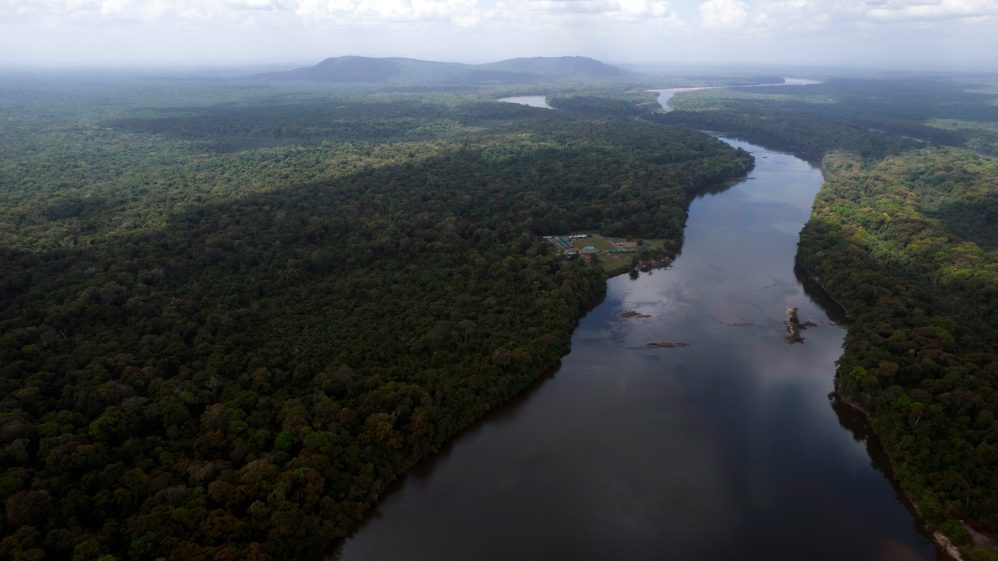
The International Court of Justice located in The Hague is conducting a series of proceedings between these South American nations, both of whom assert ownership over Essequibo — a nearly 62,000-square-mile area abundant in gold, diamonds, timber and additional natural resources, positioned close to substantial offshore petroleum reserves.
Since the era of Spanish colonization, Venezuela has regarded Essequibo as part of its territory, as the forested region was within its colonial borders. However, an 1899 arbitration decision made by representatives from Britain, Russia and the United States established the boundary along the Essequibo River, primarily favoring Guyana’s position.
Venezuelan officials contend that a 1966 Geneva agreement designed to settle the territorial disagreement essentially invalidated the 19th-century arbitration decision.
Monday will mark the concluding court session, featuring Rodríguez’s testimony. The tribunal will likely require several months before delivering a final and legally enforceable decision.
Upon her arrival at Amsterdam’s Schiphol Airport, Rodríguez — who took office in January after a U.S. military action that removed Nicolás Maduro from power — stated that her nation has “demonstrated at every historical stage what our territory has meant since we were born as a Republic.”
Guyana initiated the Essequibo case at the ICJ in 2018, seeking international confirmation that the 1899 decision — rather than the 1966 agreement — should determine the boundary. Venezuelan officials have cautioned that their participation in these proceedings doesn’t constitute acceptance or acknowledgment of the ICJ’s authority.
During the hearings’ opening session, Guyanese Foreign Minister Hugh Hilton Todd informed the international panel of judges that this territorial disagreement “has been a blight on our existence as a sovereign state from the beginning” and noted that 70% of Guyana’s land area is in question.