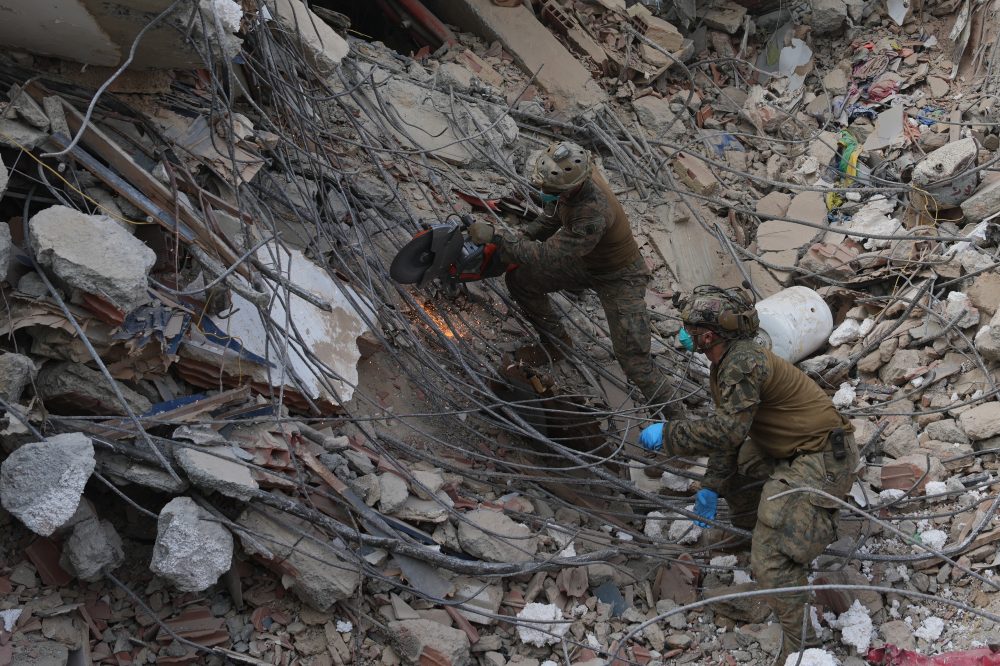

LA GUAIRA, Venezuela — Angelica Mundrain has spent six agonizing days waiting for the heavy equipment necessary to recover the bodies of her son, niece, and nephew, who remain buried beneath the crushed remains of her beachfront apartment building. Massive concrete slabs and mangled metal are all that stand between her and her family — and the machinery needed to move it has not come.
She is not alone. Across the northern state of La Guaira, earthquake survivors are asking the same desperate question: Who is actually in charge?
Venezuela’s government, which has long portrayed itself as a protector of its people, has failed to live up to that image when it mattered most, according to many survivors. The powerful back-to-back earthquakes on June 24 have exposed deep failures within the ruling party — now led by acting President Delcy Rodriguez — after 27 years in power.
“We’ve been abandoned,” Mundrain said Tuesday, seated in a chair on the street in front of the ruins of the 11-story building she once called home. “We feel helpless. What we have seen is a lack of organization, a lack of empathy, a lack of everything.”
In the critical first 72 hours following the disaster — which brought down apartment buildings, restaurants, pharmacies, hotels, and convenience stores throughout La Guaira state, Caracas, and surrounding areas — the government’s visible presence on the ground was largely limited to directing traffic. Police officers, intelligence agents, and military personnel were stationed at intersections while the search for survivors was left largely to ordinary citizens.
Civilians, many working on their own and some alongside foreign rescue teams, combed through rubble looking for loved ones. Ambulances sat trapped in miles-long traffic jams. Hospitals were overwhelmed, understaffed, and lacking basic supplies. Emergency responders showed up with little or no equipment.
A week after the earthquakes, residents of coastal communities in La Guaira credited most of the rescues and body recoveries to fellow Venezuelans and international teams equipped with thermal cameras, sound detection technology, and trained search dogs. Many noted that while these groups worked tirelessly, Venezuelan government personnel in uniform stood by and watched — and in some cases, posed for photos.
Tulane University professor David Smilde, who has spent three decades studying Venezuela, said the disaster has made painfully clear that the country’s government is fundamentally broken. He connected the earthquake response failures to the stunning January 3rd capture of then-President Nicolas Maduro by U.S. forces — describing both as signs of a state that “was not able to defend itself at all.”
“It also can’t do anything like get started with digging people out,” Smilde said, adding that the situation should be deeply concerning for Rodriguez, who was sworn in after Maduro was removed from power and taken to New York to face drug trafficking charges.
Smilde attributed the poor response to the mass exodus of workers from the public sector, driven by extremely low wages and widespread corruption — including thousands of people who remain on the government payroll but have not actually worked in months or even years. He said a functioning government would have clearly defined roles and emergency protocols already in place.
“It’s like trying to have a baseball team with three people on the field. You’re not sure who’s going to be the pitcher, who’s going to be catching, and who’s going to be outfielder,” he said, describing the government’s lack of coordination.
Wealth and political connections also shaped which victims received attention. One collapsed building drew heavy police and military presence — and residents quickly figured out why. Officers from a neighboring state were searching for a captain, while military students and national guard members were looking for a major general.
A telescopic crane — exactly the kind of equipment Mundrain desperately needs — sat parked for hours outside that building. The families of well-connected residents were able to rent it. Mundrain cannot afford to do the same.
“I think that if there were someone in a position of authority in each of these apartments, there would be a well-oiled machine working like they have in other residences,” she said, gesturing toward her destroyed building.
Frustration over the response has boiled over into confrontations. In one incident at a collapsed public housing building, residents blocked traffic to prevent a government-provided excavator from leaving the site and physically pulled the operator out of the cab to stop it from going.
Venezuelan authorities have confirmed that 1,943 people died and more than 10,500 were injured in the 7.2 and 7.5 magnitude earthquakes that struck on June 24. Thousands more remain unaccounted for.
On Tuesday, rescue teams continued pulling some survivors from the debris, giving grieving families a fragile reason for hope — even as the odds of finding anyone alive grew slimmer with each passing hour. Experts note that the first 48 to 72 hours after a disaster are the most critical for rescue efforts, though survival is possible longer if victims have access to food and water.
Electrician Daniel Castillo managed to rescue his mother and son from their second-floor apartment in a collapsed public housing building in La Guaira just hours after the earthquakes hit. His brother’s body remained inside for another full day before he could reach him.
On Tuesday, Castillo stood in line to receive a free bag of hygiene supplies — including toilet paper and soap — distributed from a tent run by the Venezuelan armed forces. He had harsh words for the government’s handling of the crisis.
“You see the guards, and their uniforms are spotless, not dirty at all,” Castillo said, drawing a sharp contrast between the immaculate appearance of Venezuela’s National Guard members and the dust-caked clothing of civilians and foreign rescuers who have been digging through rubble for days. “The government did nothing.”