
VATICAN CITY — The Vatican launched a forceful response Thursday against a traditionalist Catholic society that ordained new bishops without the pope’s blessing, formally declaring the Society of St. Pius X in schism, excommunicating its bishops and priests, and putting its own members on notice that they too could face the church’s most severe penalties.
The Vatican’s doctrine office went further than what the church’s canon law strictly required in responding to the Wednesday consecrations of four new bishops at the society’s seminary in Econe, Switzerland.
The society, widely referred to by its initials SSPX, is devoted to the ancient Latin Mass and stands in opposition to the modernizing changes of the Catholic Church, which it has condemned as riddled with heresies and errors and accused of abandoning the true Catholic faith.
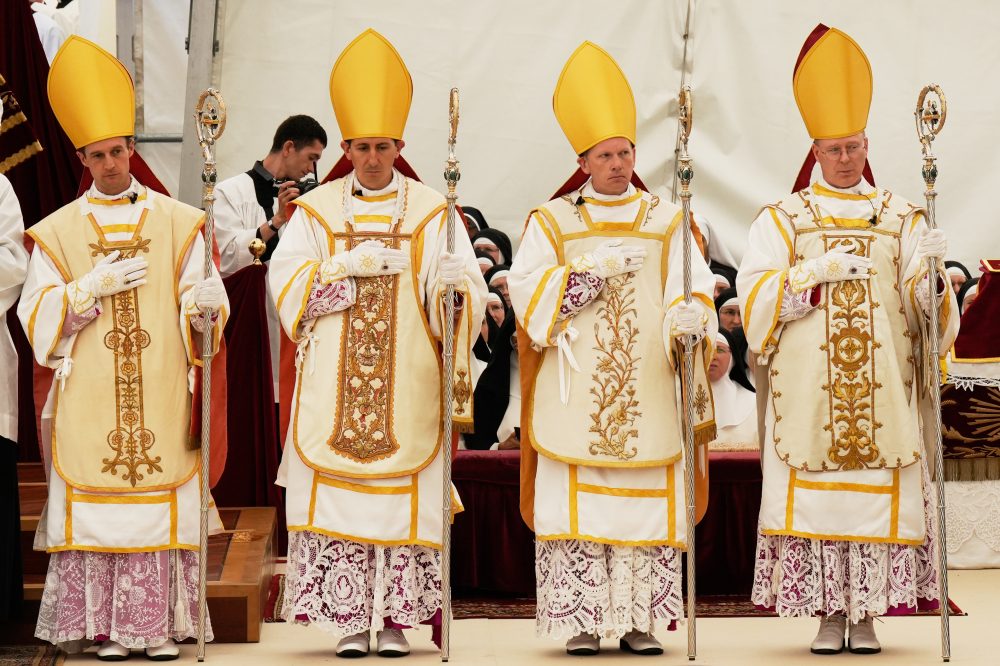
The ordination ceremony Wednesday was a lengthy, ritual-heavy five-hour Mass attended by roughly 15,500 people and their families. The SSPX carried out the consecrations in open defiance of Pope Leo XIV, who had personally called on the group to hold off in the interest of preserving church unity.
Through a formal decree, the Vatican excommunicated all four newly ordained bishops along with the two bishops who participated in the ceremony. The consecrations were labeled a “schismatic act,” and the society itself was declared to have created a schism — a deliberate split from the Catholic Church.
The Vatican also put the society’s followers on notice, stating that those who formally align themselves with the SSPX are to be considered schismatic and therefore excommunicated. SSPX priests were likewise declared schismatic and excommunicated, and the sacraments of confession and marriage they perform were ruled invalid.
The breadth of the penalties — particularly those aimed at priests, laypeople, and the sacraments themselves — represented a sharp reversal of accommodations the Vatican had extended to the SSPX in recent years as part of efforts to bring the group back into full communion with Rome.
The SSPX was established in 1970 by French Archbishop Marcel Lefebvre, who created the organization to resist the modernizing reforms of the Second Vatican Council. Those 1960s meetings, commonly known as Vatican II, transformed the church’s relationships with other Christians, Jews, and people of other faiths, and permitted Mass to be conducted in local languages rather than Latin.
Lefebvre himself consecrated four bishops without papal authorization in 1988. The Vatican at that time excommunicated Lefebvre and all four bishops and similarly declared those consecrations a “schismatic act.”
Pope Benedict XVI lifted those excommunications in 2009 as part of a broader effort to reconcile with the group. Despite that gesture, the SSPX still holds no official standing within the church, and Thursday’s decree now places it formally in schism.
The situation created a significant challenge for Pope Leo XIV, who has made church unity a central theme of his papacy and has made particular efforts to reach out to the conservative and traditionalist segments of the church that felt sidelined during the pontificate of Pope Francis.
Nevertheless, the severity of Thursday’s sanctions signals that after nearly five decades of negotiations with the society, the Holy See has reached its limit.
Part of the Vatican’s forceful reaction stems from the threat the SSPX represents — a growing, parallel ultra-traditional Catholic structure that has expanded considerably since its original break with Rome. According to the society’s own figures, it now counts six bishops, 751 priests, 264 seminarians spread across five seminaries, 145 religious brothers, 88 oblates, and 250 religious sisters drawn from 50 different countries.
The SSPX has long accused the broader Catholic Church of embracing errors such as modernism and liberalism, and has maintained that it alone is preserving the authentic faith of Christ. The group justified the latest consecrations by invoking what it called a “state of necessity” to serve its faithful.
During Wednesday’s ceremony, SSPX superior the Rev. Davide Pagliarani delivered a homily defending the actions and framing them as an act of loyalty to the pope himself.
“We are accused of not respecting the pope,” Pagliarani said. “But it is precisely because we love the pope as the vicar of Christ, as the head of the church, that we don’t want to see the pope humiliated anymore, on the side of false shepherds representing false religions.”