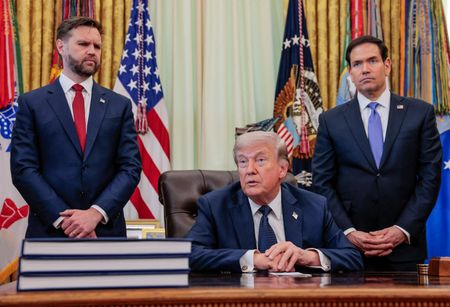

The Trump administration has made a point of projecting a unified message on the ongoing Iran situation, but statements from Vice President JD Vance and Secretary of State Marco Rubio over the past week have told a somewhat different story — particularly when it comes to Israel.
Speaking at the White House last week, Vance took aim at Israeli critics of the preliminary U.S.-Iran agreement. He also suggested that Israeli airstrikes on civilian infrastructure in Beirut — carried out in an effort to weaken Hezbollah, which has been launching attacks against Israel — were getting in the way of U.S.-led peace efforts.
Rubio, who spent the week traveling through the Gulf region, took the opposite stance. He repeatedly defended Israel’s military campaign in Lebanon, framing its actions as a legitimate response to Hezbollah aggression. When reporters pressed him on Vance’s criticism, Rubio sidestepped the question before pointing to a recent Hezbollah assault on an Israeli checkpoint.
The gap between the two officials suggests that even with the administration’s emphasis on unity, competing worldviews are occasionally breaking through — a potential headache for a White House whose political base is sharply divided on foreign policy. It also provides an early preview of the Republican Party’s future, as both Rubio and Vance are widely considered possible 2028 presidential candidates.
Both men were sent on separate high-profile international trips over the past week to make the case for the preliminary peace agreement signed between Washington and Tehran on June 17.
Vance traveled to Switzerland for direct talks with Iranian officials. Speaking to reporters on Sunday, he struck an upbeat tone about the state of negotiations. He has also repeatedly floated the idea that Gulf nations could help finance Iran’s reconstruction, and in an interview released Thursday, he revealed that the U.S. had invited an Iranian intelligence official to serve as a deconfliction liaison with the Pentagon in Qatar.
Rubio’s itinerary took him to the United Arab Emirates, Kuwait, and Bahrain, where he worked to reassure regional allies worried that the interim agreement was too favorable to Tehran. On Tuesday, he said he would not ask Gulf partners to fund Iran’s rebuilding efforts during his trip, calling that prospect “far down the road.” At a meeting with regional officials Thursday, he stressed that any final deal must firmly protect U.S. interests and those of its allies.
“While we want a deal, we don’t want a deal at any price,” Rubio said.
The White House pushed back firmly against any suggestion of a rift between the two officials.
“There is one camp – President Trump’s camp – and the entire administration is fully behind the President’s efforts to ensure Iran can never possess a nuclear weapon,” said White House spokeswoman Anna Kelly.
State Department spokesman Tommy Pigott dismissed talk of a foreign policy divide between Rubio and Vance as a “tired and fake” narrative, adding, “The entire administration is 100% in lockstep behind President Trump.” A separate State Department spokesperson also argued the two men were aligned on Lebanon, saying the administration’s shared goal was restoring the Lebanese government’s sovereignty over its full territory.
Not everyone is buying that explanation. Michael Rubin, a senior fellow at the American Enterprise Institute think tank, said the two officials clearly hold different views. “At their core they represent different strains,” he said.
Their foreign policy backgrounds are strikingly different. Before taking office, Vance was a vocal critic of foreign military engagements, often calling them costly and unnecessary. Rubio built his Senate reputation as a foreign policy “hawk” who pushed for a harder line against Iran, Russia, and Cuba.
Both are seen as potential heirs to Trump’s political legacy and represent competing wings of the Republican Party — one more inclined toward foreign intervention, the other skeptical of overseas military commitments. A Reuters/Ipsos poll that closed Monday found that only 52% of Republicans believe the current conflict has left the U.S. in a stronger position, reflecting that internal divide.
Despite their differences in style and background, both Rubio and Vance have backed all of Trump’s major foreign policy moves, including the capture of Venezuelan leader Nicolas Maduro, the U.S. attack on Iran in February, and the subsequent push for a peace agreement. Both have also used similar language in recent weeks, saying they will judge Iran by its actions rather than its words as talks continue.
When a reporter asked Rubio Thursday how much his views on Iran actually differed from Vance’s, he pointed back to Trump as the common denominator.
“Everyone here is aligned behind the president,” he said.