
With the Fourth of July approaching and America preparing to mark its 250th birthday, Utah’s governor declared a state of emergency Friday and placed temporary restrictions on fireworks — a response to the nation’s largest wildfire, which continues to burn completely out of control.
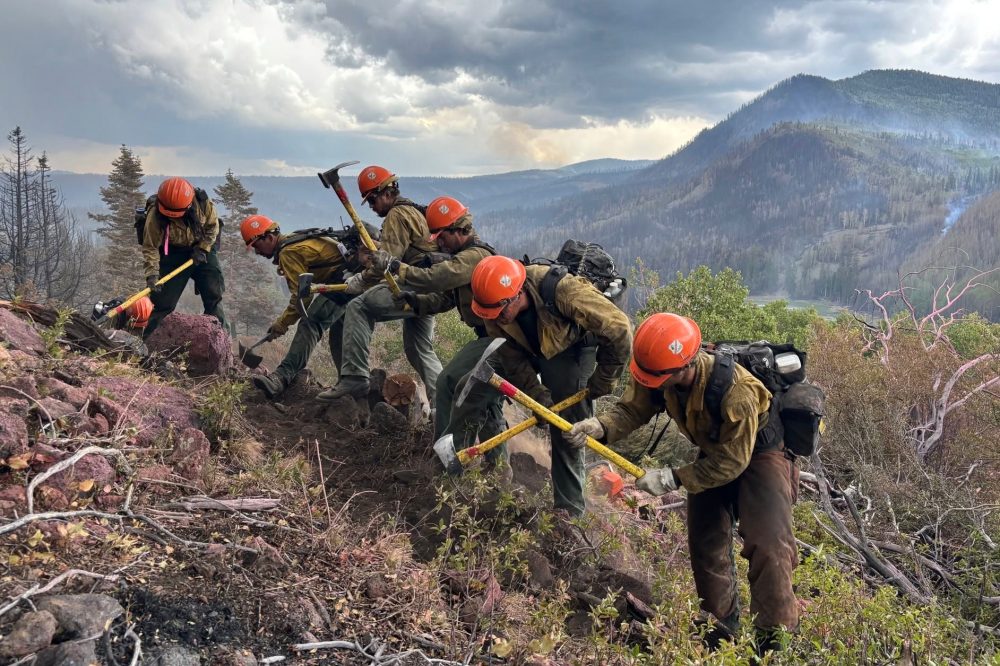
The Cottonwood Fire, which ignited Monday in a lightly populated stretch of southern Utah, had grown to nearly 111 square miles (287 square kilometers) by Friday with zero containment reported by forestry officials. It is one of six major wildfires currently burning across Utah. The blaze has caused serious damage to the Eagle Point ski resort in Beaver County and triggered mandatory evacuation orders for nearby residents.
Bruce Brown, 76, joined the local sheriff on Thursday to survey the damage, only to discover that his cabin — which he had owned for 31 years — and others nearby had been completely destroyed.
“It looks a lot like the moon,” he said. “Just burned out. Power poles tipped over all up the canyon.”
Alyssa Olsen, 27, also lost her family’s cabin in the fire. The structure held a room full of keepsakes from her grandfather’s days on the ski patrol. It was also the last place her family had gathered for photos with her grandmother before she passed away from cancer — and her brother had planned to get married there in just two months.
“That stuff you can’t just build back,” Olsen said.
Smoke from the fire has been drifting east and northeast, leaving popular tourist destinations like Zion and Bryce Canyon national parks — located well south of the fire — largely unaffected beyond some haze near the Bryce area. Even so, visitors have shared videos on social media capturing the massive smoke plume visible in the distance. The smoke has traveled hundreds of miles, reaching as far as Colorado.
“This is unlike anything we’ve seen in recent memory,” state forester Jamie Barnes said in a statement Thursday. “We’re seeing fires spread farther and faster under conditions that defy historical expectations. Some of the fires we’ve responded to this year are behaving in ways veteran firefighters simply haven’t seen before.”
Much of Utah is gripped by severe to extreme drought conditions, and parts of Arizona and Colorado are also experiencing severe drought, according to the U.S. Drought Monitor.
Gov. Spencer Cox put the fireworks restrictions in place through July 5, saying “this year is different.” His order gives state forester Barnes the authority to restrict or ban fireworks displays in Utah cities and towns, rather than leaving those calls to local communities.
The National Weather Service office in Salt Lake City issued a “Particularly Dangerous Situation” warning — the first time in the office’s history it has done so — covering five Utah counties, including the area where the Cottonwood Fire is burning. That designation was originally created to alert the public to tornado conditions. A red flag warning was also issued for most of the state, with the service urging residents to “prepare now for rapid fire growth.”
A similar warning had been issued ahead of the 2025 Palisades Fire in Los Angeles, which killed 12 people and destroyed thousands of homes across Pacific Palisades and Malibu. In a related development Friday, a federal judge declared a mistrial in the arson case against Jonathan Rinderknecht, the man accused of starting that fire, after the jury was unable to reach a verdict.
Extreme fire weather was forecast for Utah on Friday, with wind gusts reaching up to 50 mph (80 kph) and very low humidity levels across the southwest desert and central and southern mountain areas, including the Cottonwood Fire zone.
Rocky Mountain Power issued a public safety power shut-off watch and warning for parts of central, southern, and eastern Utah from Friday through the weekend.
Beaver County, where the Cottonwood Fire is burning, is home to roughly 7,400 people, according to the U.S. Census.
Separately, the Iron Fire — located about 70 miles (113 kilometers) southwest of Salt Lake City — had burned through 63 square miles (163 square kilometers) by Friday and was 26% contained. That fire had forced the evacuation of Eureka, a town of about 1,000 residents, along with people at a nearby ranch. Those residents were allowed to return Thursday.
While investigators have not determined what started the Cottonwood Fire, Gov. Cox’s emergency order noted that more than 75% of Utah’s wildfires this season have been caused by human activity.
Red flag warnings stretched across a wide portion of the western United States on Friday — from Idaho down through southern Arizona and New Mexico — indicating that low humidity, warm temperatures, and strong winds were creating extreme wildfire risk. Those warnings were expected to continue into Saturday, with winds of 25 to 35 mph (40 to 56 km/h) and very low humidity. The most dangerous conditions were forecast from northern Arizona into central and southern Utah.
In New Mexico, firefighters were working to contain a wildfire that forced evacuations at campgrounds and a YMCA camp in the Jemez Mountains. In Arizona, a separate fire near Sedona prompted evacuations last weekend, burning several hundred acres of steep, rugged terrain near Oak Creek Canyon.