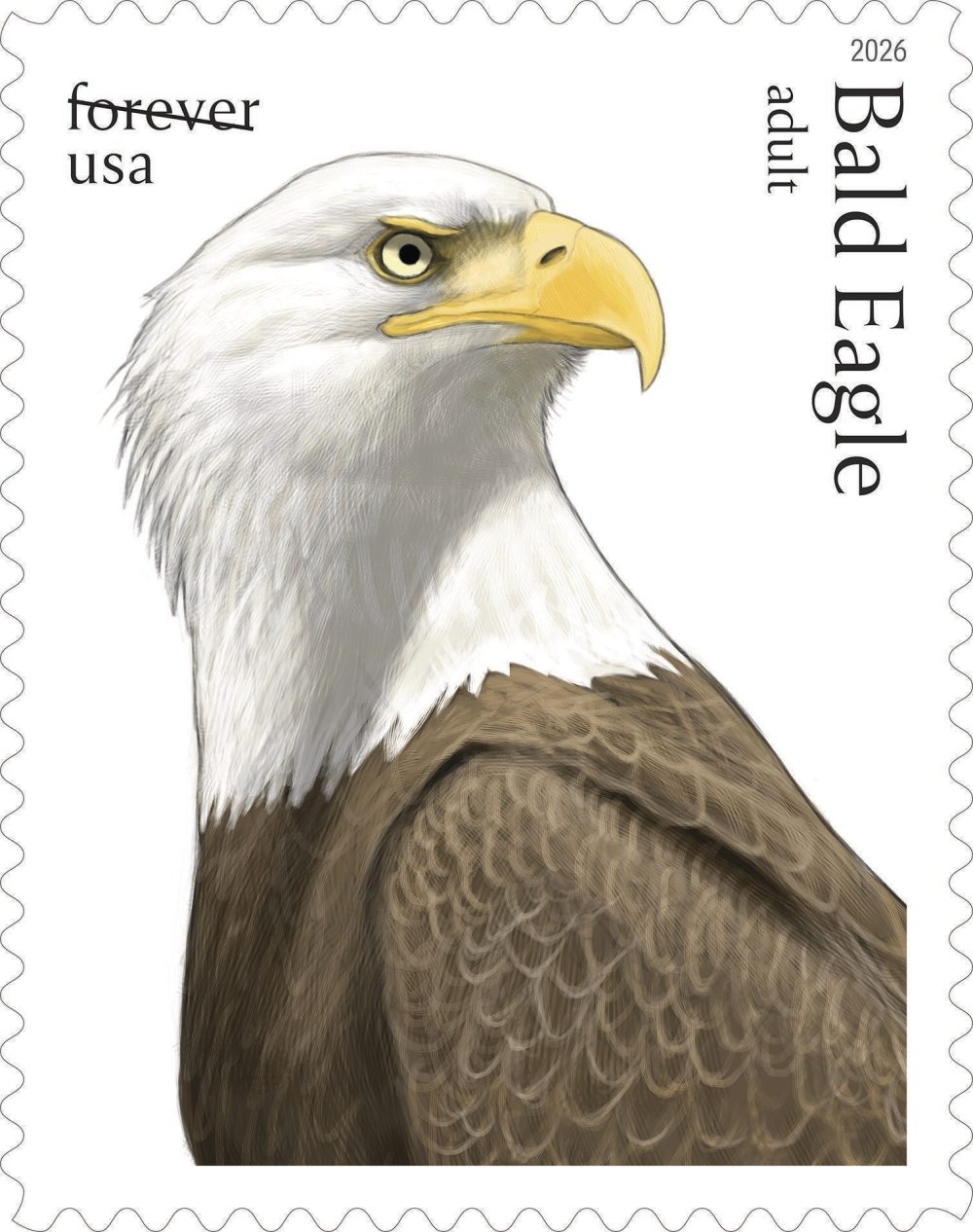

The United States Postal Service has introduced commemorative stamps depicting the nation’s most recognizable symbol in honor of America’s upcoming 250th anniversary celebration.
Officials revealed the special collection Thursday at the National Eagle Center in Wabasha, Minnesota. The stamps display bald eagles throughout five distinct phases of development, beginning with young hatchlings and progressing to the mature, white-headed birds featured on America’s official seal. The stamps became available for purchase nationwide immediately following the announcement.
“The fact that we’re seeing the eagles in all different stages of its life, it’s sort of making us look back at the stages of the life of our country,” said Steve Kochersperger, a historian at the Postal Service. “At one time, we were just fuzzy little hatchlings, too.”
Congress established the bald eagle as a national emblem when it approved the Great Seal in 1782, although the bird didn’t receive official national bird status until 2024.
According to Kochersperger, the species has traditionally represented American principles including strength, freedom and independence. The bird’s position as an apex predator, combined with its remarkable wingspan and powerful talons, makes it a dominant force in its aerial habitat.
While some people think Benjamin Franklin preferred the wild turkey as the national bird due to the eagle’s habit of taking food from other species, Kochersperger explained this belief is incorrect.
The bald eagle also represents a remarkable environmental recovery story, providing another connection to American identity. During the 1960s, these birds nearly disappeared from American skies due to DDT pesticide contamination.
However, officials reversed this population decline through a DDT prohibition implemented in 1972 and the species’ inclusion on the endangered species list in 1978.
“The public relations campaign brought greater awareness that, ‘Hey, this is our national symbol, but they may all be gone if we don’t change our ways,’” Kochersperger said. “And that turned out to be very effective.”
The bald eagle regained stable population status in 2007 when it was removed from endangered species protection, and current estimates show over 300,000 eagles living throughout the continental United States, according to the U.S. Fish and Wildlife Service.
David Sibley, the Massachusetts-based artist and bird watcher behind the stamp collection, said the conservation story is part of what makes him think of the bald eagle as a symbol.
“Maybe seeing a bald eagle on the stamp as a bird, living its life from nestling to adult, will hopefully make people think about the natural world and how important things like eagles are, not as a symbol but as part of the ecosystem around us,” he said.
Sibley dedicated almost twelve months to creating the digital artwork for the collection. Working within the small stamp dimensions presented the greatest difficulty for someone accustomed to drawing life-sized birds, leading him to emphasize the bald eagle’s head to capture maximum detail.
While postage stamps traditionally commemorate holidays and showcase American culture, they also provide educational opportunities for those who examine them carefully.
“A stamp does not demand your attention, but it rewards it,” Kochersperger said. “A tremendous amount of planning and effort went into producing that tiny little piece of paper.”