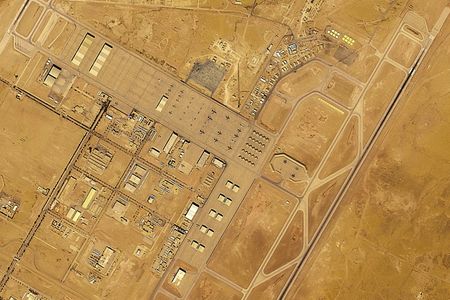

Recent satellite imagery has revealed a notable increase in American military aircraft stationed at a key Saudi Arabian airbase as the United States continues building its regional presence while tensions with Iran remain high.
Analysis of high-resolution satellite photos shows that aircraft numbers at Prince Sultan Airbase climbed from 27 planes on February 17 to 43 aircraft by February 21, before declining to 38 by February 25. The Saudi facility has served as a host location for U.S. military operations for many years.
According to William Goodhind, a forensic imagery analyst with Contested Ground who spoke to Reuters, the February 21 satellite image captured 13 Boeing KC-135 Stratotankers and six Boeing E-3 Sentry aircraft, commonly called AWACS, among 29 total large, swept-wing military planes positioned at the installation.
The earlier February 17 image showed just 11 large, swept-wing aircraft based on analysis conducted by Reuters.
Pentagon officials declined to provide any statement regarding the apparent aircraft buildup, which aligns with standard military policy of not discussing troop or equipment movements publicly. Saudi government representatives also did not respond to requests for comment about the increased activity at the base.
This military positioning occurs as Saudi Arabia, a key American partner in the region, publicly stated last month that it would not permit its territory or airspace to support any military operations targeting Iran. The announcement came as Tehran engaged in indirect diplomatic discussions with Washington on Thursday concerning its nuclear program.
Oman, which has been facilitating communications between the United States and Iran, reported that Thursday’s negotiations showed progress, though no major breakthrough emerged that might prevent potential American military action.
Omani Foreign Minister Sayyid Badr Albusaidi announced Thursday that both nations plan to continue talks following consultations in their respective capitals, with technical discussions set for next week in Vienna.
President Donald Trump issued an ultimatum on February 19, stating Iran has 10 to 15 days to reach an agreement, warning that “really bad things” would occur otherwise.
Satellite analysis comparing early February images with January photographs also indicates a broader military equipment and aircraft accumulation throughout the region.
Meanwhile, recent satellite surveillance has captured Iran conducting repairs and reinforcement work at various locations, including a sensitive military facility that Israel reportedly targeted in a 2024 bombing operation.