
A 72-hour truce between Russia and Ukraine, negotiated by the United States, came to an end Monday amid mutual accusations of violations from both warring nations, leaving American and European leaders weighing their next diplomatic moves.
Officials in Ukraine reported Monday that Russian aerial attacks, explosive devices, and artillery bombardment targeted civilian locations in the northeastern Kharkiv and southern Kherson areas, resulting in at least two deaths and seven injuries.
Moscow’s military leadership claimed Sunday that Ukraine had violated the temporary truce more than 1,000 times, according to state-controlled media outlets.
Previous temporary ceasefires declared throughout the conflict, which began when Russia invaded its neighboring country over four years ago, have likewise collapsed, and diplomatic initiatives led by the United States over the past year have produced no results.
The Washington-based Institute for the Study of War reported that NASA satellite data showed reduced but ongoing military operations following Trump’s Friday announcement that Russian President Vladimir Putin and Ukrainian leader Volodymyr Zelenskyy had agreed to his ceasefire proposal spanning Saturday through Monday. The timing coincided with Victory Day, Russia’s annual commemoration of Nazi Germany’s defeat.
The ISW observed Sunday evening that “ceasefires without explicit enforcement mechanisms, credible monitoring, and defined dispute resolution processes are unlikely to hold.”
Trump had indicated the agreement would include a prisoner swap, stating the pause in hostilities might represent the “beginning of the end” of the conflict. Zelenskyy confirmed preparations were underway for exchanging 1,000 detainees from each nation.
However, neither side appears willing to compromise on their fundamental negotiating demands.
Putin seeks control over the entire Donbas region, Ukraine’s manufacturing center, despite his forces failing to fully secure it, while Zelenskyy refuses to cede the territory. The Ukrainian president has proposed a ceasefire and direct talks with Putin, but the Russian leader has rejected face-to-face meetings until a negotiated agreement is nearly complete.
Putin proposed over the weekend that former German Chancellor Gerhard Schröder, who maintains close Russian business connections, could serve as an intermediary. However, German and European officials rejected this suggestion while acknowledging the European Union might assume a larger role in peace negotiations after being marginalized by Washington’s efforts over the past year.
Nevertheless, EU foreign policy chief Kaja Kallas emphasized the bloc must clarify its goals before engaging with the Kremlin.
“Before we discuss with Russia, we should discuss amongst ourselves what we want to talk to them about,” she told reporters in Brussels.
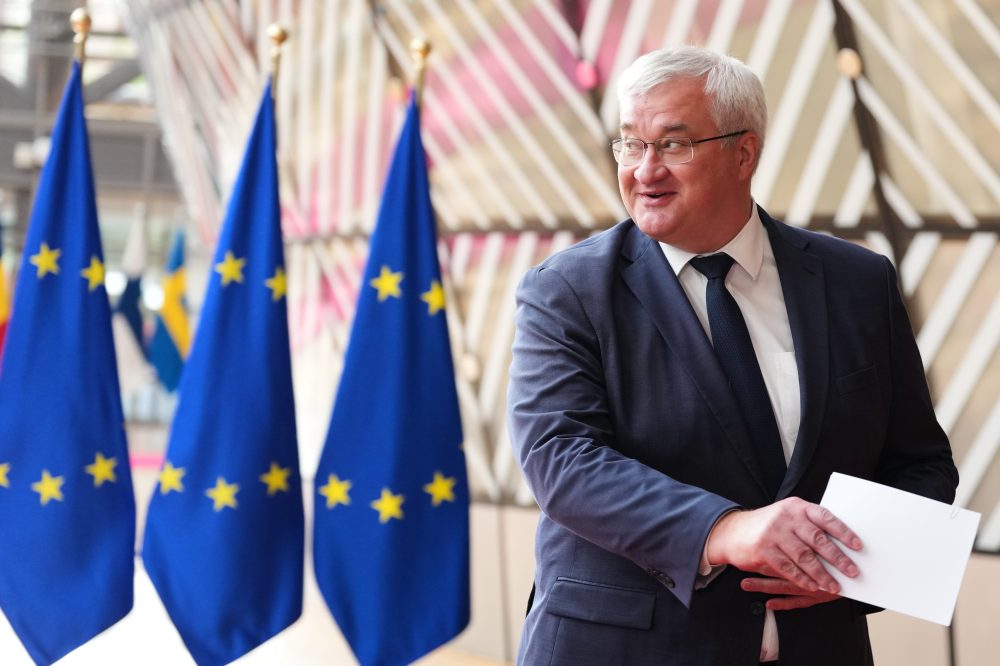
Ukraine’s Foreign Minister Andrii Sybiha participated in the Brussels gathering with EU foreign ministers. “We have mainstream peace talks under the leadership of the U.S., and we need this track and we need U.S. leadership. But Europe could play also its role,” Sybiha said.
He emphasized that Ukraine has recently strengthened its battlefield position, forcing the larger Russian military into slow and expensive advances along the 1,250-kilometer (780-mile) battle line, while deploying domestically produced long-range drones and missiles against targets within Russian territory.
“We have a new reality on the battlefield … Ukraine became stronger after the most difficult winter,” Sybiha said.
German Defense Minister Boris Pistorius became the newest high-ranking European official to visit Kyiv, arriving Monday for an unscheduled trip focused on expanding defense collaboration between the nations.
Prime Minister Evika Silina ordered the dismissal of Defense Minister Andris Sprūds on Sunday following recent drone incidents in the Baltic nation.
In a social media post, Silina stated Sprūds had “lost my trust” after a drone incident that “clearly demonstrated that the political leadership of the defense sector has failed to fulfill its promise of safe skies over our country.”
Sprūds resigned, characterizing it as a domestic political disagreement.
Ukraine’s Sybiha reported Sunday he had another conversation with Latvian Foreign Minister Baiba Braže regarding recent drone incidents in Latvia, after investigations revealed Russian electronic warfare had intentionally redirected Ukrainian drones from their planned targets inside Russia.
Sybiha confirmed Ukraine’s dedication to collaborating with the Baltic nations and Finland to avoid similar incidents, proposing direct participation from Ukrainian technical experts.
Estonia, Poland and Romania have also documented stray drones landing within their borders.