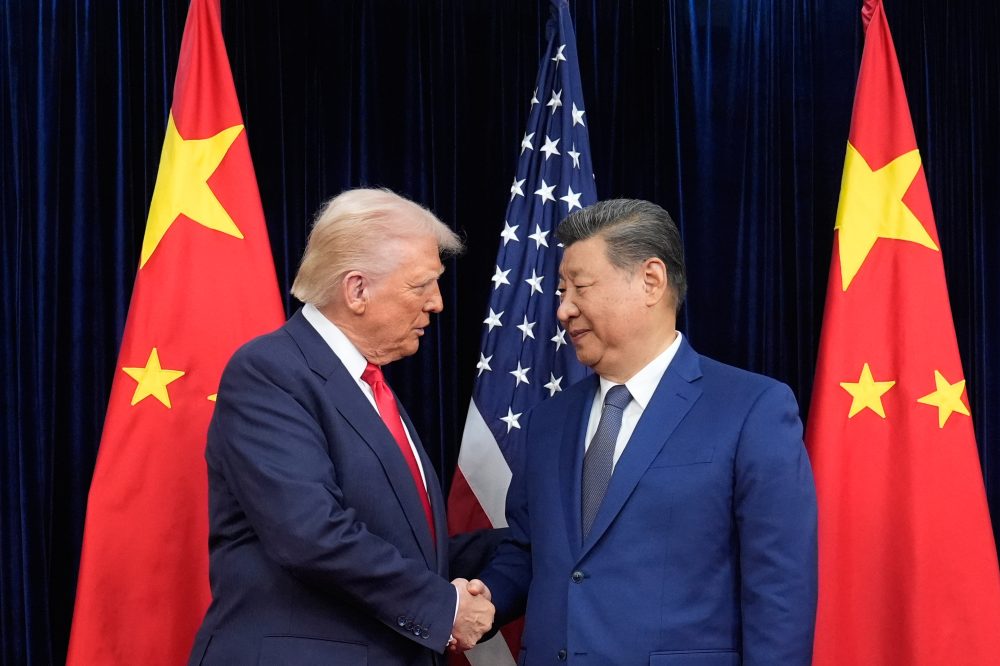

As President Donald Trump prepares for a crucial meeting with Chinese President Xi Jinping this week, concerns are mounting about the future of U.S. support for Taiwan, the self-governing island that Beijing considers its territory.
Trump’s recent actions have sent mixed signals regarding America’s relationship with Taiwan. While he greenlit a record-breaking $11 billion weapons package for the island in December, the delivery remains on hold, and Trump has acknowledged discussing the sale directly with Xi. The president has also criticized Taiwan for taking away America’s chip manufacturing dominance and suggested the island should compensate the United States for military protection.
Meanwhile, Trump has used tariff threats to pressure Taiwan into making substantial investments in American semiconductor facilities and agreeing to purchase billions in U.S. natural gas and oil.
These mixed messages have sparked debate in Washington, Beijing, and Taipei about whether America’s long-standing commitment to Taiwan’s defense might be wavering under Trump’s leadership.
Retired Navy Rear Admiral Mark Montgomery, now with the Foundation for Defense of Democracies, expressed worry about Taiwan becoming a bargaining chip in the upcoming talks.
“I do worry that we have a transactional president and a transactional opportunity could arise, and then we would have a challenge,” Montgomery stated.
Chinese officials have made clear they plan to prioritize Taiwan discussions during the summit. Foreign Minister Wang Yi brought up Taiwan during preparations with Secretary of State Marco Rubio, encouraging the United States to “make the right choices” regarding the island to maintain bilateral stability.
However, Rubio maintained that American policy remains unchanged. Speaking to reporters in Rome on Friday, he said, “We don’t want to see any forced or compelled change in the situation,” calling such action “destabilizing to the world.” He confirmed Taiwan would be discussed but wouldn’t be “a feature of our trip.”
The White House has emphasized that Trump has already authorized more military aid to Taiwan in his second term’s first year than the approximately $8.4 billion approved by former President Joe Biden throughout his entire presidency, including $330 million in aircraft components last November.
Under pressure from the Trump administration to boost defense spending, Taiwan’s legislature ended months of political deadlock Friday by approving $25 billion for military purchases. This amount fell short of the $40 billion requested by Taiwan President Lai Ching-te last year. A senior Trump administration official, speaking anonymously, called the reduced funding disappointing.
Taiwan’s National Security Bureau Director-General Tsai Ming-yen attempted to calm concerns, telling reporters that while “(China) may attempt some maneuvering during the talks,” the United States has consistently reaffirmed through public and private communications that its Taiwan policy hasn’t changed.
The central question among China specialists is how aggressively Xi will push Trump toward Beijing’s perspective on Taiwan.
Beijing views Taiwan as a rebellious province that must be reunited with mainland China, using military force if necessary. China prevents nations with which it maintains diplomatic ties from establishing formal relationships with Taiwan. Since recognizing modern China diplomatically in 1979, America has balanced Beijing’s demands while providing unofficial support and weapons to Taiwan.
This delicate balance involves Washington acknowledging Beijing’s claim that Taiwan belongs to China without explicitly agreeing with that position. The U.S. has traditionally stated it “does not support” Taiwan’s independence while opposing any unilateral changes to the current situation.
Experts suggest Xi might try to convince Trump to reduce Taiwan ties by limiting arms sales or restricting high-level American visits to the island. In February, Trump indicated he had broken with established policy by consulting Xi about Taiwan weapons sales.
Patricia Kim from the Brookings Institution’s Assessing China Project warned about potential policy shifts.
“Even if we don’t see something as dramatic as a formal shift in declaratory policy, this time around, there is always a risk that President Trump may make an off-the-cuff remark given he’s not necessarily somebody who appreciates the nuances of longstanding policy language,” Kim explained.
Tensions between U.S. ally Japan and China have also raised questions about Trump’s Taiwan commitment. In November, Japanese Prime Minister Sanae Takaichi called a potential Chinese attack on Taiwan a regional concern that could create “a survival-threatening situation” for Japan, possibly requiring military response.
Trump spoke with both Takaichi and Xi that same month but has remained mostly quiet about the dispute. When hosting Takaichi for discussions in March, Trump said, “I know they have a little bit of an edgy relationship,” adding, “I’ll be speaking Japan’s praises when I’m in China with President Xi.”
Questions about Trump’s Taiwan support also arose when the 2026 U.S. National Defense Strategy failed to specifically mention the island.
Taiwan’s advantage lies in its dominant global semiconductor industry, which America needs to maintain its technological edge over China.
“Trump at the very least realizes the role that Taiwan plays in the U.S.’s economic growth,” said Lev Nachman, a political science professor at National Taiwan University. “So I think that is sort of the main silver lining in thinking that nothing drastic will change in terms of policy toward Taiwan.”
Despite Trump’s deal-making reputation, his administration hasn’t treated challenging U.S.-China issues as tradeable commodities, according to Edgard Kagan, a former State Department official who worked under both Trump and Biden on East Asian affairs.
“The president understands leverage. My experience of being in meetings with him, he has a very, very acute sense of how to use it,” said Kagan, now the China Studies chair at the Center for Strategic and International Studies. “And so I think that the idea that there’s going to be a trade where the president sort of sacrifices U.S. interests in Taiwan in order to get other things — I think it’s unlikely based on my own experience of how he operates.”
The summit’s impact on Taiwan will likely be measured by the leaders’ public statements afterward.
Following his previous face-to-face meeting with Xi in October, Trump claimed Xi hadn’t mentioned Taiwan and that Chinese officials “know the consequences” of military action against the island.
“I think the best-case scenario Taiwan can hope for is that Taiwan is not talked about publicly or, at the very least, in a minimal way,” Nachman concluded.