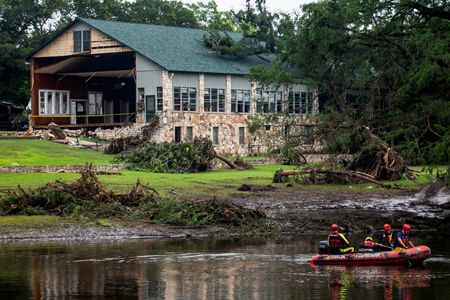

A flash flood watch blanketed a large portion of Texas on Wednesday as powerful rainstorms swelled rivers to dangerous levels, destroying more than 100 roadways and forcing emergency crews to rescue dozens of people trapped by rising floodwaters.
Texas Governor George Abbott identified the Nueces River basin as the area hit hardest by the storms. The basin stretches from a plateau northwest of San Antonio southward through the Texas Hill Country — a region that suffered devastating floods in July 2025.
That disaster claimed nearly 140 lives, including 27 victims — most of them children — at Camp Mystic, located along the Guadalupe River. The Guadalupe runs roughly parallel to the Nueces, and both rivers drain into the Gulf of Mexico. This week’s heavy rainfall inundated both watersheds.
Speaking to reporters at a late-afternoon briefing Wednesday, Governor Abbott said no deaths had been reported from the current flooding. He urged area residents to take flood warnings seriously.
“There will be a lot of rising water for the next 24 to 48 hours,” the governor said. He noted that more than 75 people had been rescued, with most of them being motorists stranded on flooded roads. “We are dealing with and responding to a flood that is likely going to break records in Texas history,” he added.
Video from local news outlets showed streets and vehicles swallowed by deep, fast-moving currents of muddy water. A state transportation official said at least 114 roads and highways had been washed out at the height of Wednesday’s storms.
On Tuesday, Abbott issued a disaster declaration covering 59 counties across south-central Texas — roughly one-quarter of the entire state. The declaration activated emergency response plans and deployed 1,300 personnel from more than 30 agencies.
A flood watch was in place for most of the affected region, with a flash flood emergency declared specifically for Kendall County, which borders San Antonio, Abbott said.
“This is a life-threatening rainfall event,” said state emergency management chief W. Nim Kidd, who told reporters that meteorologists had recorded rainfall rates as high as 3 inches — about 7.6 centimeters — per hour.
Rain that began falling Monday had already dropped between 10 and 15 inches on the stricken region by Wednesday. Abbott warned that an additional 10 to 15 inches of rain was expected to fall through Thursday morning.
Texas was not the only state grappling with dangerous water conditions. The National Weather Service issued a flash flood watch for Thursday covering much of central and southern Arizona, stretching from the Prescott and Phoenix areas south through Tucson and down to the Mexican border, as heavy monsoon storms moved through the region.
Similar flood advisories were put in place for canyon areas in southern Utah.
The flooding across the Southwest was unfolding at the same time a prolonged heat wave was pushing hot, humid conditions into the Rocky Mountain region, the Northern Plains, the Great Lakes, and the mid-Atlantic, according to the weather service.