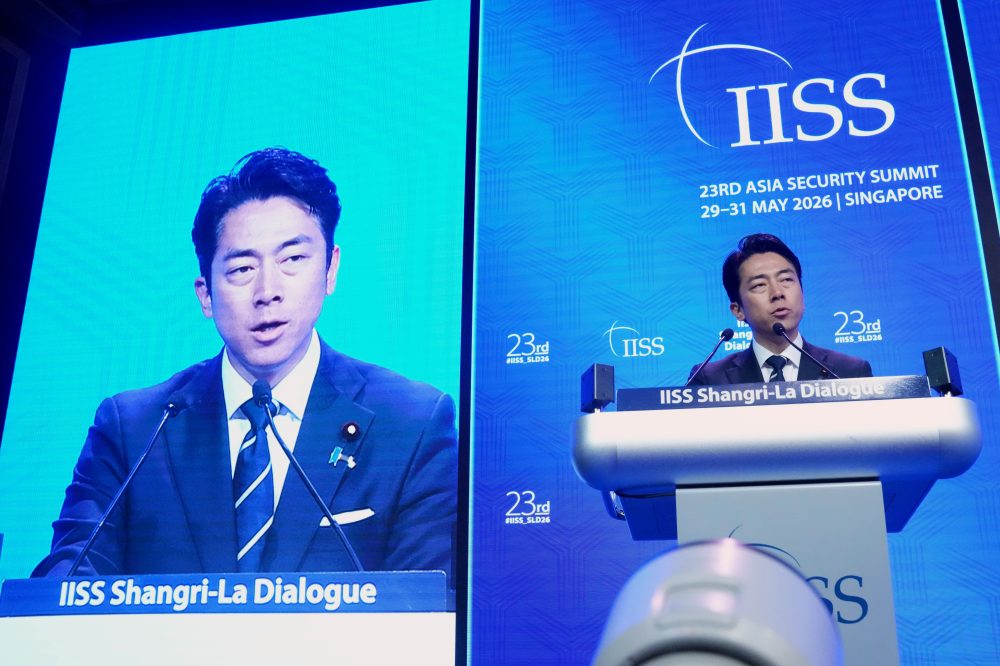

SINGAPORE (AP) — Defense leaders from allied nations emphasized the critical importance of international cooperation during a major security conference on Sunday, warning that growing global threats require unified responses even as tensions rise among traditional partners.
The discussions at the Shangri-La conference occurred one day after U.S. Defense Secretary Pete Hegseth criticized Western European nations at the same forum for insufficient defense spending commitments.
Japan’s Defense Minister Shinjiro Koizumi commended Hegseth’s dedication to the Indo-Pacific region while emphasizing the ongoing necessity for robust international partnerships.
“Division weakens deterrence, unity strengthens deterrence,” he stated during the conference organized by the International Institute for Strategic Studies.
“If gaps emerge among the United States, Europe, and allies and like-minded countries, forces which take it as an opportunity will surely come in,” he continued. “We must prevent such as situation. We must keep our cooperation going on. Now is the time to make our cooperation even stronger.”
Japan has been transforming its defense strategy as China continues rapid military expansion and modernization. Last month, Prime Minister Sanae Takaichi’s Cabinet eliminated restrictions on lethal weapons exports, marking a significant shift from its postwar pacifist stance.
China condemned this policy change, with Foreign Ministry spokesperson Guo Jiakun stating China would “resolutely resist Japan’s reckless moves toward a new type of militarism.”
Koizumi dismissed that criticism as contradictory, given China’s own military capabilities.
“Think about it, there is a country that has a huge arsenal of nuclear weapons and strategic bombers,” he remarked in English. “Japan has neither of such weapons, and yet Japan is labeled new militarism. Isn’t it strange?”
He noted that openness requires “discussion and dialogue” and expressed disappointment that China’s defense minister did not attend the conference.
During Saturday’s address, Hegseth praised several Asian partners for increasing defense expenditures while maintaining his critique of European allies, whom he accused of being “distracted by empty globalist rhetoric about the rules-based international order, while European capitals threw open their borders and hollowed out their militaries.”
“You can have all the rules you want and rules are great,” Hegseth stated. “But if you can’t back them up with hard power, the rules are not worth the paper they are written on.”
Australian Defense Minister Richard Marles told reporters during the conference that while he supported Hegseth’s view that “the rules based order needs to be underpinned by power,” he also believed strong regulations were “more important today than they have ever been.”
“We are all committed to a rules based system, because that is actually what gives, middle powers like Australia or smaller countries agency,” he explained.
He stressed that partnerships continue to be essential for regional security.
“This is a collective challenge and it demands a collective response, which is actually what the rules based order is all about,” he said.
Netherlands Defense Minister Dilan Yesilgöz-Zegerius argued that today’s conflicts have worldwide consequences requiring coordinated responses.
“A war in Europe involves drones from Iran, soldiers and ammunition from North Korea and various types of support from China,” she observed. “The lesson is clear: regional tensions are no longer regional. Our security is interconnected.”
She warned that without cooperation, middle powers risk becoming observers or the “subject of conversations,” but through alliances they can help maintain stability.
“The fact that international rules are being violated does not mean we should abandon them,” she stated.
“On the contrary, it means we must defend them more constantly and more courageously. International law may be imperfect, but history teaches us that the alternative is far worse.”